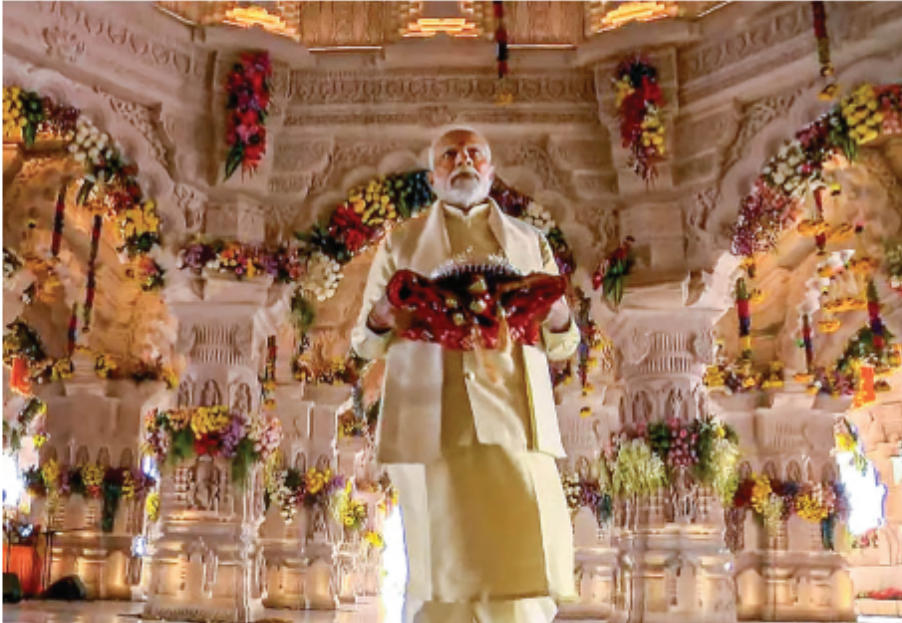
On a wintry morning in Ayodhya, dressed in crisp off-white and carrying a golden crown, he walked confidently towards the destination he had vowed to reach—undeterred by obstacles. His strides were as solemn as the air was thick with devotion. In the next few minutes—India’s most televised homecoming of a god displaced by a disputed history but never abandoned by aggrieved Hindus—he presided over a ceremony no other head of government in a secular state had undertaken. On 22 January 2024, in Ayodhya, Uttar Pradesh, Narendra Modi fulfilled his promise as he led the consecration of Ram in a grand temple. The world’s most popular politician in a liberal democracy redefined national freedom in terms of cultural inheritance and civilisational memory, and, in doing so, achieved a rare feat in the history of political power in this country: by restoring a much-beloved god to his birthplace, he ordained himself the redeemer of Hindu nationalism—which, in his telling, is not a repudiation of modernity but a reminder of its cultural content.
It was a moment of religious and cultural rupture. Nationalism has always been a contentious sentiment in the story of independent India, as vital as it was in the freedom struggle. If the Nation—capital “N”—was an idea under occupation before 1947, after independence it needed guidance from original nation-builders with a deeper understanding of it. India shared with many post-colonial societies the lofty mission of dutiful liberators, but it defied the trajectory of so many newly freed nations where liberators chose the surest path to tyranny. In the founding playbook, modernisation required restraining primordial impulses and enforcing officially sanctified secularism. This progressive view cast the idea of nation and the public attitude to religion as anti-modern. The New Indian—scientifically tempered and secularly programmed, like the New Man of socialism—was to be modernity’s ideal advertiser. Was it a hollow golem?
When Narendra Modi became prime minister in the summer of 2014, it was not merely the end of perhaps the longest campaign in Indian politics—one that had smouldered since the embers of Gujarat 2002. He was India’s most popular chief minister, yet he made himself inevitable to the state across three consecutive elections not as a provincial politician but as a passionate interpreter of the nation—one, he argued, held hostage by an establishment that distrusted India’s cultural ancestry and civilisational memory. Power in 2014 intensified his campaign to rebuild the nation, and it was to be a long journey; redeemers do not want the foreword to their saga written in haste.
From 2014 to 2024, the “Modi decade” turned a worn-out political word—change—into lived experience in the world’s most impatient democracy. One politician’s struggle—and his conversation with the future—became a nation’s reassessment of its very being. Pride was no longer restricted, and public expressions of religion were not a subversion of the secular ideal. India, as a nation-state, shed its inhibitions. A higher sense of nationhood let Modi treat power not as privilege but as emotional engagement with cultural identity. He posed the question that has mobilised, divided and united nations for centuries: who are we? If a Hindu adjective to nationalism looks organic and inevitable today, it is because, as a rebuilder, he does not see a people’s cultural impulses as a threat to modernity. The backstories of the world’s most developed societies carry overwhelming religious content—“Christendom” long ago normalised its debt to the Book. India’s nationalist text with a religious flavour has just begun. Modi’s emphasis is that secularism is not repudiation but integration of traditions; nationalism with a religious accent, he implies, is not a project in fear, as those trapped in the jargon of majoritarianism claim, but a cultural synthesisation that gives secularism meaning.
Modi’s battlefield has never been confined to the electoral arena. Once in power, another constituency mattered as much: the Great Indian Mindspace. He is not a proselytiser or an indoctrinator; he is a storyteller. Stories change nations. His narratives—part motivational, part aspirational—blend dreams, patriotism and purpose, ranging in style from avuncular intimacy to prophetic grandeur to conversational ease. The India in his telling is no fairyland of nationalist-autocrats, but a place rooted in hard realism. Its full realisation, he says, is the ultimate realisation of nationhood. Mann Ki Baat, his storytelling session with India in which the listener becomes a character, is the most vivid episodic expression any politician here has produced.
Even as tradition furnishes content to his modernisation agenda, the tomorrow he intends to build does not draw its raw material from perfumed history. The Modi of the marketplace harnesses technology to make India as egalitarian as possible. Hence the “digital destiny” is not a trendy mantra but an acceptance of the inevitable. He is no market revolutionary, nor a panegyrist of capital—disappointing those who expected an Indian Reagan or Thatcher. As a gradualist reformer, he judged India too unequal for ruthless reforms. The state still has a role—not of socialist vintage, not a nanny—but to provide the best context for the individual’s most daring text. He gave a nationalist spin to Deng Xiaoping’s aphorism: it is glorious to be rich. The start-up nation testifies to a state that frees, not restrains, the individual. The pin-striped Davos man now sports a dash of the tricolour on his lapel. In the marketplace, a true nationalist can afford only one ideology: freedom.
That ideology of freedom underpins his internationalism. India has travelled far from its leadership of Third-Worldism and the relic of a Non-Aligned mindset. That is not the India with a seat at the global high table. In the India of the new Wise Man from the East, anti-Americanism is redundant, and national interest is not subordinated to borrowed ideologies. Modi’s India belongs not to blocs but to alliances and attitudes sustained by political and economic freedom. As a pragmatic globalist, he has achieved the rare feat of remaining a trusted friend to antagonistic big powers without devaluing India’s international morality—Ukraine being a case in point.
With China, India long nursed an inferiority complex despite democracy’s advantages, turning stoicism into a diplomatic virtue even as provocations persisted along the border. No longer. Confidence in freedom’s dividends allows Modi’s India to balance national interest with international responsibility. Today, India’s global ambition matches its influence. No prime minister since Nehru has practised internationalism with such panache.
In a democracy as unforgiving as India’s, no politician can enact a script of individual audacity and nationalist ambition without authenticity. What leaders, desperate to postpone political mortality, often lack is precisely that. Authenticity springs from old-fashioned virtues a disillusioned people seek in a new leader on a mission: credibility, integrity, honesty. Modi is not a “professional” politician; for him, politics is a permanent, dutiful struggle in a deified nation. Devotion to the nation adds a spiritual content to his idea of power. He has never been tentative about his relationship with power, which, in his book, is the most effective instrument of cultural and economic change. He has turned power into a form of spiritual contentment in which the personal blends with the national. This clarity of purpose—terrifying to opponents—makes him authentic. Through rhetorical flamboyance, he reminds India that his pursuit of power is a necessary condition for national renewal.
Authenticity begets trust. In a country where power and corruption long coexisted, principled governance has become an enforced norm. Pre-Modi, privilege and patronage—entitlement and entrenchment—sustained political power. Modi brought a spartan intensity, refusing distraction. Nothing was at stake but the nation, redeemable only by one who held power with equal detachment and clarity—and, for a vast majority, he was that one. The most popular politician in a democracy draws upon a massive wealth of trust; the more he grows in power, the more those who trust him feel empowered. In a nation where elections are won and lost by the poor, and where every social engineering and salvation ideology has failed to create a revolutionary, an ordinary man—an outsider in power—declares that what India needs is not a phoney revolution but a cultural transformation. They trust him for that.
In Ayodhya, in the afterglow of Ram’s consecration, he said with rhythmic flourish, “Ram is flow; Ram is effect.” He invoked the god to emphasise the great cultural continuum and, as prime minister, implied he was within his “constitutional” right to do so, because even secular India’s Constitution invokes Ram. Thus, consecration became national reassertion: “We have to lay the foundation of the India of the next thousand years.” In the nation’s flow, such a far-horizon mission can only be stated by one who sees power as a sacred text. When Narendra Modi plays national redeemer, he ensures that god stands witness.
S. Prasannarajan is the Editor of Open magazine. This article is extracted from the essay “The Redeemer’s Rite: How Narendra Modi Has Redefined Power,” published in the book Indian Renaissance: The Age of PM Modi, edited by Aishwarya Pandit.
The Noida Traffic Police has put out an official traffic advisory for March 15, warning…
Iran’s Foreign Minister Seyed Abbas Araghchi has accused the United States of launching rocket attacks…
The Lawrence Bishnoi gang issued a death threat to rapper Badshah through a social media…
