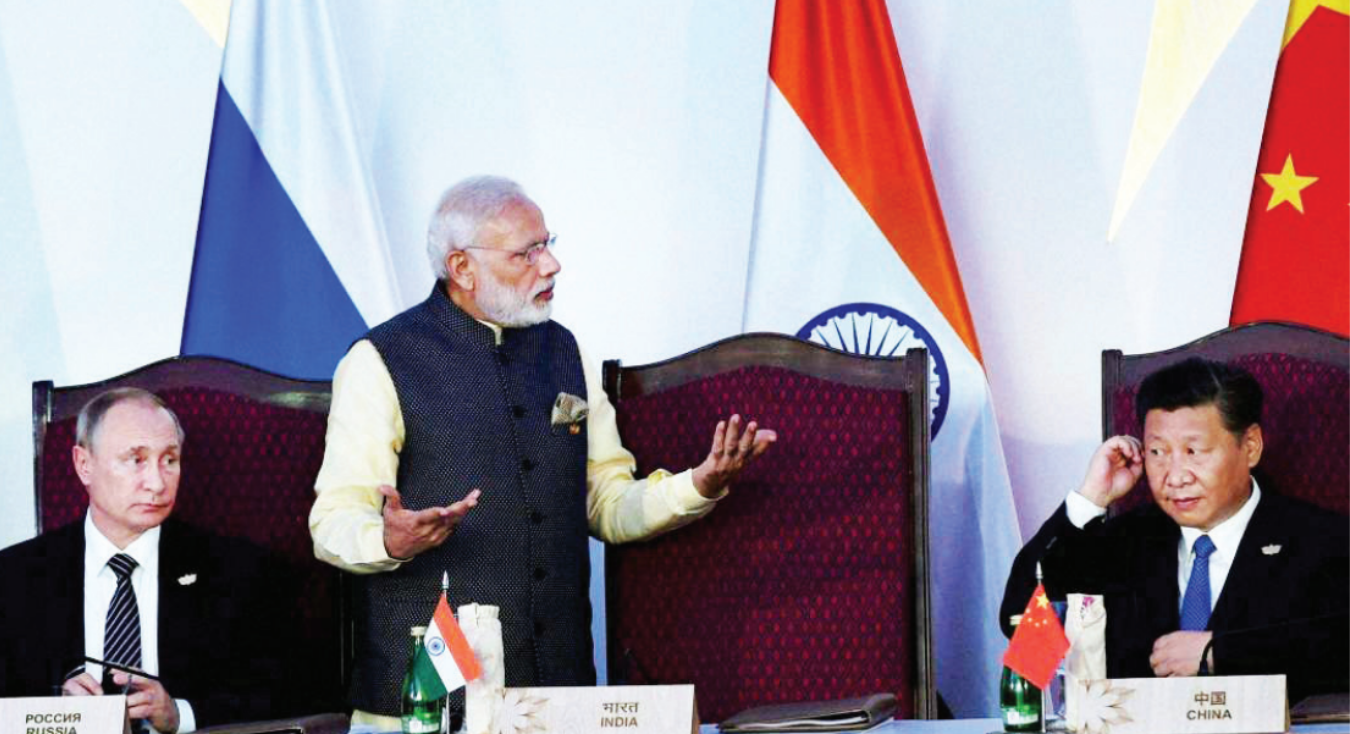
When Narendra Modi walked into South Block in 2014, sceptics wondered whether a leader rooted in India’s grassroots politics could navigate the complex maze of global diplomacy. Eleven years later, those doubts have vanished. Modi has not only transformed Bharat’s global image but also recast the very grammar of its foreign policy—confident, assertive, civilisational, and unapologetically rooted in national interest.
From day one, Modi signalled a break from the past. Gone was the hesitation that had long paralysed New Delhi, the siege mentality that reduced India to a passive responder, and the Pakistan-obsession that consumed strategic energy without yielding results. In its place emerged a foreign policy marked by boldness and clarity—one that saw Bharat not as a bystander but as a natural leader. Whether it was inviting SAARC leaders to his swearing-in, walking the streets of Kathmandu, embracing diaspora in Madison Square Garden, confronting Chinese aggression in Doklam and Galwan, or delivering vaccines to faraway nations in the middle of a global pandemic, Modi has consistently shown that diplomacy is not about symbolism alone—it is about redefining India’s place in the world. His decade in power has given Bharat a foreign policy that is both pragmatic in execution and civilisational in vision, a rare combination in the annals of modern diplomacy.
Operation Sindoor and the Birth of the ‘Sindoor Doctrine’
Operation Sindoor was not merely a military or diplomatic episode—it was a defining assertion of Bharat’s sovereignty and strategic will. For decades, adversaries and even so-called partners assumed India would always respond with hesitation, trapped in ambiguity. Operation Sindoor shattered that perception. It drew new red lines—bold, uncompromising, and unmistakable—that Bharat’s territorial integrity, maritime rights, and civilisational dignity are non-negotiable.
Just as the surgical strikes (2016) and Balakot airstrikes (2019) reshaped India’s security posture with Pakistan, Operation Sindoor elevated the game further by creating a strategic template: calibrated restraint where possible, overwhelming retaliation where necessary. It signalled to the world that the age of Indian strategic hesitation was over, and that Bharat would now shape the environment rather than be shaped by it.
This new template deserves a name of its own—the “Sindoor Doctrine.” Just as the Monroe Doctrine (1823) warned Europe against interfering in the Americas, and the Begin Doctrine set Israel’s uncompromising stand against hostile nuclearisation, the Sindoor Doctrine declares that Bharat will defend its sovereignty and red lines with clarity and decisive action. It is not merely a military doctrine but a civilisational statement: that the guardians of Dharma will not allow external forces—whether state, non-state, or great-power rivals—to erode Bharat’s strategic space.
In global terms, the Sindoor Doctrine elevates India’s identity as a civilisational state with modern realpolitik. It reassures allies, deters adversaries, and positions Bharat as a power that enforces deterrence rather than merely speaking of it. Operation Sindoor will thus be remembered as the birth of this doctrine—a milestone in India’s strategic history that redefined our national security framework and announced to the world that Bharat’s rise is protected by both vision and strength.
Neighbourhood First: Healing Old Wounds
One of Modi’s earliest messages was clear—a strong Bharat needs a secure and cooperative neighbourhood. His invitation to SAARC leaders at his swearing-in in 2014 signalled a new beginning. The 2015 Land Boundary Agreement (LBA) with Bangladesh, which ended a decades-old humanitarian nightmare of enclaves, symbolised bold decision-making. With Nepal, despite political turbulence, India’s consistent outreach ensured projects in trade and infrastructure kept moving. In Sri Lanka, India balanced Tamil concerns with strategic cooperation, offering Colombo trust and economic collaboration.
Moving Beyond Pakistan: Breaking the Shackles
For decades, India’s foreign policy was trapped in a Pakistan-centric loop. Modi broke free. While extending an initial olive branch, he decisively cut the cord after the Pathankot and Uri attacks. The surgical strikes of 2016 and the Balakot airstrikes of 2019 conveyed that Bharat would not tolerate terror sanctuaries. This decoupling liberated New Delhi to focus on more meaningful arenas—the Bay of Bengal, BIMSTEC, and the wider Indo-Pacific.
China Challenge: Standing Tall Against Expansionism
Beijing’s aggressive moves—from the Doklam standoff (2017) to the Galwan clash (2020)—tested India’s resolve. Unlike the past, Modi’s India stood firm. By building sub-regional initiatives like BIMSTEC and BBIN, India outflanked China’s Belt and Road Initiative in South Asia. Simultaneously, the Quad (India, US, Japan, Australia) positioned India as a pillar of the Indo-Pacific security architecture.
Connectivity as Diplomacy
Modi recognised that trade corridors and highways are as strategic as military bases.
India–Myanmar–Thailand Highway to link South and Southeast Asia.
BBIN initiative for smoother cross-border logistics.
INSTC and IMEC to create alternate supply chains, reducing dependence on Western-dominated routes.
These corridors transform India into a transit hub for goods, energy, and markets—cementing its role as the region’s growth engine.
Act East: Expanding Horizons
Modi turned the old Look East policy into a robust Act East strategy. Beyond trade, this includes security partnerships with Vietnam, Singapore, and the Philippines, as well as joint naval exercises in the South China Sea. Culturally, India projects itself as a civilisational partner—using Buddhism, Ramayana traditions, and Yoga as bridges with ASEAN nations.
Maritime Leadership: From Indian Ocean to Red Sea
Recognising that Sea Lines of Communication (SLOCs) are vital lifelines of global trade, India has emerged as the net security provider in the Indian Ocean. The Indian Navy’s role during the Red Sea crisis of 2023, alongside constant patrols in the Gulf of Aden and aid to island nations, has redefined India’s maritime identity. Smaller states now see India as their first responder, not an outsider.
Who Was Wang Yefei? Chinese Influencer Passes Away At 39 After Clutching Her Head During Livestream
Viewers who tuned in to watch Chinese content creator Wang Yefei’s livestream on March 9,…
Read the 15 March 2026 daily horoscope with predictions for love, career, money and health…
Petrol, Diesel Price Today in India: Petrol and diesel prices in India remain unchanged on…
