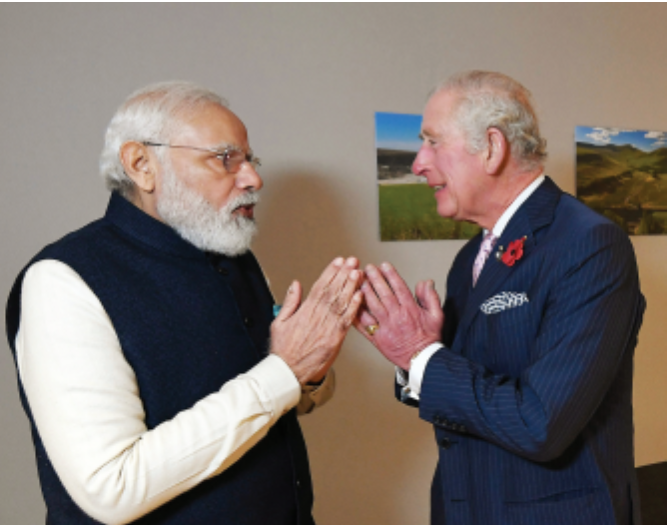
“We are dealing with an absolute political phenomenon.” That is how Boris Johnson—then foreign secretary and later prime minister of the UK—described Indian Prime Minister Narendra Modi in 2019. And that is how PM Modi has led India, both domestically and internationally.
Under Modi’s leadership, India has levelled up on all fronts—from roads, railways and aviation to the fintech revolution of the Unified Payments Interface (UPI) for digital payments; the streamlining of taxation through Goods and Services Tax (GST) reforms; and freeing up markets to deliver cheaper, better-quality goods. These positive domestic changes, along with deft and dependable diplomacy—first directed by the exceptional Sushma Swaraj and then by S. Jaishankar—have resulted in India transforming into the “New India” that is Bharat. With the world’s fastest-growing, Make in India-driven economy powering reforms and resurgence since 2014, India has begun to meaningfully leverage the dividends of freedom and independence to realise its long-standing potential.
Around the same time, the UK saw a surge in support for a referendum to answer the Brexit question. The UK Independence Party won the most seats in the 2014 European parliamentary elections in the UK, and the Conservative Party promised a referendum in the 2015 general election—delivering it in 2016. Truth is, here in Global Britain, we too had been encumbered by a puffed-up metropolitan liberal elite—unable to look beyond its next deal, unwilling to govern the country as an independent nation, and uninterested in taking responsibility for the ill-governance it had inflicted upon the population through endless governments of “no alternative.” People across the country had been clamouring for freedom and independence, to take back control from the European Union and to be sovereign once again. That is the decision the British people made—first in 2015 with the first majority Conservative government since 1992, and then with the historic Leave vote in the 2016 Brexit referendum, the biggest democratic exercise in British history.
However, the parallels between the resurgence of Indian freedom and democracy with the election of PM Modi in 2014—which finally ended the era of shaky, horse-trading coalitions—and the Conservative majority of 2015 and Brexit mark the point at which the shared story of taking back control and making those who govern in our name accountable diverges into two different paths. India is democracy-driven, with a focus on minimising government and maximising good governance. It boasts a steady slew of reforms to fix what needs fixing, under strong and stable leadership. In the UK, by contrast, until 2019 we were besieged by instability and the directionless dithering of seemingly trying to get Brexit done—without actually having the civil service and foreign service, let alone much of a misaligned Parliament, wanting to get Brexit done.
Much like PM Modi, it took the leadership of Boris Johnson to emerge victorious with a stonking eighty-seat majority, go with the mood of the nation and get Brexit done—only then to be undermined by a political class where the Right was more interested in diluting conservatism as a pound-shop version of Blairism, and the Left more interested in re-running the battles of yesterday as a silver bullet to the problems of tomorrow. Not to mention the prevailing orthodoxy of institutions and the great blob of the civil-service quangocracy fighting solely to preserve its leeching hold on the levers of power.
This is where Global Britain has much to observe and learn from our friends in New India. The world’s oldest democracy can learn from the world’s greatest democracy how to make democracy matter again. The world’s oldest and most successful political party—the Conservative and Unionist Party—must see how PM Modi and the world’s largest political party, the Bharatiya Janata Party, have doubled down on the one idea that brings people together: the national interest. And as one civilisational nation, the UK needs to learn from another civilisational nation, India, how to overcome challenges to deliver a national resurgence—where people feel proud to be nationals and not just residents. As much as any of this, the UK needs to deliver much of what the Boris-led Conservative victory of 2019 promised electors: good governance. We need—as PM Theresa May promised in the 2017 general election—a strong and stable government.
Ultimately, any government is a product of three things: the people who elect, the people who stand for election, and the people who deliver the manifesto they campaigned for. That is the most important lesson to be learned from the absolute political phenomenon that is PM Modi. A simple glance at the core team that has strengthened PM Modi’s hand in shaping this New India shows that he and the BJP have largely got their candidate selection spot-on—matching ministerial portfolios to a lifetime of experience and enforcing accountability to ensure promises are delivered.
Be it the finance minister, the foreign minister, the IT minister, or the railways and roads ministers—each is delivering the three core ingredients of good governance: competence, stability and accountability. In turn, this is delivering strong and stable governance—the mainstay of meaningful reforms, economic growth and the democratic dividend. By allowing free enterprise to get on with the job of delivering free trade that powers the aspirations of the Indian people, this strengthens free democracy.
All this is further augmented by a deft and dependable diplomatic miracle that is India’s international relations since 2014. As S. Jaishankar put it at the Munich Security Conference 2024: “If I am smart enough to have multiple options, you should be admiring me. Is that a problem for others? I don’t think so.” This is possible because, in this Modi era, India is putting one ideal as its hallmark—left, right and centre: the national interest first.
This is the number-one priority that we in Global Britain ought to learn and put into practice in building a post-Brexit UK: fully leveraging our newly found Brexit freedoms to deliver in Britain’s national interest—securing our borders, reforming the orthodoxy holding back good governance and conserving our national inheritance. We campaigned for Brexit to look beyond the European Union, and our natural partner—our friend of old—a New India of free democracy is one to work with to deliver for people in the national interest. For our two nations, we are unique in the world: our national interests coincide on nearly every graph and every path. This is made true by our shared values, shared languages and shared ideas of what prosperity and peace mean, as we head into what very much looks likely to be a third historic win for PM Modi.
So, let’s skill India with British innovation; let’s bring in Digital India to level up British public services; and let’s build a Global Britain that takes a leaf out of New India’s book to secure our Brexit freedoms, national interest and sovereignty. Together, Global Britain and New India matter to the world. What matters to us is the freedom to be, the independence to do and the enterprise to achieve—and this has been made possible because Modi matters to India.
Aman Bhogal is the Founding Chairman of Global Britain Centre, UK. He stood for Parliament in the 2015 UK general elections.
This article is extracted from the essay “India, Britain and lessons for democracies,” published in the book Indian Renaissance: The Age of PM Modi, edited by Aishwarya Pandit.
Which Jet Was Ajit Pawar On? Deputy CM Dies in Baramati On Learjet 45XR, Investigation Underway
Ajit Pawar, Maharashtra Deputy CM, died in a Learjet 45XR crash near Baramati on January…
Ajit Pawar died on Wednesday after a plane carrying the Maharashtra Deputy Chief Minister crashed…
Here are the live streaming details of Australian Open 2026 Quarterfinal: Ben Shelton Vs Jannik…
