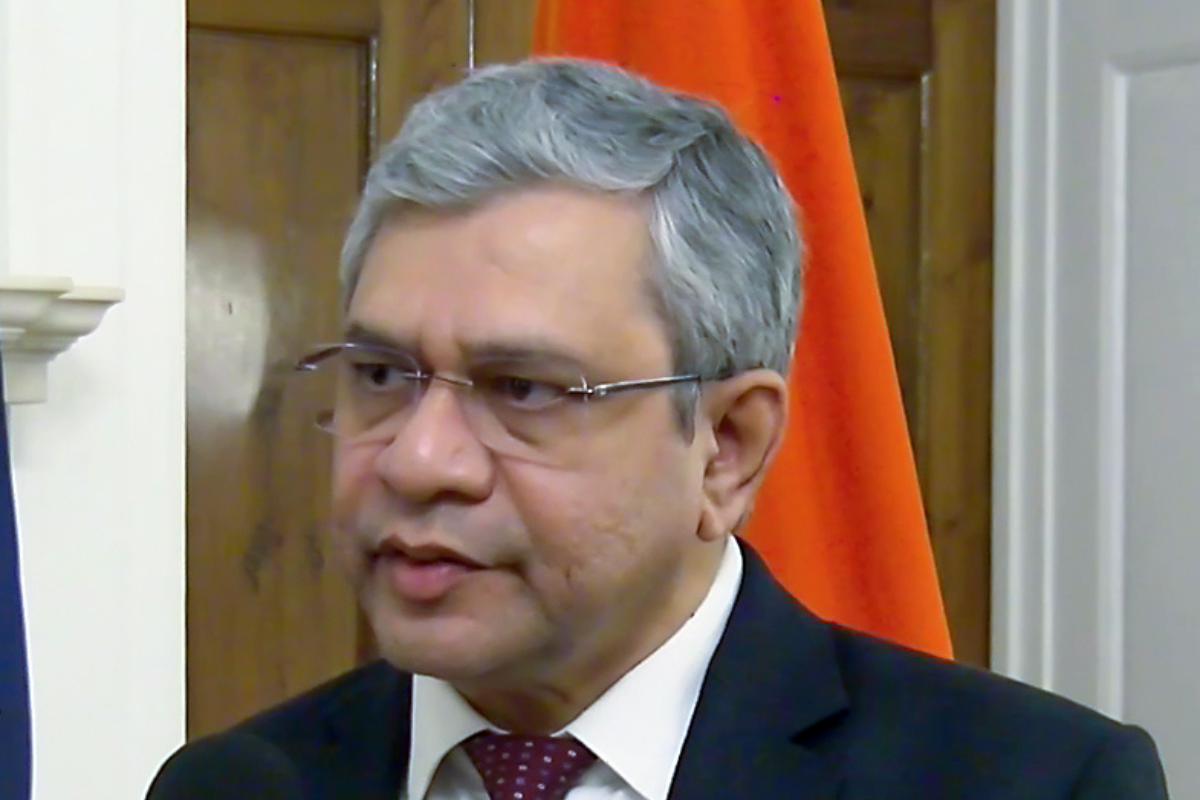
Ashwini Vaishnaw, ANI
Ashwini Vaishnaw, the Union Minister for Information Technology, has outlined India’s all-encompassing plan to rule the world of artificial intelligence, highlighting a move away from big-tech-controlled resources and toward a public-private partnership model.
Speaking at a World Economic Forum panel on the “Role of AI in Economic Growth and Global Influence,” the Minister disclosed that, in contrast to many nations where big tech controls GPU access, India has successfully formed a public-private partnership with 38,000 GPUs as a common compute facility, accessible to students, researchers, and startups at about one-third the global cost.
Vaishnaw promoted a “techno-legal” strategy in order to address the crucial issue of regulation instead of depending exclusively on stand-alone legislation. He maintained that in order to mitigate dangers like prejudice and deepfakes, the complexity of modern technology necessitates the use of strong technological tools, such as detection systems that are precise enough to withstand legal examination. In order to reduce bias, enable accurate deepfake detection, and guarantee appropriate “unlearning” prior to the deployment of AI models, he continued, India is creating technology.
The Minister also emphasized a strategic change in the economics of the Fifth Industrial Revolution, arguing that scalable, affordable solutions—rather than merely “brute-force” computing—will provide the enormous return on investment of the future. He refuted the notion that costly hardware is necessary for all advancements in AI, pointing out that “nearly 95% of AI work can be done using the 20-50 billion parameter models.”
Vaishnaw claims that these more compact, effective versions can operate on widely accessible CPUs, so lessening India’s reliance on particular foreign suppliers and lowering the geopolitical risks connected with the global chip supply chain.India intends to democratize AI by investing heavily in people capital in addition to hardware. In an effort to guide the local IT sector toward offering scalable AI services for the international market, the government is now supervising the training of 10 million workers in AI skills. The Minister cited recent rankings from Stanford University as evidence of this development, pointing out that India is currently ranked third in the world for AI talent, preparedness, and penetration.
India is establishing itself as a “use-case capital” for the world by providing free AI models for common social requirements and government-subsidized GPU access. In closing, the Minister reaffirmed that India’s strategy is essentially inclusive, guaranteeing that those at the bottom of the pyramid benefit from the AI revolution. This methodical approach solidifies India’s position as a leading global AI leader by combining inexpensive infrastructure, a distinctive legislative environment, and an emphasis on effective model deployment.
(ANI)
Also Read: Is OnePlus Shutting Down In India?’: CEO Robin Liu Says THIS As Massive Speculation Grows
Syed Ziyauddin is a media and international relations enthusiast with a strong academic and professional foundation. He holds a Bachelor’s degree in Mass Media from Jamia Millia Islamia and a Master’s in International Relations (West Asia) from the same institution.
He has work with organizations like ANN Media, TV9 Bharatvarsh, NDTV and Centre for Discourse, Fusion, and Analysis (CDFA) his core interest includes Tech, Auto and global affairs.
Tweets @ZiyaIbnHameed
The US‑Israel‑Iran conflict enters its second week with escalating strikes, global energy disruption, rising casualties,…
Iran and Israel exchanged strikes on critical oil facilities—Haifa refinery and Tehran depot—escalating Middle East…
Israeli Prime Minister Netanyahu pledges full-force military operations amid escalating Middle East tensions, honors national…
