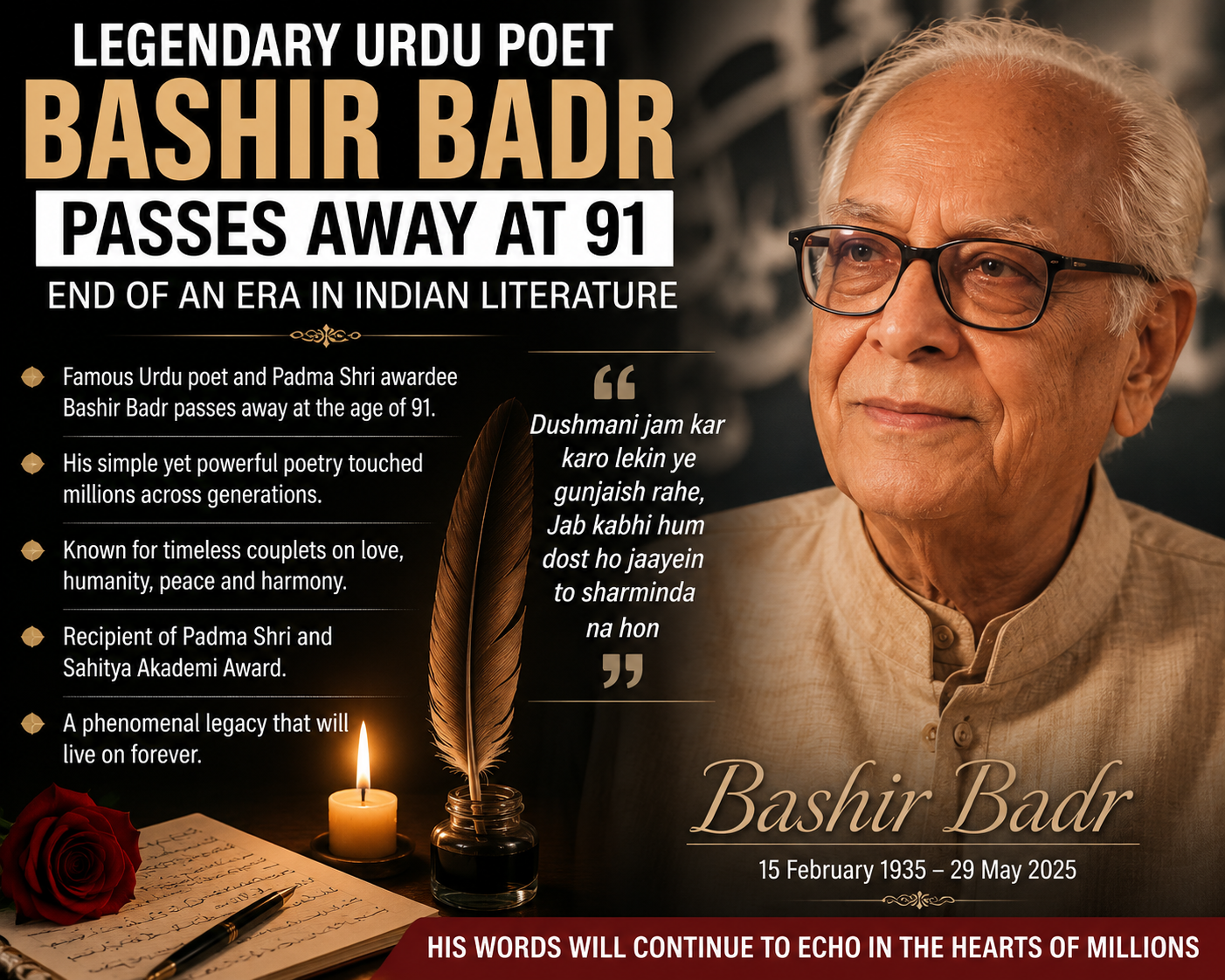
India’s literary world kind of fell into grief on Thursday, right after the demise of the legendary Urdu poet and Padma Shri awardee Bashir Badr, at the age of 91. As per reports that quote family sources, the poet breathed his last after going through a prolonged illness, and yes it left behind a lasting, timeless body of work—poetry, ghazals, and those unforgettable couplets that really touched millions across different generations.
Bashir Badr was seen as one of the most influential voices in modern Urdu poetry. His style was simple yet emotionally strong, and because of that, Urdu shayari felt approachable not only for scholars and literary circles, but also for ordinary readers as well as listeners, in India and even beyond. With his passing, it feels like an era in Urdu literature has truly come to its end.
Born as Syed Mohammad Bashir on February 15, 1935, in Uttar Pradesh, Bashir Badr got an interest in poetry at a very young age, like really early. He then studied at Aligarh Muslim University (AMU), where he finished his higher education and later served as a lecturer in Urdu literature. Over the decades, he turned into one of the more respected names in mushairas and literary get-togethers.
Bashir Badr’s poetry kept returning to themes of love, loneliness, pain, separation, humanity, and social harmony. His couplets became almost everyday lines, the kind people quote in conversations, films, speeches, or even political debates. One of his most iconic verses
“Dushmani jam kar karo lekin ye gunjaish rahe,
Jab kabhi hum dost ho jaayein to sharminda na hon”
Became immensely popular, and was even tossed into the mix during diplomatic conversations between India and Pakistan, like it wasn’t just a poetic thing but a sort of… shared reference.
Also, the poet’s life had its own deep personal tragedy. During the 1987 Meerut riots, a lot of his unpublished work, books, and personal belongings were ruined in communal violence, and afterwards, it felt like everything was suddenly gone, not fully, but enough. After that, he moved permanently to Bhopal, where he kept writing and living at a distance from the public spotlight, in a quieter rhythm.
Even with those hardships, Bashir Badr never let bitterness take over his poetry. Rather, his verses kept showing compassion, emotional depth, and some kind of hope, always there in the background. His collections— “Aahat,” “Aamad,” “Ikai,” and “Ujale Apni Yaadon Ke” — were widely praised by Urdu readers.
Across the long span of his illustrious career, Bashir Badr received many prestigious honours, such as the Padma Shri, the Sahitya Akademi Award, and several other literary recognitions, all connected to his contribution to Urdu literature and ghazal writing.
As news of his demise spread, politicians, writers, actors, poets and admirers across the country made those heartfelt tributes on social media, you know the kind. Lyricist Javed Akhtar said his passing was a huge loss for Urdu literature, and that Bashir Badr’s words would keep living, like, forever in the hearts of people.
Literary organisations and Urdu academies also mourned him, calling Bashir Badr a kind of bridge between classical Urdu poetry and a more modern emotional voice, the one that people actually feel.
Bashir Badr’s contribution to Indian literature went further than poetry alone. He carried an expressive tone, a sentiment that linked different generations using simple yet relatable words and sincere expressions, too. Even now, his couplets are still widely shared in books, during speeches, on social media posts, and in everyday talk, like it’s normal.
Though the poet is no longer among us, his lines will keep echoing through mushairas, classrooms, literary festivals, and in the hearts of poetry lovers, forever.
Some of his most quoted couplets include:
“Dushmani jam kar karo lekin…”
“Koi haath bhi na milayega…”
“Ujale apni yaadon ke…”
He helped popularise modern Urdu ghazals among younger generations and mainstream audiences.
Saniya Siddique is a skilled Content Writer with a background in Journalism. Specializes in creating engaging, accurate, and audience-focused content, with expertise in news writing, digital media, and writing trendy articles on buzz and entertainment.
United States National Team FIFA World Cup 2026: Squad, Ranking, Key Players & Full Preview
Learn about the United States national football team FIFA World Cup 2026 squad, FIFA ranking,…
Controversy Erupts In Reasi Over Eid-ul-Adha Greeting Post Shared On Social Media By A School
Presentation Convent High School in Jammu and Kashmir’s Reasi district sparked controversy after sharing an…
Who is DK Shivakumar? Congress veteran to replace DK Shivakumar as Karnataka CM
Congress leader D. K. Shivakumar is likely to replace Siddaramaiah as Karnataka Chief Minister amid…
