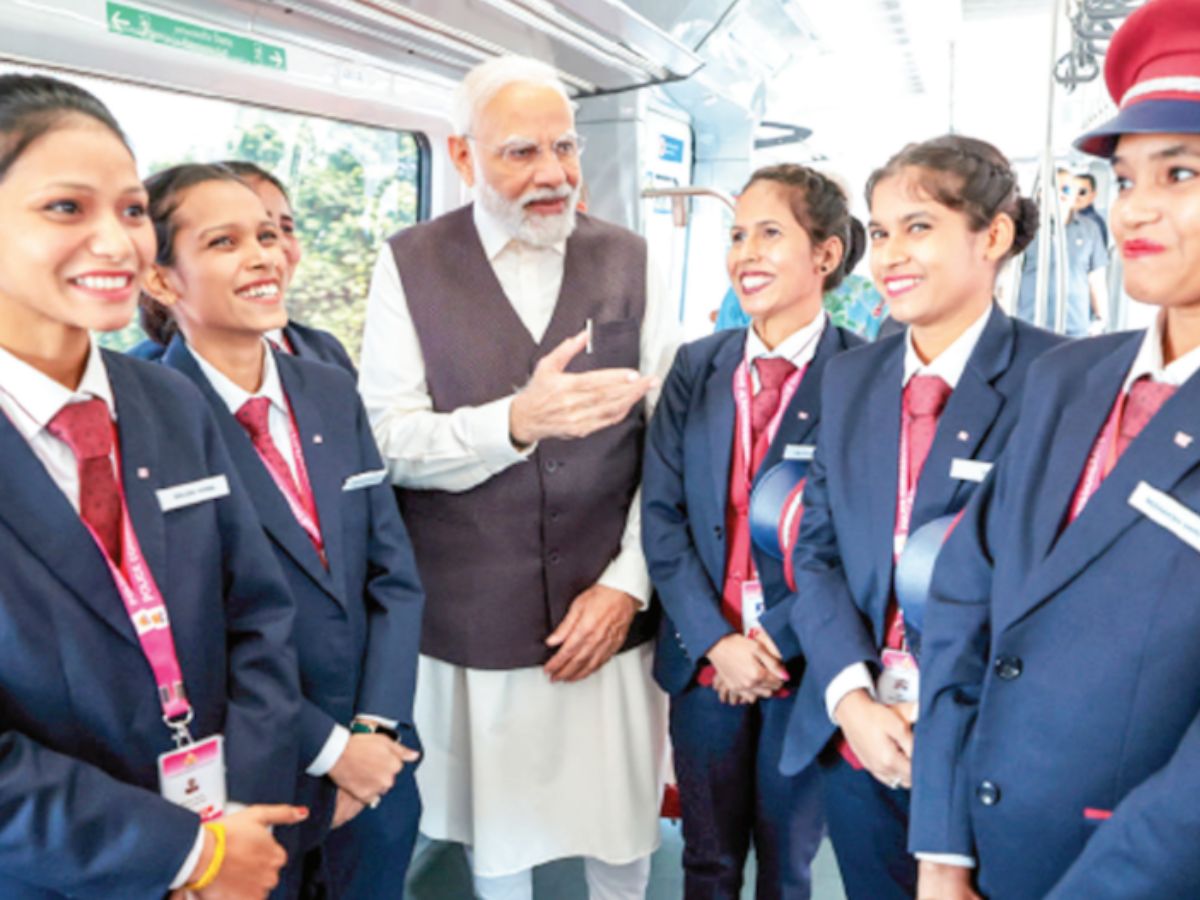
India’s journey towards becoming a developed nation cannot be envisioned without empowering its women. Over the past eleven years, Prime Minister Narendra Modi’s government has placed women at the centre of governance and development, recognising that the nation’s progress is deeply tied to the advancement of its women. The vision has been clear: not just “women development” but “women-led development.” From health and dignity to education, financial independence, and political representation, a wide range of initiatives have been launched to break traditional barriers and provide Indian women with equal opportunities.
Women’s empowerment cannot be achieved through isolated measures. Recognising this, the Modi government adopted a lifecycle-based approach through Mission Shakti, an umbrella programme aimed at ensuring safety, security, and empowerment of women.
Mission Shakti has two key components: Sambal and Samarthya. Sambal focuses on safety and protection through initiatives like One Stop Centres (OSCs), 181 Women Helplines, and the inclusion of Nari Adalats—community-based legal forums offering speedy resolution of women’s grievances. The flagship Beti Bachao, Beti Padhao campaign also operates under this stream, targeting gender imbalance and advocating for the education of the girl child.
Samarthya is dedicated to promoting economic and social empowerment. It integrates schemes like Pradhan Mantri Matru Vandana Yojana (PMMVY), which has already benefited nearly 4 crore pregnant and lactating mothers; Ujjwala and Swadhar Greh for safe housing; Working Women Hostels; and the National Crèche Scheme. Together, these initiatives support women at critical stages of their lives—childhood, adolescence, maternity, and working years—ensuring holistic empowerment.
The results are visible: an improved sex ratio at birth of 1020 women per 1000 men for the first time, a significant rise in institutional deliveries, declining infant and maternal mortality rates, and enhanced confidence among women across rural and urban India.
Launched in 2016, the Pradhan Mantri Ujjwala Yojana revolutionised rural households by providing free LPG connections to poor women. For decades, women were forced to cook using firewood and cow dung, leading to chronic respiratory illnesses and immense drudgery. Today, more than 10 crore women enjoy smoke-free kitchens.
The scheme has not only improved women’s health but also restored their dignity and reduced domestic drudgery. Freed from the burden of collecting firewood, women now devote more time to education, income-generating activities, and family care. By directly impacting their health and productivity, Ujjwala has become one of the most transformative social schemes of independent India.
Economic empowerment remains the cornerstone of women’s independence. The MUDRA Yojana has been a game-changer in this regard. Of the more than 52 crore loans sanctioned under MUDRA, 68% have gone to women entrepreneurs, amounting to over ₹14.7 lakh crore disbursed.
From tailoring units and small shops to agri-enterprises and service ventures, crores of women have been able to start or expand businesses. The availability of collateral-free credit has created a vast pool of first-generation women entrepreneurs, many of whom are now employing others in their communities.
Additionally, the Mahila Samman Savings Certificate, introduced in the 2023–24 Union Budget, offers an exclusive small savings option for women, further strengthening their financial inclusion. Self-Help Groups (SHGs) have also flourished, with 10 crore women mobilised into over 90 lakh SHGs, providing micro-credit and collective bargaining power to women at the grassroots level.
The government has also sought to strengthen women’s role within the household. Under PM Awas Yojana, nearly 73% of rural housing beneficiaries are women, ensuring they become co-owners or sole owners of family homes. This legal recognition of ownership has enhanced women’s authority in household decision-making—a historic step towards gender equality.
Access to sanitation through the Swachh Bharat Mission and safe drinking water under the Jal Jeevan Mission has further improved women’s dignity, health, and safety. The daily struggle of walking miles to fetch water or facing unsafe sanitation conditions is now, for many, a relic of the past.
Women’s empowerment is incomplete without their participation in governance and leadership. The Modi government has consistently promoted greater representation of women in politics and public life.
In 2023, Parliament passed the Women’s Reservation Bill, reserving 33% of seats in the Lok Sabha and State Assemblies for women. This landmark decision will permanently reshape India’s political landscape, ensuring women’s voices are heard in the highest forums of democracy.
Beyond politics, the government has worked to enhance women’s representation in the police, armed forces, and STEM fields. The number of women in police forces has steadily increased, while policy reforms have opened combat roles in the armed services. Similarly, there has been a sharp rise in women enrolling in Science, Technology, Engineering, and Mathematics (STEM) courses, a domain traditionally dominated by men.
The Modi government has also enacted landmark legal reforms to safeguard women’s rights. The ban on Triple Talaq has liberated Muslim women from a discriminatory practice that jeopardised their security. The proposal to raise the legal age of marriage for women from 18 to 21 years seeks to provide them with more time for education and career opportunities.
In Jammu and Kashmir, the abrogation of Article 35A ensured that women married outside the state did not lose their property rights—a denial that had lasted for decades. Additionally, the increase in paid maternity leave from 12 weeks to 26 weeks has made work-life balance more feasible for working women.
Eleven years into this governance model, the outcomes speak for themselves:
Over 35 crore MUDRA loans to women worth ₹14.72 lakh crore.
Over 10 crore smoke-free kitchens under Ujjwala.
Improved sex ratio at birth: 1020 women per 1000 men.
Paid maternity leave doubled to 26 weeks.
Maternal mortality rate reduced to 80 per lakh births in 2023.
10 crore women mobilised into SHGs with a vision of creating 3 crore “Lakhpati Didis.”
These milestones highlight a transformative shift: empowerment is no longer symbolic but structural, irreversible, and inclusive. Women are now equal stakeholders in the nation’s growth story, not passive beneficiaries.
From rural kitchens to boardrooms, from grassroots SHGs to Parliament, Indian women are scripting a new chapter of empowerment. Prime Minister Modi’s governance model has ensured that policies are not confined to token gestures but translate into tangible, everyday transformations in women’s lives.
The transition from “women development” to “women-led development” is no longer an aspiration but a lived reality. With social dignity restored, economic opportunities expanded, and political space assured, women in India are emerging as the driving force of the country’s journey towards Viksit Bharat.
Vani Verma is a content writer with over 2 years of experience in lifestyle, entertainment, health and digital media. She has a knack for creating engaging and research-driven content that resonates with readers, blending creativity with clarity. Passionate about media trends, culture, and storytelling, she strives to craft content that informs, inspires, and connects.
Hardik Pandya recalls a hilarious rookie-season prank by Ricky Ponting during IPL 2015 that gave…
X, formerly Twitter, faced a major outage in India, with thousands reporting issues accessing feeds…
Looking for Barcelona vs Newcastle live streaming? kick-off times, and mobile streaming options for the…

