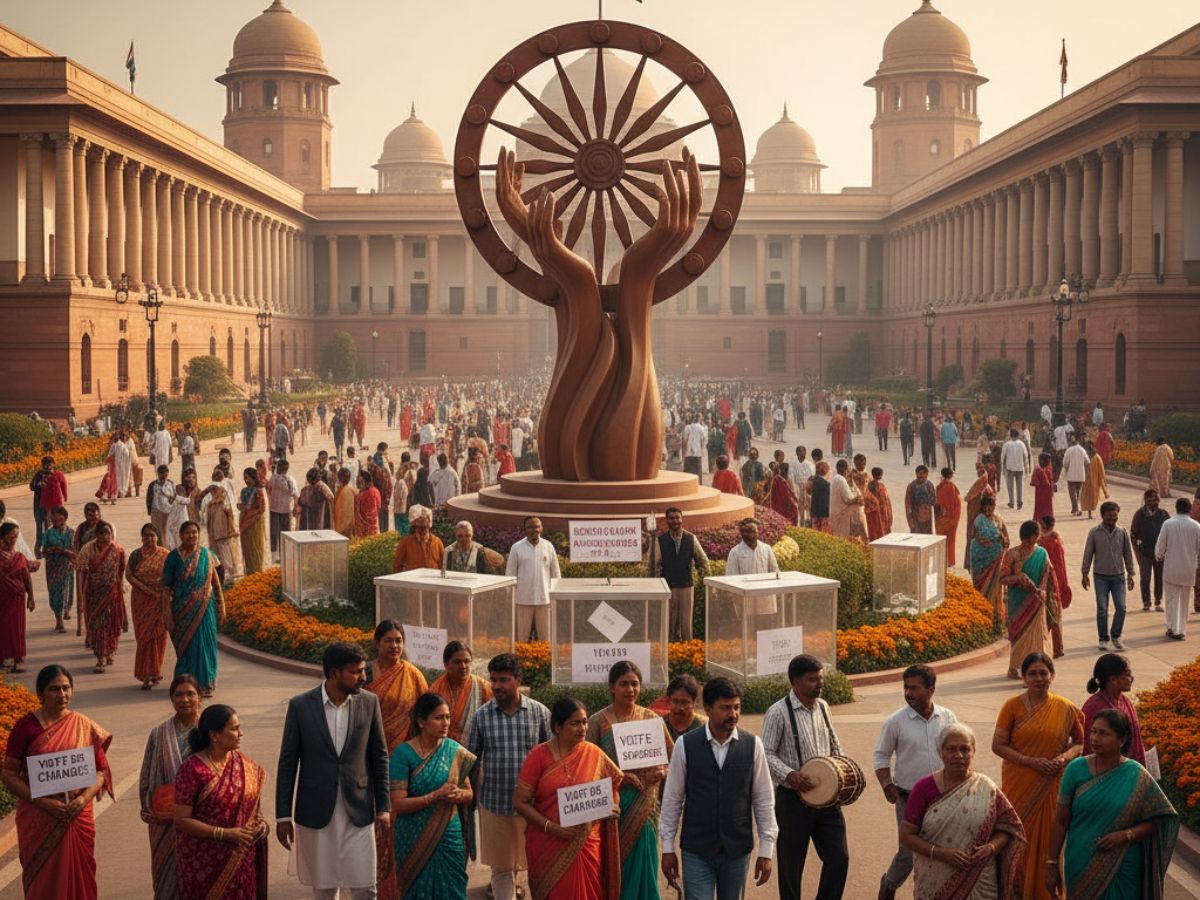
The International Day of Democracy: History And Significance, How Democratic India Is? (AI image created by Google Gemini)
The International Day of Democracy has been observed every year on September 15 since 2007. It was established by the United Nations General Assembly to promote and uphold the principles of democracy.
The day is observed to remind that democracy is not just about casting votes but also about protecting human rights and ensuring the rule of law.
The United Nations highlights the theme for this year as ‘Democracy under Strain: Solutions for a Changing World’. The global body writes on its website, “The International Day of Democracy provides an opportunity to review the state of democracy in the world.”
UN Secretary-General Antonio Guterres noted, “Democracy is powered by the will of the people, by their voices, their choices, and their participation.”
The website further said, “Freedom of expression is a fundamental human right, enshrined in Article 19 of the Universal Declaration of Human Rights. But around the world, there are governments and those wielding power who find many ways to obstruct it.”
The most accepted definition of Democracy by political scientists is a system of government where power rests with the people. Former American President Abraham Lincoln, in his Gettysburg Address (1863), defined Democracy as a government of the people, by the people, for the people.
Other key features of democracy are rule by the people, marked by free and fair elections. It also provides for majority rule with minority rights and protection of rights and freedoms.
The International Day of Democracy has been celebrated on 15 September since 2007 as a litmus test to know how democracy in the world is functioning. It reminds us that the democratic system is more than just elections, it is about ensuring freedom, equality and participation of all.
Around the world, the International Day of Democracy is celebrated, as per the United Nations website, to promote democratic values and to encourage people to participate in the democratic process. The day is also observed to strengthen democratic institutions and to address challenges.
The Democracy Ranking is a global index designed to evaluate political rights, civil liberties and the quality of society and governance of a country. The index is published by the Economist Intelligence Unit.
It focuses on how democracy affects people’s quality of life rather than elections. It ranges from political dimensions – Gender equality, Political participation, Freedom of press, to non-political dimensions, i.e. how it impacts society.
For the 16th consecutive year, Norway topped the list as the most democratic country in the world, with a score of 9.81, followed by New Zealand and Sweden. However, Afghanistan has been the lowest-ranked country since 2021, scoring just 0.25 points.
India stands at 41st out of 167 nations on the Democratic Index released by the Economist Intelligence Unit.
ALSO READ: BPSSC, CSBC Aspirants Protest Over Transparency In Exams In Patna
Garima Malhotra, mother of designer Manish Malhotra, passed away peacefully at 94 in Mumbai on…
The Chhattisgarh Professional Examination Board has declared CG TET 2026 results on March 19. Candidates…
Iran To Boycott USA But Not FIFA World Cup 2026, Football President Confirms
Iran will boycott the USA but not the FIFA World Cup 2026. FA President Mehdi…
