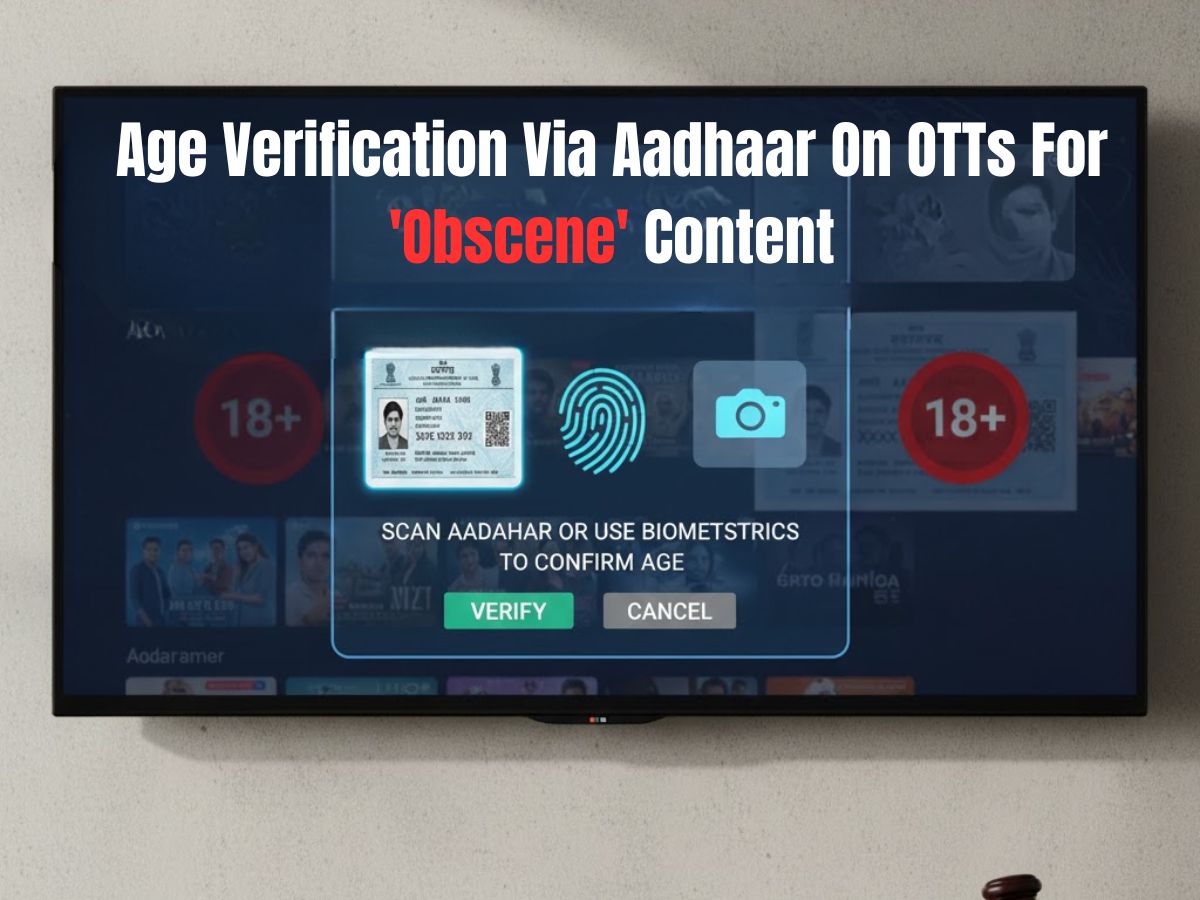
Verification Via Aadhaar On OTTs For Watching 'Obscene' Content? (Representative Image: Gemini)
The Supreme Court on Thursday indicated that Aadhaar-based age verification could be used to control access to “obscene” OTT content. A bench led by the Chief Justice of India, Surya Kant and Justice Joymalya Bagchi stressed the importance of displaying clear warnings, pointing out that such content may not be appropriate for all viewers.
According to Bar & Bench, Justice Bagchi remarked, “Obscenity can be in book, painting etc. If there is an auction… there can be restriction also. The moment you switch on phone and something comes which you don’t want or is forced on you, then what?”
According to Bar and Bench, the CJI said, “See the issue is given and the shown starts. But by the time you decide not to watch it starts. The warning can be for a few seconds.. then perhaps ask for your aadhaar card etc. So that your age can be verified and then the program starts. Of course these are illustrative suggestions…a combination of different experts .. someone from judiciary and media can be there also.
He further added, “let something come up on pilot basis and if it clogs free speech and expression it can be looked at then .We need to build a responsible society and once that happens most of the problems will be solved,”
The Supreme Court also urged the Centre to explore creating a law that would make insulting or mocking people with disabilities or rare genetic conditions a punishable offence, similar to the provision in the SC-ST Act.
“Why can’t you bring a stringent law on the lines of the SC-AT Act which criminalises casteist remarks-there is punishment if you demean them,” a bench comprising Chief Justice Surya Kant and Justice Joymalya Bagchi said, as reported by PTI.
The court once again stressed the importance of regulating online content, stating that an independent authority is needed to determine what should be permitted. CJI Kant noted that “self-appointed” bodies are insufficient and emphasised the need for a neutral, autonomous regulator free from external influence.
The court asked, “Only an autonomous body is needed to decide for the interregnum period to see if something can be allowed or not.. If permissible, then fine. If everything is allowed, then what will happen?”
The court clarified that fundamental rights would have to be balanced and that it would not approve “something which can gag somebody.”
The top court was hearing a petition filed by M/s SMA Cure Foundation, which works for individuals affected by the rare Spinal Muscular Atrophy disease. The plea flagged jokes made by “India’s Got Latent” host Samay Raina and other social media influencers, Vipun Goyal, Balraj Paramjeet Singh Ghai, Sonali Thakkar, and Nishant Jagdish Tanwar.
On March 3, the top court had allowed Allahbadia to resume his podcast ‘The Ranveer Show’, subject to maintaining ‘morality and decency’ and making it suitable for viewers of all ages.
Manisha Chauhan is a passionate journalist with 3 years of experience in the media industry, covering everything from trending entertainment buzz and celebrity spotlights to thought-provoking book reviews and practical health tips. Known for blending fresh perspectives with reader-friendly writing, she creates content that informs, entertains, and inspires. When she’s not chasing the next viral story, you’ll find her diving into a good book or exploring new wellness trends.
Iran and Israel exchanged strikes on critical oil facilities—Haifa refinery and Tehran depot—escalating Middle East…
Israeli Prime Minister Netanyahu pledges full-force military operations amid escalating Middle East tensions, honors national…
MEA Confirms Safe Return of 52,000 Indians Amid West Asia Crisis; Israeli-Iran Strikes Escalate _
Over 52,000 Indians safely returned from the Gulf amid West Asia tensions. MEA set up…
