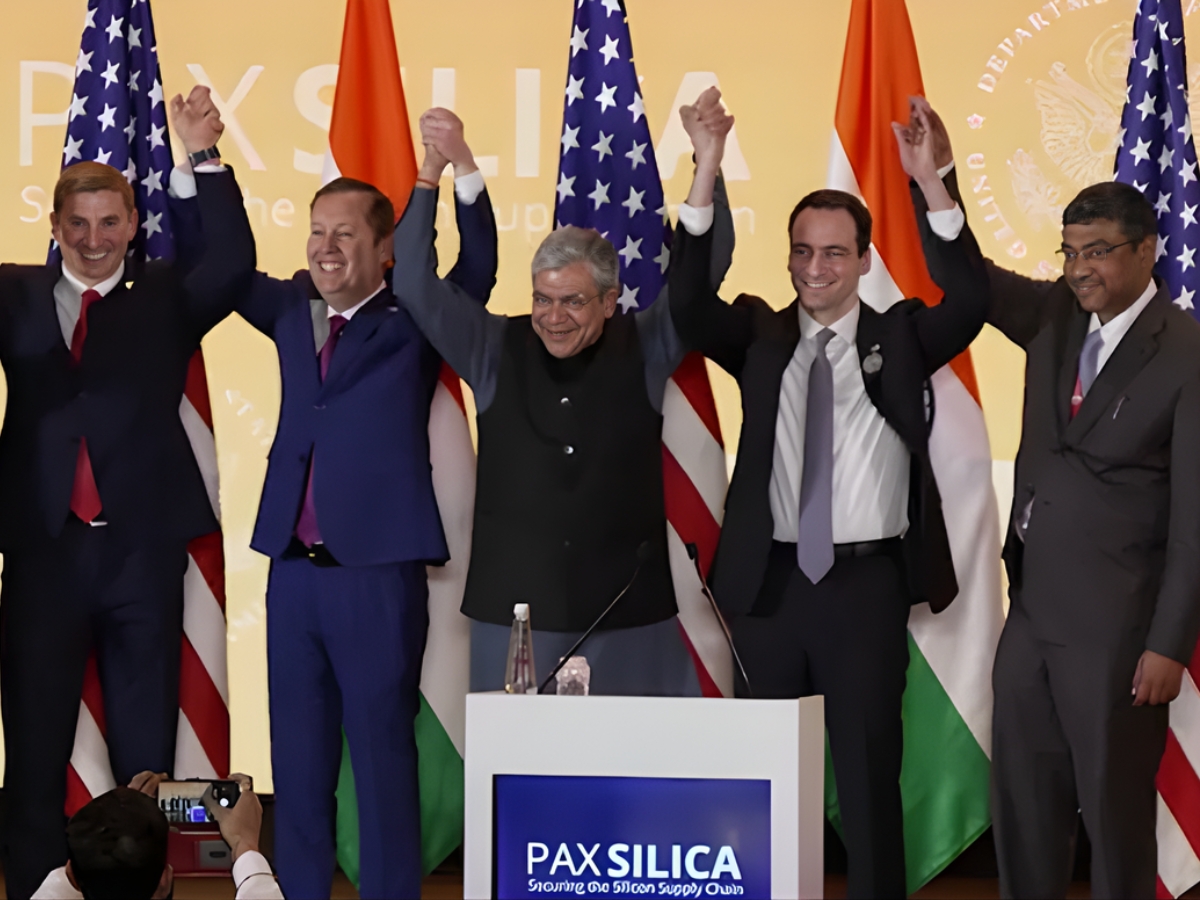
India joins US-led Pax Silica for AI, supply chain security, strengthening global economic and tech collaboration. Photo: X.
India has formally joined Pax Silica, the US-led effort on artificial intelligence and supply chain security, on the sidelines of the Global AI Impact Summit being held here in the national capital. US Ambassador to India Sergio Gor; Jacob Helberg, United States Under Secretary of State for Economic Growth, Energy, and the Union Minister for Information Technology Ashwini Vaishnaw were present during the signing of the declaration. The Pax Silica Declaration underlines the importance of a reliable supply chain indispensable to mutual economic security and recognises AI as a transformative force for long-term prosperity.
Pax Silica is the US Department of State’s flagship effort on AI and supply chain security, advancing new economic security consensus among allies and trusted partners.
As per an official statement by the State Department, the signatories of the Declaration include Australia, Greece, Israel, Japan, Qatar, South Korea, Singapore, UAE, UK; with non-signatory participants being Canada, the Netherlands, European Union, Organization for Economic Cooperation and Development and Taiwan.
Pax Silica aims to reduce China’s dominance and counter coercive dependencies across critical minerals, energy inputs, semiconductors, advanced manufacturing, AI infrastructure, and logistics.
On the policy front, the coalition is working to align export controls, investment screening, and R&D subsidies. The goal is to ensure that “trusted” tech doesn’t leak to adversaries and that the member nations provide each other with preferential access to critical components.
In the context of intensifying global competition over AI capabilities, the initiative reflects a broader shift in US economic policy toward proactive coalition-building and long-term strategic planning rather than reactive market corrections.
United States Ambassador to India Sergio Gor on Friday highlighted India’s determination and the expanding scope of cooperation between the two countries. Welcoming India to the Pax Silica initiative he said by signing this partnership the two nations had chosen to win.
“We welcome India joining to co found the future tax silicon is about free society, whether free societies will control the commanding heights of the global economy. It’s about whether innovation happens in Bangalore and Silicon Valley or in surveillance states they use technology to monitor and control their people. We choose freedom, we choose partnership. We choose strength. And today, with India’s entry into Pax silica, we choose to win,” Gor said
Gor said it was not only India’s scale that impressed him, but also its resolve to chart an independent course.
Jacob Helberg, United States Under Secretary of State for Economic Growth, Energy, and the Environment on Friday hailed India joining the Pax Silica Declaration, noting that it underscores the importance of economic security translating into national security and stands in the face of coercion and blackmail undermining the prosperity of nations.
Speaking at the Pax Silica declaration, Helberg highlighted, “We watch as our friends and allies face daily threats of economic coercion and blackmail, forced to choose between their sovereignty and their prosperity. We find ourselves grappling with a global supply chain that is massively over-concentrated”.
“So today, as we sign the Pax silica declaration, we say no to weaponised dependency, and we say no to blackmail, and together, we say that economic security is national security, but we must be precise about what that word means.”
China controls approximately 90% of global rare-earth processing and refining capacity and about 70% of mining output. In 2025, China tightened its control over critical minerals by restricting exports of rare-earth magnets and banning technical collaborations on advanced lithium-ion battery technology.
The heavy dependence on China has spurred global efforts to diversify supply chains. Western countries began pursuing alternative sources after the COVID-19 pandemic, and these initiatives have gained renewed urgency amid export restrictions and geopolitical tensions. It is in this background that Pax Indica gains a huge importance for India and the rest of the member countries.
(With inputs from ANI)
Zubair Amin is a Senior Journalist at NewsX with over seven years of experience in reporting and editorial work. He has written for leading national and international publications, including Foreign Policy Magazine, Al Jazeera, The Economic Times, The Indian Express, The Wire, Article 14, Mongabay, News9, among others. His primary focus is on international affairs, with a strong interest in US politics and policy. He also writes on West Asia, Indian polity, and constitutional issues. Zubair tweets at zubaiyr.amin
In a world of fleeting digital connections, Do Deewane Seher Mein explores lasting love through…
CBSE Class 12 Board Exam 2026: Physics Paper Analysis, Difficulty Level, And Exam Guidelines
The Central Board of Secondary Education conducted the Class 12 Physics board examination on Friday, February…
Ranvir Sachdeva made history as the youngest individual to speak at the India AI Impact…
