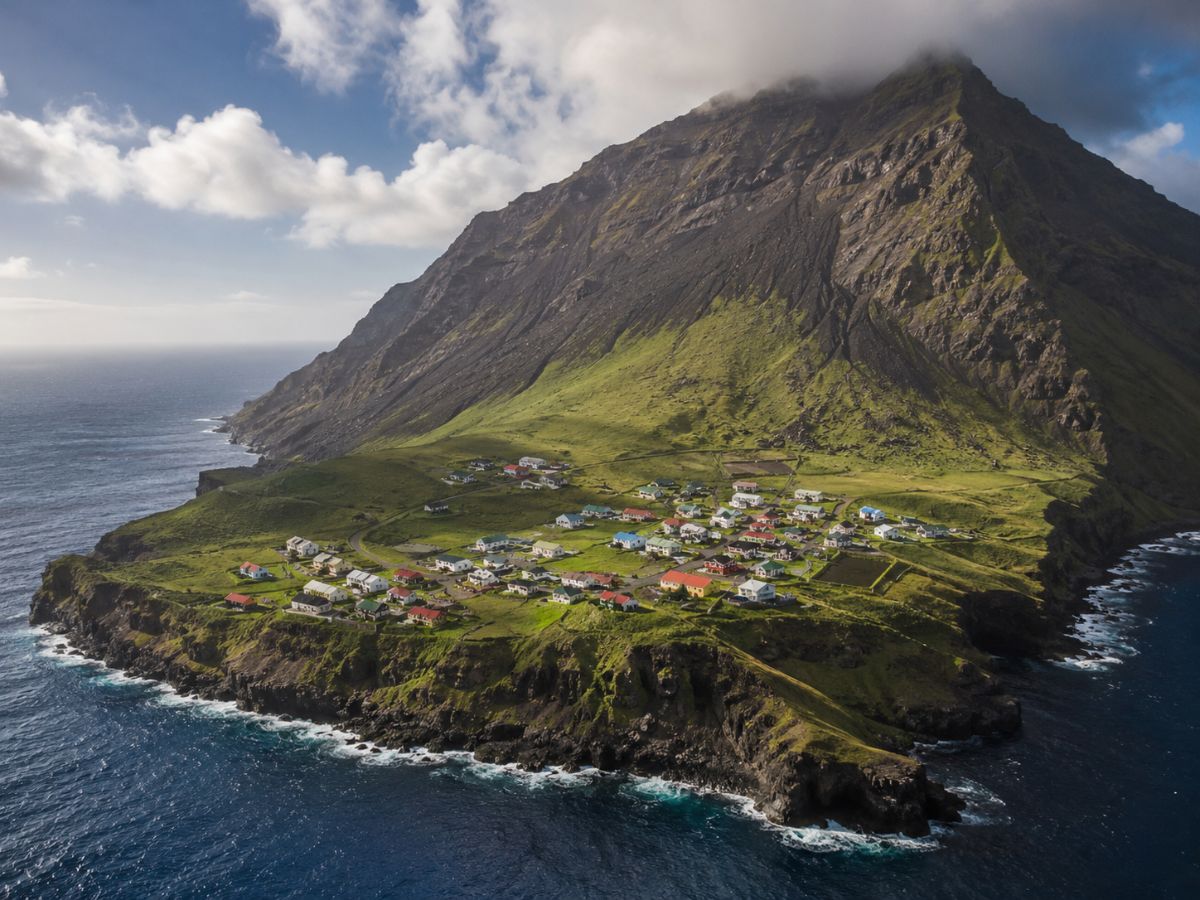
9 Most Remote Places on Earth You Won't Believe Actually Exist (Photo generated by AI)
In an age of satellites, smartphones, and instant connectivity, it may seem like nowhere on Earth remains truly isolated. Yet a handful of extraordinary locations continue to exist far from civilisation, separated by vast oceans, frozen wilderness, or inhospitable terrain. Some are home to small communities that have adapted to extreme conditions for generations. Others are scientific outposts accessible only a few months each year. Together, they represent the last frontiers of human habitation. Here are the nine most remote places on Earth.
Often described as the world’s most remote inhabited island, Tristan da Cunha lies deep in the South Atlantic Ocean, thousands of kilometres from the nearest mainland. The island has no airport, meaning every visitor and supply must arrive by sea, typically from South Africa. The settlement of Edinburgh of the Seven Seas is home to only a few hundred residents who rely largely on fishing and farming.
What makes Tristan da Cunha remarkable is not just its distance from civilisation, but also the fact that an entire community thrives there despite its isolation.
Pitcairn Island is one of the most isolated inhabited places in the Pacific Ocean. Best known as the refuge of the HMS Bounty mutineers and their descendants, the island has a tiny population and no airport. Reaching Pitcairn requires a lengthy sea journey from French Polynesia.
Its remote location and unique history have made it one of the world’s most fascinating island communities.
Located in the southeastern Pacific Ocean, Easter Island is renowned for its giant stone moai statues. It is also one of the most isolated inhabited islands on Earth, located thousands of kilometres from continental Chile and over 2,000 kilometres from the nearest inhabited island.
Despite modern air connections, its geographic isolation remains extraordinary and has shaped its unique culture for centuries.
If remoteness is measured by climate and accessibility rather than oceans, Oymyakon ranks near the top. This tiny Siberian village is widely recognised as one of the coldest permanently inhabited places on Earth, with winter temperatures plunging below minus 60°C.
Road access is difficult, especially during winter, and residents have adapted to one of the harshest environments known to humanity.
Situated on Greenland’s eastern coast, Ittoqqortoormiit is one of the most isolated settlements in the Arctic. No roads connect it to other towns, and seasonal boats and helicopters generally provide access. Surrounded by ice-covered landscapes and some of the world’s largest fjords, the settlement offers a rare glimpse into life at the edge of the Arctic wilderness.
McMurdo Station is the largest research facility in Antarctica and one of the most remote human settlements on the planet. Located on Ross Island, the station serves as a hub for scientific research and logistics across the continent.
Although not a traditional town, it demonstrates humanity’s ability to survive in one of Earth’s most unforgiving environments.
Often called the ‘Galápagos of the Indian Ocean’, Socotra is renowned for its alien-looking landscapes and unusual plant species, including the iconic Dragon Blood Tree. The island’s geographic isolation has allowed unique ecosystems to evolve over millions of years.
Many visitors describe the island as looking more like another planet than a part of Earth.
Nicknamed the ‘Desolation Islands’, the Kerguelen archipelago lies in the remote southern Indian Ocean. There is no permanent civilian population, only rotating scientists and support staff. Access is generally limited to infrequent supply ships from the French territory of Reunion.
Strong winds, rough seas, and extreme isolation make the islands one of the most inaccessible places on Earth.
Perched high in the Peruvian Andes at an altitude of more than 5,000 metres, La Rinconada is considered the highest permanent settlement on Earth. The town’s remote mountain location and harsh conditions make everyday life extremely challenging.
Despite the difficult environment, thousands of people live there, largely drawn by opportunities in the nearby gold mining industry.
These remote locations reveal just how adaptable humans can be. Whether surviving Arctic winters, living on isolated volcanic islands, or conducting research in Antarctica, the people who inhabit these regions have learned to thrive where most would struggle to endure.
In a world that feels increasingly connected, these places remain powerful reminders that true wilderness and isolation still exist.
ALSO READ: Top 10 Countries With Highest Rate Of Depression In 2026
Harshita is a journalist and digital content writer specializing in breaking news, current affairs, travel, education, and trending stories. She is focused on delivering accurate, timely, and engaging content with a strong emphasis on clarity and audience relevance.
Ariana Grande criticises the Trump administration after a White House TikTok used her 2024 song…
Mexico defeated South Africa 2–0 in a historic, card-heavy FIFA World Cup 2026 opening match…
What Does Iran Peace Deal Include? Trump Claim It Could Be Signed This Weekend
US President Donald Trump says a peace deal with Iran could be finalised within days…
