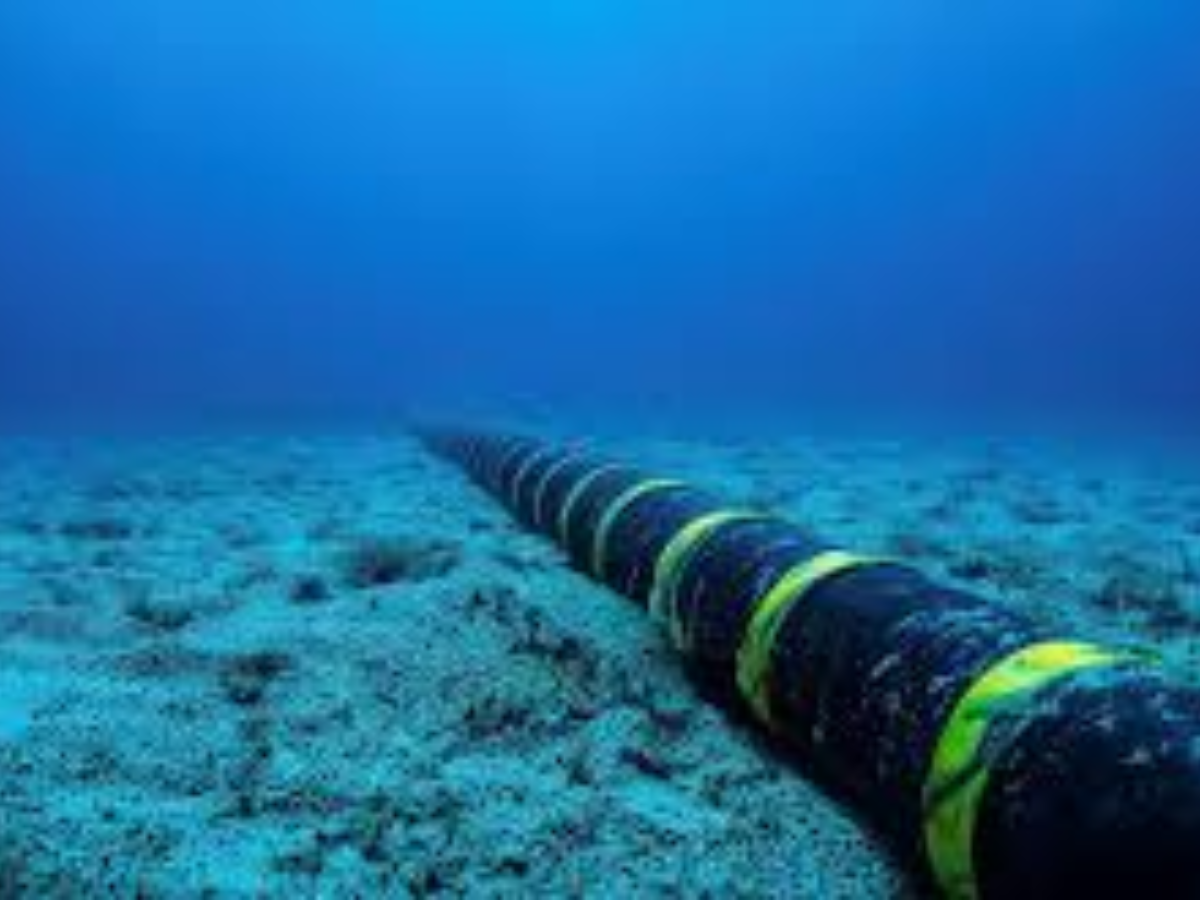
Maritime security experts from India, Indian Ocean countries and the European Union (EU) will come together for a workshop in New Delhi on 5 December to discuss how to better protect submarine infrastructure in the strategically important Indian Ocean region. This seminar will strengthen the India, EU and the larger Indo pacific area maritime cooperation on securing critical undersea infrastructure by mapping risks, sharing best practices, and driving practical, technology and policy led solutions.
Data cables connect continents and states, link islands to the mainland and connect both EU and India to the rest of the world, carrying 99% of inter-continental internet traffic. They have become indispensable to commerce and digital growth across every sector of the global economy. However, lying unprotected on the ocean floor, physically accessible and difficult to monitor, undersea infrastructure is vulnerable to malign activities and intentional damage, which can have significant global impacts.
This track 1.5 EU-India regional seminar will assess current risks and consider possible responses with an emphasis on regional and global cooperation.The 70 participants at the day-long event will include representatives from India, the EU, Madagascar, the Maldives, Mauritius, Oman and the Seychelles, comprising military personnel and officials from government agencies including the Navy and the Coast Guard.
The activity is jointly organised by the National Maritime Foundation (NMF) of India and European Union and implemented by the EU security and defence project ESIWA+ (Enhancing the EU’s Security Cooperation in and with Asia and the Indo-Pacific), which is co-funded by the EU, Germany and France.
Placing a focus on submarine cables, the workshop represents an essential step forward in the ongoing EU-India maritime security dialogues, said H.E. Hervé Delphin, European Union Ambassador to India.
“Cooperation in the maritime domain is a key component of the strategic EU-India agenda. This workshop on the security and resilience of submarine cables reflects the shared interest we have in developing a comprehensive approach to maritime security. The EU Action Plan on Cable Security provides a framework to strengthen the security and resilience of submarine cable infrastructures. It can serve as a basis to develop further cooperation and joint strategies with key international partners like India in this domain,” he said.
“The EU’s regional focus on the Indian Ocean is all the more important given the increasing number of initiatives between Europe, India and other regional partners, not least in the context of the India-Middle East-Europe Economic Corridor and other projects connecting these geographies,” Ambassador Delphin added.
Vice Admiral Pradeep Chauhan, AVSM & Bar (Retd), Director-General of the National Maritime Foundation, said: “The workshop will help foster further regional maritime dialogue and action on securing undersea infrastructure, which is critical for economic security and sovereignty. The discussion will in particular identify vulnerabilities, highlight best practices, and promote concrete solutions that integrate technology, policy and cooperation.”
The seminar builds on the conclusions of the 4th EU-India Dialogue on maritime security and the Ministerial Meeting on the protection of critical maritime infrastructure, held on 21 November in Brussels at the margins of the 4th EU Indo-Pacific Ministerial Forum. Protecting critical maritime infrastructure is vital to the security and prosperity of both the EU and Indo-Pacific regions. Protecting undersea infrastructure requires a combination of enhanced surveillance and monitoring systems to detect threats in real time. It also demands strategic coordination between governments, private operators, and international partners to ensure rapid response and resilience.
The EU contributes to maritime security in the region, in particular with its naval operations Atalanta and Aspides in the North-West Indian Ocean.
As the world’s two largest democracies, the European Union and India share a commitment to a rules-based global order, effective multilateralism, and sustainable development. Since 2004, India has been a strategic partner of the EU, and 2022 celebrated the 60th anniversary of their relations. The collaboration between the EU and India from 2020 to 2025 is steered by the EU-India Strategic Partnership Roadmap, the EU Strategy for Cooperation in the Indo-Pacific, and the Global Gateway Strategy. There are over 50 EU-India sectorial dialogues. On 17 September 2025, the European Commission and the High Representative adopted the Joint Communication (JC) outlining a ‘New Strategic EU-India Agenda‘. This was endorsed by European Council as well.
During the recent visit of the College of Commissioners to India, leaders from both sides welcomed growing cooperation between EU and India in the defence and security domain, including their shared commitment to international peace and security, particularly maritime security, by addressing traditional and non-traditional threats to safeguard trade & sea lanes of communication. During the inaugural EU-India Strategic Dialogue on 10 June, the High Representative for Foreign Affairs and Security Policy Kaja Kallas and the Minister of External Affairs of India Dr. Subrahmanyam Jaishankar discussed enhanced cooperation in the field of security and defence across key areas of mutual interest, including maritime security and maritime domain awareness.
In the framework of IMEC, the EU is advancing the EU-Africa-India Digital Corridor, including the 11,700 km Blue Raman submarine cable system connecting Europe to India via the Mediterranean, the Middle East and Eastern Africa. This EU initiative will provide ultra- high-speed, secure, and diversified data connectivity resilient to disruptions caused by natural disasters or human activity.
ESIWA+ (Enhancing the EU’s Security Cooperation In and With Asia and the Indo-Pacific) works to enhance cooperation in four thematic areas: counterterrorism and preventing violent extremism, crisis management/addressing hybrid threats, cyber security, and maritime security. ESIWA+ is co-funded by the European Commission’s Service for Foreign Policy Instruments (FPI), the German Federal Foreign Office, and the French Ministry for Europe and Foreign Affairs. ESIWA+ is co-implemented by the German Corporation for International Cooperation (GIZ) and by Expertise France.
Swastika Sruti is a Senior Sub Editor at NewsX Digital with 5 years of experience shaping stories that matter. She loves tracking politics- national and global trends, and never misses a chance to dig deeper into policies and developments. Passionate about what’s happening around us, she brings sharp insight and clarity to every piece she works on. When not curating news, she’s busy exploring what’s next in the world of public interest. You can reach her at [swastika.newsx@gmail.com]
LPG cylinder prices remain high across India as of March 15, 2026, adding pressure on…
Anurag Dobhal, also known as UK07 Rider and a former Bigg Boss 17 contestant, has…
Amid West Asia tensions, SpiceJet restricts Dubai flights and launches special Fujairah–India services; Gulf Air…
