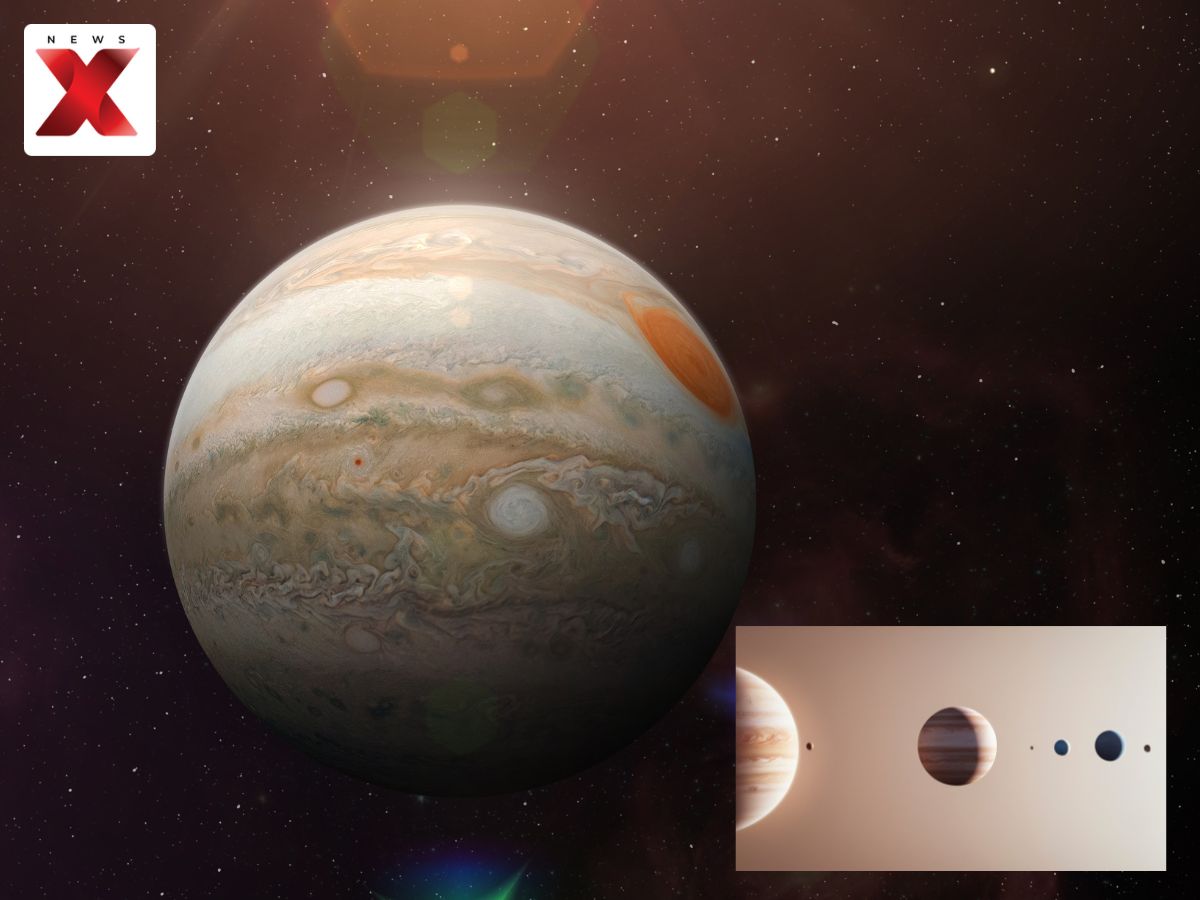
On January 10th, 2026, the planet Jupiter will be at opposition. Earth will form a line with the sun and with Jupiter. Thus, this will be the photographer’s best time to take Jupiter’s picture, as it will be at its brightest. The heavenly body will be above the twin stars and shining at a magnitude of -2.7, so only Sirius will be brighter than it.
Opposition is the term describing the situation when Jupiter is the farthest from the sun on the other side of the Earth, and at that very moment, it rises with the sun, so when the sun sets, Jupiter is already up. On the 10th of January, at 08:34 GMT (1:34 PM IST), Jupiter, which is about 632 million km away, looks biggest at 45.6 arcseconds; actually, it had its closest approach to Earth the day before. This phenomenon occurs every 13 months due to Jupiter’s 12-year orbit.
Look to the east after sunset in a clear and totally dark sky, you can see it with the naked eye, but binoculars will let you see its four Galilean moons (Io, Europa, Ganymede, Callisto). At high power, telescopes will show the Great Red Spot and cloud bands. From Faridabad, point your telescope southeast; avoid city light and moonlight interference during new moon phases.
The planet Jupiter will be the king of the night sky in early 2026; it will lose a little bit of its brilliance post-opposition but still be very noticeable until March. The Sky Tonight app will help you to spot it among Gemini’s stars, Castor and Pollux. Weather allowing, January 10-15 should be the prime time for observation before it moves west.
Stable binoculars (10×50) are enough for the moons, and a small telescope (4-6 inches) can reveal the details of the atmosphere. Watch the shadows of the moons creating dynamic views.
Shubhi is a seasoned content writer with 6 years of experience in digital media. Specializing in news, lifestyle, health, sports, space, optical illusions, and trending topics, she crafts engaging, SEO-friendly content that informs and captivates readers. Passionate about storytelling, Shubhi blends accuracy with creativity to deliver impactful articles across diverse domains.
SBI Clerk Mains Result 2026 Out: Download Merit List PDF From sbi.bank.in
The State Bank of India has announced the SBI Clerk Mains Result 2026 on February…
Arvind Kejriwal: An emotional atmosphere unfolded at Arvind Kejriwal’s residence on Friday after a Delhi…
Fresh developments outside the Catalina home of missing 84-year-old Nancy Guthrie have intensified public scrutiny…
