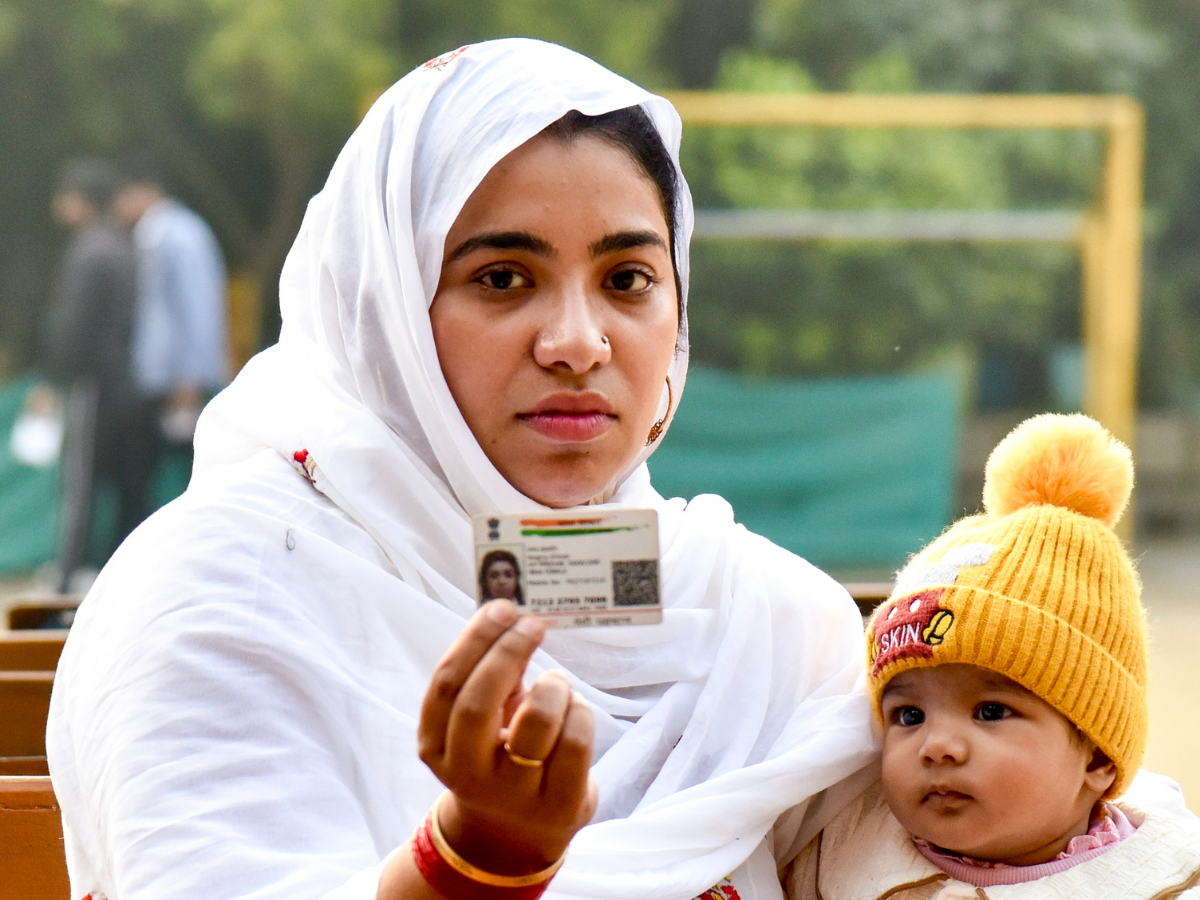
Face Authentication becomes mandatory, credit: ANI
The central government has notified new Aadhaar rules. This notification formally clarifies the use of face authentication while tightening consent and purpose-limitation requirements aligned with the recently implemented Digital Personal Data Protection (DPDP) Act.
This notification marks a significant shift in how Aadhar card can be used beyond government services and how private entities may legally access the system.
This notification come at a time when Unique Identification Authority of India (UIDAI) is planning to launch the new redesigned Aadhaar app. The officials say that user could enable Aadhaar based identity checks for everyday use such as event entry, hotel check-ins, deliveries and access control, without relying on continuous database authentication.
The new Aadhar rule gives regulatory recognition of face authentication as a valid mode of Aadhar authentication, alongside existing biometric and OTP-based methods. Till now the facial verification had limited formal backing and it was majorly limited to specific government-led use cases
The rules also strengthen the rules for offline Aadhar verification. Now identity details can be verified without using UIDAI’s central database. This update will allow users to share digitally signed credentials through a QR code or a third-party app
The government is seeing face authentication as critical in scenarios where fingerprint or iris scans are not practically possible.
UIDIA officials have stated that this feature of on-device facial verification can serve as a “proof of presence”. The face authentication would confirm that the Aadhar holder is physically present at the point of verification, without transmitting biometric data to UIDAI servers.
This can be also used for entry to public events, gated communities, or ticketed venues.
With the expansion of authentication modes, the users also question privacy. This update is aligned with the newly implemented Digital Personal Data Protection (DPDP) Act. This places a strict restriction on entities to avoid data over-collection and misuse.
As per the new notification, an Aadhar holder should be able to approve or deny a request and share only selected data such as age or photograph despite full Aadhar profile.
Syed Ziyauddin is a media and international relations enthusiast with a strong academic and professional foundation. He holds a Bachelor’s degree in Mass Media from Jamia Millia Islamia and a Master’s in International Relations (West Asia) from the same institution.
He has work with organizations like ANN Media, TV9 Bharatvarsh, NDTV and Centre for Discourse, Fusion, and Analysis (CDFA) his core interest includes Tech, Auto and global affairs.
Tweets @ZiyaIbnHameed
For over six decades, Metformin has remained the go-to treatment for Type 2 Diabetes, valued…
Petrol Price Today: Petrol prices have risen sharply by over ₹5 per litre in several…
Boman Irani humorously questioned Donald Trump’s delayed concern for Iranians, asking “Where were you when…
