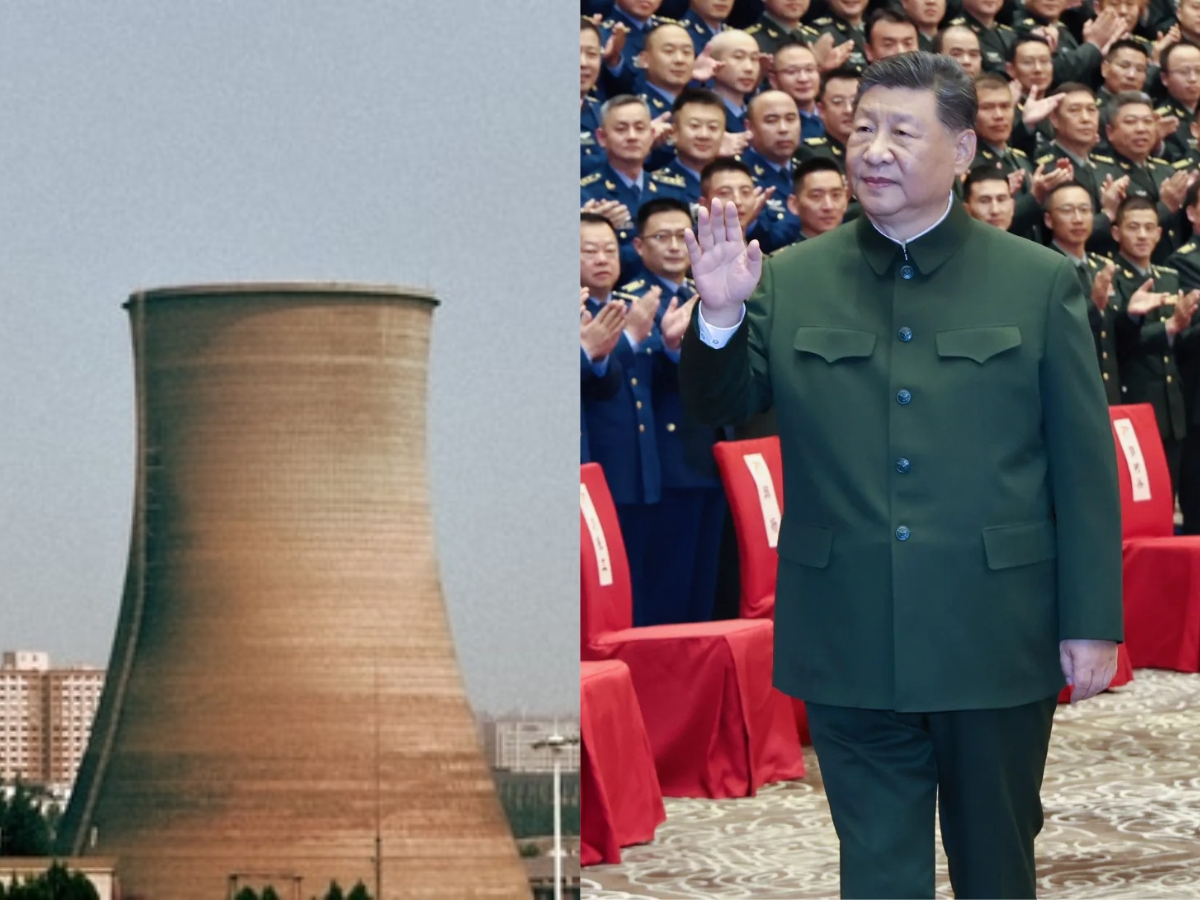
Satellite images reveal expansion of China’s nuclear facilities in Sichuan. Photos: X.
Is China expanding its nuclear facilities? A geospatial review of satellite imagery captured between 2022 and 2026 has identified what analysts describe as a substantial expansion of covert nuclear weapons–related facilities in southwest China’s Sichuan Province, according to a report by The New York Times. The findings, shared by geospatial intelligence specialist Renny Babiarz, suggest that Beijing’s nuclear weapons development programme has accelerated since 2019.
At a location known as Zitong, satellite imagery shows the construction of new bunkers and defensive ramparts positioned within a valley. Analysts also identified a recently built complex featuring extensive piping infrastructure, which they say is characteristic of facilities designed to manage hazardous materials.
Experts cited in the analysis believe the bunkers are likely being used for high-explosives testing, a crucial step in refining the chemical detonators that compress nuclear material inside a warhead.
“You have a layer of high explosives and the shock wave at the same time implodes into the center. This needs blast tests to perfect them,” said Hui Zhang, a physicist studying China’s nuclear programmes at the Harvard Kennedy School, who reviewed Babiarz’s findings.
Satellite images also indicate continued activity at another double-fenced installation known as Pingtong, also located in Sichuan. The facility includes a main structure distinguished by a 360-foot-high ventilation stack. Experts believe this site is involved in producing plutonium-packed cores for nuclear warheads.
Imagery suggests the structure has undergone refurbishment in recent years, including the addition of new ventilation systems and heat-dispersion features. Further construction activity has also been observed near the primary building.
Babiarz noted that the architectural design of the Pingtong complex resembles facilities in other countries used to manufacture nuclear warhead pits, the plutonium cores that trigger nuclear explosions.
According to the latest estimate from the Pentagon, cited in the report, China possessed more than 600 nuclear warheads by the end of 2024, with projections indicating the stockpile could reach 1,000 by 2030.
While those figures remain significantly lower than the arsenals of the United States and Russia, analysts say the speed of China’s expansion is a cause for concern.
Matthew Sharp, a former US State Department official now affiliated with the Massachusetts Institute of Technology, warned that limited communication between major powers increases the risks associated with the buildup.
“Without a real dialogue on these topics, which we lack, it’s really hard to say where it’s going,” he said. “Now we’re forced to react and plan around the worst-case interpretation of a concerning trend line.”
Zubair Amin is a Senior Journalist at NewsX with over seven years of experience in reporting and editorial work. He has written for leading national and international publications, including Foreign Policy Magazine, Al Jazeera, The Economic Times, The Indian Express, The Wire, Article 14, Mongabay, News9, among others. His primary focus is on international affairs, with a strong interest in US politics and policy. He also writes on West Asia, Indian polity, and constitutional issues. Zubair tweets at zubaiyr.amin
In early February, Yadav had turned himself in at Tihar Jail when the court declined…
Who is Bhupen Borah? Why Former Assam Congress Chief Resigned Ahead Of Crucial Assembly Elections
Former state Congress president Bhupen Borah on Monday resigned from the party resulting in a…
Kanye West will perform his first-ever India concert at New Delhi’s Jawaharlal Nehru Stadium on…
