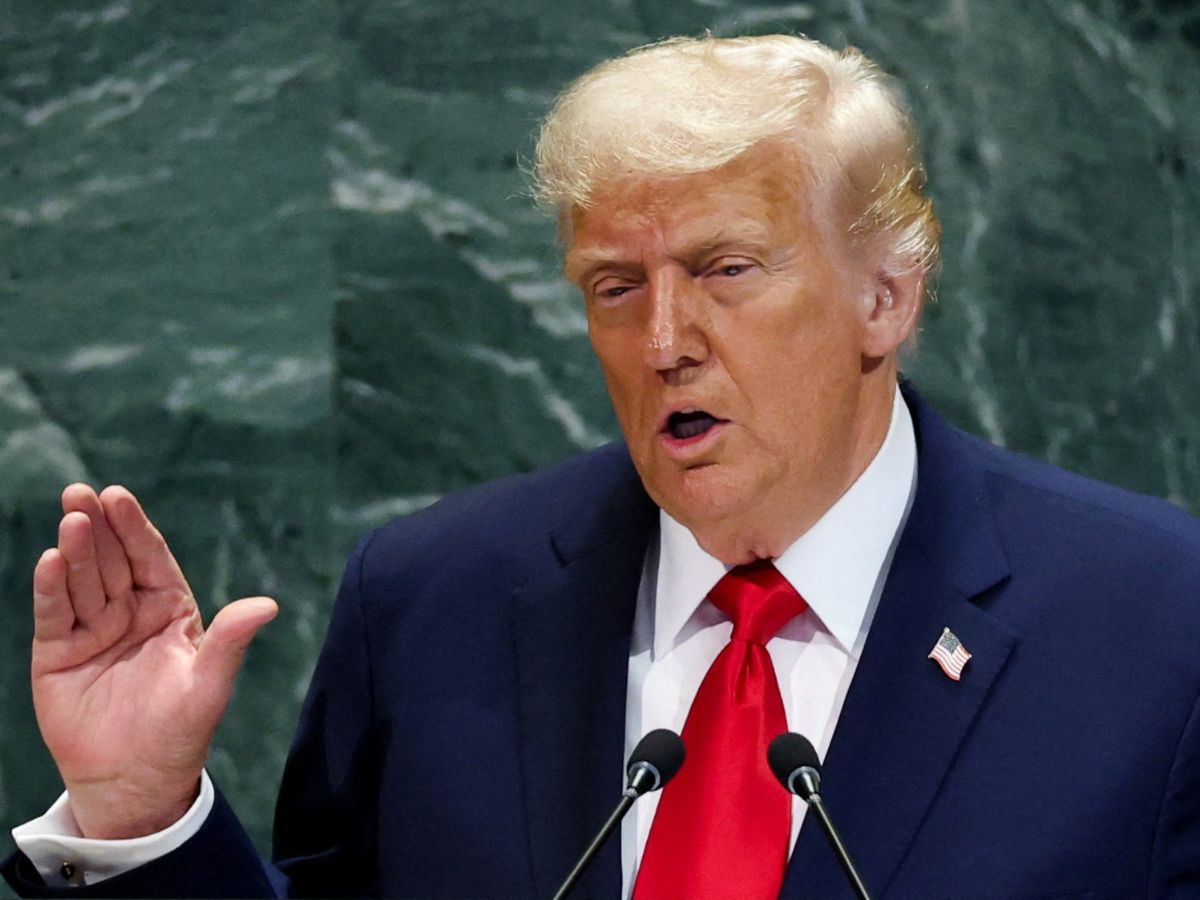
Trump asked Japanese Prime Minister Sanae Takaichi not to further escalate a dispute with China. (Photo: ANI)
Donald Trump asked Japanese Prime Minister Sanae Takaichi not to further escalate a dispute with China during talks this week, sources with knowledge of the matter said, as he tries to preserve a fragile trade war truce with Beijing.
Takaichi has touched off the biggest diplomatic dispute with Beijing in years when she told parliament this month that a hypothetical Chinese attack on Taiwan that threatened Japan could justify a military response.
Her remark has enraged Beijing and thereby prompted it to warn its citizens against travel to its East Asian neighbour.
In Tuesday’s telephone call with Takaichi, Trump said he did not want to see further escalation, said the two Japanese government sources, who sought anonymity as the matter is a sensitive one.
Trump made no specific demands of Takaichi, however, one of the sources said, suggesting that he did not echo Beijing’s call for a retraction. Japan has said her remarks reflect longstanding government policy.
At a regular press briefing on Thursday, its Chief Cabinet Secretary Minoru Kihara declined to comment on the details of the “diplomatic exchange”.
That telephone conversation came after Trump spoke to Chinese President Xi Jinping, who told the U.S. leader Taiwan’s return to China was central to Beijing’s vision for the world order, the official Xinhua news agency said.
Democratically governed Taiwan rejects Beijing’s sovereignty claim.
Trump, who plans to travel to Beijing in April, has not commented publicly on whether the talks featured Taiwan, saying instead that the world’s two biggest economies have “extremely strong” ties and are close to finalising a broad trade deal.
“The United States’ relationship with China is very good, and that’s also very good for Japan, who is our dear and close ally,” Trump said in a statement issued by the White House in response to questions from Reuters.
“We signed wonderful trade deals with Japan, China, South Korea, and many other nations, and the world is at peace. Let’s keep it that way!”
In Tokyo, some officials have long worried that Trump may be prepared to soften support for Taiwan in pursuit of a trade accord with China, a move they fear will embolden Beijing and spark conflict in an increasingly militarised East Asia.
“For Trump, what matters most is U.S.-China relations,” said Kazuhiro Maejima, a professor of U.S. politics at Sophia University. “Japan has always been treated as a tool or a card to manage that relationship.”
Trump‘s public silence on Japan’s escalating dispute with China has further frayed nerves in Tokyo.
Washington’s envoy to Tokyo has said the United States supports Japan in the face of China’s “coercion”, but two senior ruling party lawmakers told Reuters they had hoped for more full-throated support from their top security ally.
Japan hosts the largest overseas concentration of U.S. military, including an aircraft carrier strike group and a U.S. Marine amphibious force that hem in China’s military ambitions.
Washington has welcomed Tokyo’s defence build-up in recent years that has also irked Beijing.
“We’d like a word from Trump himself,” said one of the lawmakers, speaking on condition of anonymity. Trump‘s public silence could be perceived as a green light for Beijing to exert more pressure on Japan, he added.
Beijing has turned up the rhetoric.
China urged the United States to rein in Japan to prevent “actions to revive militarism”, the ruling Communist Party’s People’s Daily said in an editorial on Thursday that highlighted the role of Japan as their common enemy during World War Two.
“China and the United States share a common responsibility to jointly safeguard the post-war international order and oppose any attempts or actions to revive militarism,” it added.
China’s defence ministry said Japan would pay a “painful price” if it stepped out of line over Taiwan, in response to Tokyo’s plans to put air defence missiles on its westernmost island, Yonaguni, just 110 km (68 miles) from Taiwan’s coast.
Asked about Takaichi‘s call with Trump, the prime minister’s office referred Reuters to its official summary that said the two discussed U.S.-China ties, but did not elaborate.
It also denied an earlier Wall Street Journal article that said Trump advised her not to provoke Beijing on the question of Taiwan’s sovereignty.
Takaichi‘s off-the-cuff remark in parliament on Taiwan broke from the strategic ambiguity of her predecessors, who declined to publicly discuss the scenarios that could be deemed a sufficient threat to Japan to trigger military action.
Now that the comments are in the public domain, however, they will be hard to retract, officials previously told Reuters, making it all the harder to defuse a dispute that could hammer the economy and usher in a long winter in China-Japan ties.
(With Reuters Inputs)
Sofia Babu Chacko is a journalist with over five years of experience reporting on Indian politics, crime, human rights, gender issues, and stories about marginalized communities. She believes journalism plays a crucial role in amplifying unheard voices and bringing attention to issues that truly matter. Sofia has contributed articles to The New Indian Express, Youth Ki Awaaz, and Maktoob Media. She is also a recipient of the 2025 Laadli Media Awards for gender sensitivity. Beyond the newsroom, she is a music enthusiast who enjoys singing. Connect with Sofia on X: https://x.com/SBCism
A West Bengal school served pani puri as a mid-day meal due to LPG shortage,…
Iran Attacks UAE’s Oil Lifeline: Fujairah Port Hit Again, Massive Fire Breaks Out | WATCH
A drone strike triggered a major fire at the oil infrastructure in Fujairah. Another drone…
PSTET 2026 Exam Analysis: Check Paper Difficulty, And Section-Wise Review
The Punjab State Education Board conducted the Punjab State Teacher Eligibility Test (PSTET) 2026 on…
