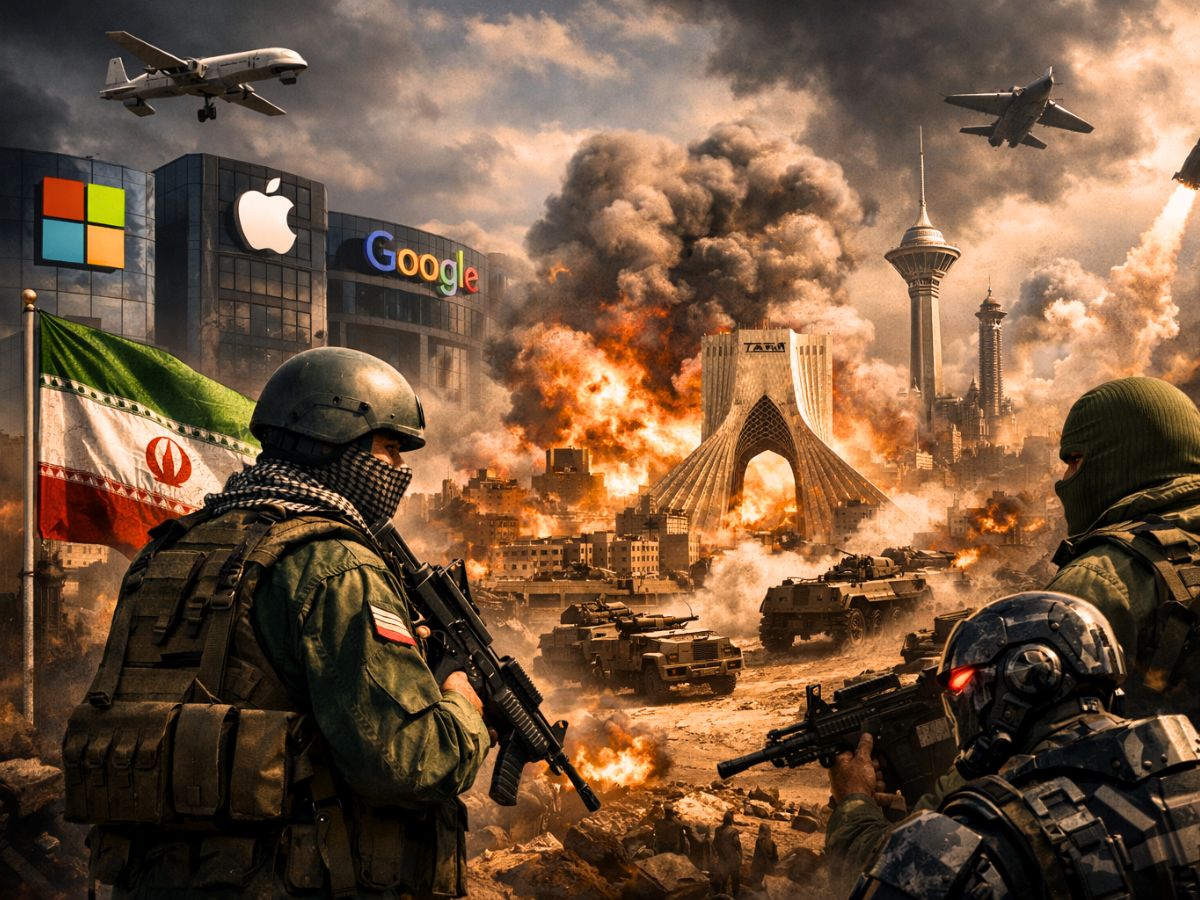
Iran’s IRGC threatens Google, Apple, Microsoft and 15 other US firms. (Photo: AI)
Iran’s Islamic Revolutionary Guard Corps (IRGC) has issued a dangerous warning to major US technology and industrial firms, including Google, Apple, Microsoft, Intel, IBM, Tesla, and Boeing, threatening to target their regional operations starting April 1. The threat comes amid escalating US-Israel-Iran tensions in the Gulf region, following a series of strikes on Iranian military officials.
The IRGC named 18 firms, citing their alleged involvement in operations against Iran. Other companies on the list include Dell Technologies, HP, Cisco, Oracle, Meta Platforms, JPMorgan Chase, General Electric, Palantir, Nvidia, Spire Solutions, and G42.
The statement warned:
“These companies should expect the destruction of their respective units in exchange for each terror act in Iran, starting from 8 PM Tehran time on Wednesday, April 1. We advise the employees of these institutions to immediately leave their workplaces to preserve their lives.”
This marks a significant escalation as the IRGC expands its targets beyond military installations to economic and technological infrastructure in West Asia.
According to Iranian state media, technology firms are viewed as playing a critical role in planning and executing operations against Tehran. This includes IT and artificial intelligence companies that may have worked with US and Israeli militaries on unmanned drones and precision targeting systems.
Microsoft and Apple, for instance, maintain corporate offices and retail hubs in the UAE, while Google and other AI pioneers are cited for their involvement in technologies that could aid military operations against Iran.
Iran’s IRGC statement highlights that artificial intelligence firms, including Google, Microsoft, OpenAI, and Anthropic, are seen as key players in enabling operations targeting Iran. AI technology is reportedly used for drone navigation, intelligence analysis, and target selection tools that the IRGC claims are directly supporting foreign strikes against Iranian officials and infrastructure.
Analysts note that while these companies primarily operate in civilian markets, historical collaborations with defense projects have made them targets in Tehran’s assessment.
The threat follows the confirmed killing of Brigadier General Jamshid Eshaghi, head of Iran’s armed forces budget and financial affairs, in a US-Israel strike. Eshaghi, sanctioned by the US in 2025 for funding Tehran-backed regional proxies such as Hezbollah, Hamas, and the Houthis, was killed along with several family members.
Earlier in the conflict, Supreme Leader Ali Khamenei and security chief Ali Larijani were also killed, signaling Tehran’s high-level losses. Despite this, analysts report Iran is showing resilience and a capacity to recover from leadership decapitation.
US Defense officials, including Secretary Pete Hegseth and Gen. Dan Caine, stressed that American military action remains focused on disabling Iran’s naval capabilities, minelaying operations, and defense industrial base, including nuclear research sites. Talks with Tehran to de-escalate the conflict are ongoing, though no ground troop deployments have been confirmed.
For Google, Apple, Microsoft, and other US companies, the warning from the IRGC signals an unprecedented threat to their regional infrastructure and employees. Experts say it highlights the increasingly blurred line between civilian tech operations and geopolitical conflict, especially in regions with heightened military tensions.
Businesses with operations in the UAE and wider Gulf region are now assessing risk mitigation strategies as Tehran sets a clear deadline for potential retaliatory measures.
Sofia Babu Chacko is a journalist with over five years of experience reporting on Indian politics, crime, human rights, gender issues, and stories about marginalized communities. She believes journalism plays a crucial role in amplifying unheard voices and bringing attention to issues that truly matter. Sofia has contributed articles to The New Indian Express, Youth Ki Awaaz, and Maktoob Media. She is also a recipient of the 2025 Laadli Media Awards for gender sensitivity. Beyond the newsroom, she is a music enthusiast who enjoys singing. Connect with Sofia on X: https://x.com/SBCism
Qatar urged de-escalation, diplomacy, and regional cooperation amid rising Gulf tensions, warning against attacks on…
A tanker carrying Iranian crude is heading to India’s Vadinar port, potentially marking the first…
Oracle has begun a new round of layoffs affecting employees globally, including in India, with…
