Here’s a useful excerpt of the eye-opening interview by NewsX Senior News Editor Devika Diwan with Michael Lester. Lester authored ‘We Are The Bad Guys’, a book that explores how a modern USA is built a modern-empire through wars, coups, sanctions and manipulations.
Devika Diwan: Iran has now already warned that if the strikes against Lebanon continue, all talks in Pakistan will essentially be meaningless. President Donald Trump has tried to address this; he says that he’s asked Israel to “low-key it”. But in your assessment, why is the United States of America not really being able to get Israel to pause for talks ?
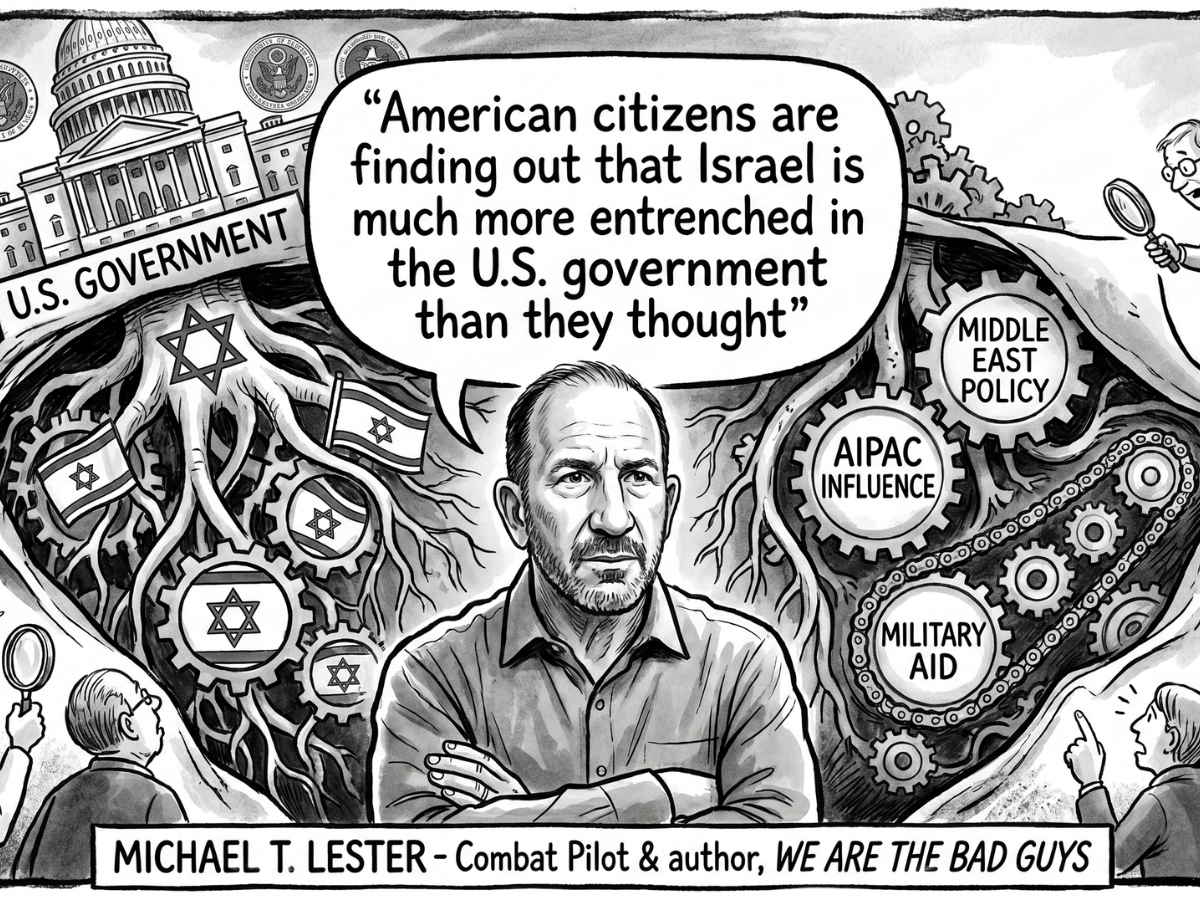
Michael Lester: I think this is one of the biggest issues we have, quite honestly. We are finding out – American citizens are finding out – that Israel is much more entrenched in the U.S. government than they thought. Two years ago, you couldn’t say anything contrary to Israel. Today, we’re seeing protests in the street, we’re seeing news articles, we’re seeing entire segments of news on the Israeli influence inside the American government, and it is extensive. So, for that reason, right now, I think many of our top politicians look at this and think, “the political cost of pushing Israel too hard is more than the political cost of letting them continue to do what they do”. I don’t think that will last. I think world attention is now on that; it’s in the open, it’s being exposed more and more, and I don’t think it can continue.
Watch the full interview here :
Devika Diwan: There was an attempt to change the regime in Iran, and Iran claims it wasn’t entirely successful. Yes, they’ve lost a large chunk of their very core and critical leadership that was leading the country for the past many decades, but it doesn’t seem to have really broken essentially the spirit of Iran. Why would Iran agree to the U.S terms and conditions now?
Michael Lester: They wouldn’t, in my assessment, quite honestly. One of the things about regime change, if you will – when you have a tight society, whether or not they agree with their government or not, another government coming in and killing their leaders usually revolutionizes them more. It makes them more steadfast in what they were believing rather than just saying, “Okay, yeah, our leader’s dead; we’ll pick a whole new one”. That happens in some countries; usually not with the population the way it is in Iran. I think the U.S. misread Iranian culture. Being attacked doesn’t make them feel weaker; it makes them more emboldened, and the conditions that are set right now, I think they’re non-attainable . What we’re asking Iran to do is basically abdicate all of its power, give up everything, so that we will stop sanctions and stop bombing it, quite frankly. And as you pointed out, the Hormuz Strait was open; it wasn’t closed before. It hasn’t ever been fully closed. It was threatened to be closed during the Iran-Iraq war, and that typically is enough. The other thing is giving up their nuclear aspirations. You’re asking them to do something that historically has not boded well for countries that have done that. We told Gaddafi in Libya, “you need to stop your nuclear program.” He did. We saw what happened. We saw what happened with Saddam . If I were an Iranian, I would be watching that going, “you’re asking me to give up my only power I have,” and that’s not going to work. And we do have to remember that Iran agreed to the JCPOA (Joint Comprehensive Plan of Action), where they limited their nuclear enrichment and did not pursue nuclear weapons. We were pulled out of that agreement in 2018 by Trump, and that’s when they started enriching again. So, a lot of this I look at as kind of a problem of our own making.
Devika Diwan: The Pentagon has released a final combat assessment stating that 90% of Iran’s navy is at the bottom of the sea and 80% of its air defenses have been destroyed. What do you make of this assessment and Iran’s ability to continue a ground battle if that situation arises and if the war resumes?
Michael Lester: Well, if that were absolutely true, we wouldn’t be in negotiations; we would just be walking in. I think battle damage assessments are always somewhat inflated, and in this case, it’s a little bit different because it’s a very asymmetrical war. Iran launches a $40,000 Shahed drone; we shoot it down with a $4 million Patriot missile. It’s going to cost us a lot more than it’s going to cost them. One drone – again, $40,000 – maybe can take out an entire tanker. Our assessment that I’ve seen most recently from our intelligence services is that Iran still maintains at least 50% of its missile force. I don’t think that’s something to just ignore. I think that we still have a great deal to deal with with Iran if that’s what we want to do, but again, it’s an asymmetrical war and I don’t think that’s going to change.
Devika Diwan: What does the public in the USA truly feel about this war, given that the President was sworn in on a very clear promise of “no more wars”?
Michael Lester: Yes, absolutely. That’s been brought up many times in our country – that this is not what we signed up for. Overall, the American public is absolutely against this war. The most recent polling I’ve seen is 58% to 61% against. But that splits very, very distinctly between our political parties. On our Democratic side, the polling is 89% against the war; on the Republican side, it’s 34%. And it’s skewing much more towards the younger people.
Younger people are much more against it than the older ones. But even given both sides not agreeing with each other, overall it’s very unpopular, and most Americans are not for this in any way, shape, or form.
Devika Diwan: Do you think President Trump is being poorly advised? What should he be doing instead?
Michael Lester: I think if you look at Rubio, Witkoff, and JD Vance, they’re advising him using a plan that we’ve used for 80 years. It’s 80 years old – it’s “whoever has military
dominance, you will use that as your primary political stance”. Unfortunately, that doesn’t work anymore. We’re really good at starting wars; we’re not very good at ending them .Because ending them means we need to use more diplomacy, and diplomacy means we have to admit that the military is not the only way to do this. I think what I would like to see is less use of the military, more diplomacy, more negotiation.
Devika Diwan: Mr. Lester, you’ve also served extensively in the Middle East yourself – How have the counter-attacks then led by Iran on some of the neighboring countries in the Middle Eastern region altered the course of that region in your assessment? What really is the fate of West Asia going ahead?
Michael Lester: You know, a great question. And I think unless things change, this is going to continue. Iran has attacked other countries in the region mostly because they harbored U.S. bases, and the U.S. bases were being used as a launching point to attack them. I get into this discussion very frequently with people about “what should Iran be doing?” Iran hasn’t actually attacked anyone prior to this overtly. And they all claim, “well, you know, they do a lot of proxy work.” They do – they support some proxy organizations. Most of those are anti-Israel, which they see as one of the biggest aggressors in the region. I think if we took that out of the equation – if we could get Israel to stop attacking Lebanon, Syria, everyone, Yemen – I think this would not be an issue.
Devika Diwan: What does the world then truly end up learning from this latest war by America?
Michael Lester: I think that the world is going to learn two things. First, the status quo in what we call the Middle East – Western Asia – can’t continue. I think what we should be brokering, what we should be talking about, is a comprehensive security plan for that region that the U.S. is not part of. The U.S. should not be the world policeman; it should not be the one that everybody depends on to maintain the peace. And we need to start using our political power, our position in the world, to broker security programs between regional partners. Until we do that, I think this is something that we’re going to see continue, and that would be unfortunate.
I am a seasoned writer with 2.5 years of experience who presently works at ITV Digital. I specializes in entertainment journalism, reporting on the newest Bollywood news as well as compelling healthy lifestyle pieces. I am master at creating material around popular issues and internet buzz, bringing unique, reader-friendly viewpoints to every item i write
Donald Trump Health Update: White House Declares President ‘Fully Fit’
President Donald Trump has been declared “fully fit” and in “excellent health” following a comprehensive…
Vaibhav Sooryavanshi was overcome with emotion after Rajasthan Royals' IPL 2026 campaign ended in Qualifier…
Crude Oil Price Today: WTI Slips Below $87 As U.S.-Iran Ceasefire Hopes Ease Market Fears
Crude oil prices tumbled as U.S.-Iran ceasefire hopes eased geopolitical tensions, pushing WTI below $87…
