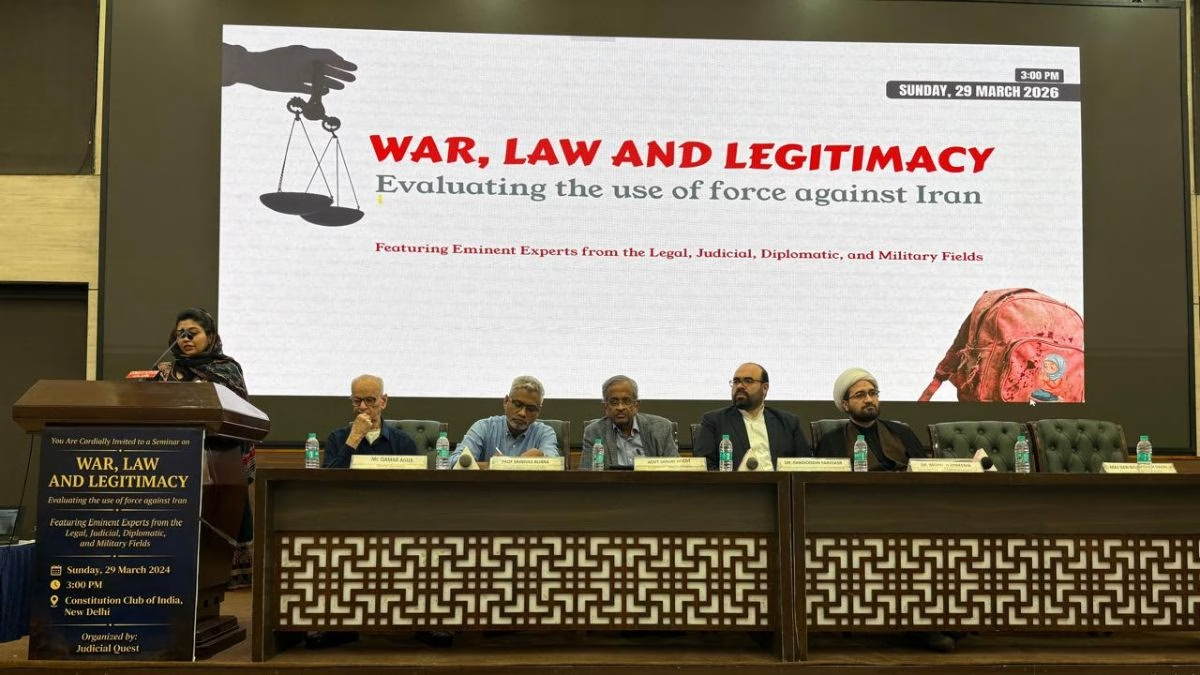
“Preemptive War against Iran Has No Place Under International Law”: Senior advocates, academics, diplomats and military experts decry selective enforcement of global norms, civilian casualties and erosion of diplomacy.
New Delhi [India], March 31: A high-level seminar titled “War, Law, and Legitimacy: A Legal Examination of the Use of Force Against Iran” was held today at the Constitution Club of India, organised by Judicial Quest. The event featured a panel discussion with distinguished speakers including Supreme Court Senior Advocate Sanjay Hegde, Prof. Srinivas Burra (South Asian University), senior journalist Qamar Agha, Dr. Faridoddin Faridasr (Cultural Counsellor, Iran Embassy), Maj. Gen. Bishamber Dayal (Retd.), and Dr. Mohammad Hossein Ziyaeenia, Deputy to the Representative of Iran’s Supreme Leader in India, followed by an interactive session with the audience.Prof. Anumeha Mishra, Faculty of Law, Delhi University, moderated the panel discussion, while Saira Mujtaba, news anchor with All India Radio, anchored the entire programme.The seminar was attended by a diverse gathering of students, social activists, professors and legal professionals, including Anas Tanvir, Senior Advocate, Supreme Court of India; Hyder Zaabit, renowned scholar; Mahdi Baqir; Jawed Habib and many others. Renowned journalist Ali Abbas Naqvi was also present.Convenor Advocate Ali Taher Abidi, Editor-in-Chief, Judiciary Quest and Coordinator Syed Zaki Zaidi, geopolitical consultant and former researcher were also shared their thoughts about this issue
Concept and Key Concerns
The concept note highlighted urgent questions regarding the integrity of international law — specifically the legal framework governing the use of force, protection of civilians, and the role of diplomacy in preventing armed conflict. It expressed deep concern over military operations continuing during active diplomatic negotiations, warning that such actions risk undermining binding legal norms and eroding the credibility of diplomacy itself. The discussion aimed to examine whether established principles of international law are being upheld in the current situation and what these developments mean for the future of the rules-based global order. The seminar concluded with a formal resolution reflecting the participants’ concerns on the legality of the use of force, the conduct of hostilities, and the erosion of diplomatic norms.
Powerful Voices from the Panel
Senior Advocate Sanjay Hegde, Supreme Court of India, stated: “World order depended on big States being altruistic hegemony. The Israel-US attack on Iran does not comply with Article 2(4) of the UN Charter or with the rules of International Humanitarian Law. Preemptive war against Iran is not permissible under International Law.”
Prof. Srinivas Burra, South Asian University, observed: “It is difficult to justify this war from International law standards. Article 2(4) has been violated the most by the West. Despite all the problems with International law, the weaker states can rely on International legal order to frame their narrative.”
Dr. Faridoddin Faridasr, Cultural Counsellor, Iran Embassy, highlighted the human suffering and double standards:“This kind of programme holds deep importance. We see how, amidst peaceful talks, war was started… how innocent children were killed in Iran… and yet at the international level, efforts are being made to blame Iran. This is being done only to suppress the Epstein file. Israel and America have no accountability; they attack anyone… 498 schools were targeted. When we talk about harming neighbouring countries, Israel has caused harm to its neighbours. Now the world should abandon double standards, raise its voice against the oppressor, and stand with justice.”
Senior journalist Qamar Agha pointed out: “The objective of this war is to capture the region’s oil, as we saw in Venezuela. Countries in the region should not allow external powers to dictate their foreign policy.”
Dr. Mohammad Hossein Ziyaeenia, Deputy to the Representative of Iran’s Supreme Leader in India, thanked the organisers for providing a platform to discuss this technical subject. Before his address, two videos from Minab School were screened, leaving the audience emotional as they witnessed the plight of innocent school children. Pointing to the videos, Dr. Ziyaeenia described the cruelty of the invaders to Iran: “The assassination of the Supreme Leader of the Islamic Republic of Iran, Aytollah syd Ali Khamenei, in his office – which is a place known to everyone – is a cowardly act. He was martyred while fasting and reciting the Holy Quran, next to his family. The first young martyrs of this imposed war were the grandson and granddaughter of the Supreme Leader, both under the age of seven. But the subsequent attack on the Shajare Tayyiba Girls’ Elementary School in Minab, and the killing of more than 175 innocent students, in two attacks 20 minutes apart, shows the level of cruelty and savagery of the enemies attacking Iran.” Lastly, he addressed issues of sovereignty and civilian protection during ongoing conflicts, emphasising the importance of upholding international legal norms. He urged international organisations such as the UN and UNESCO to fully commit to their charters.
Maj. Gen. Bishamber Dayal (Retd.) stressed the need for dialogue over force: “The people of Iran have shown what they want. Are we going 4-5 hundred years back… where any country can be occupied by force? Iran has shown its strength; it has surprised America, Israel and the whole world with its power. If someone has a problem with another, it should be resolved through talks, not war. War is no solution. You cannot make assumptions that someone will attack us or make nuclear weapons; all these assumptions are also illegal. Everyone should have rights.”
Broader Deliberations and Takeaways
Participants referred to the post-1945 international legal order, the prohibition on acquisition of territory by force, concerns over one-sided narratives, the role of the UN Security Council, and the dangers of double standards in global affairs. Speakers emphasised that, despite its limitations, international law remains a crucial tool for weaker states to challenge aggression and demand accountability. The panel collectively called for strict adherence to Article 2(4) of the UN Charter, rejection of preemptive wars based on speculative threats, and prioritisation of diplomatic solutions over military escalation. In the backdrop of continuing tensions in West Asia, the seminar served as a timely reminder of the fragility of the postwar international legal framework and the need for consistent, impartial application of global norms to preserve peace and sovereignty for all nations.
(The article has been published through a syndicated feed. Except for the headline, the content has been published verbatim. Liability lies with original publisher.)
A former child actor, Sara Arjun was earlier known for films like Ponniyin Selvan, Ek…
Pujarini Pradhan’s videos feel calm and personal, often mixing her own experiences with deep social…
Poonam Pandey, who earlier grabbed attention after a controversial fake death announcement to raise awareness…

