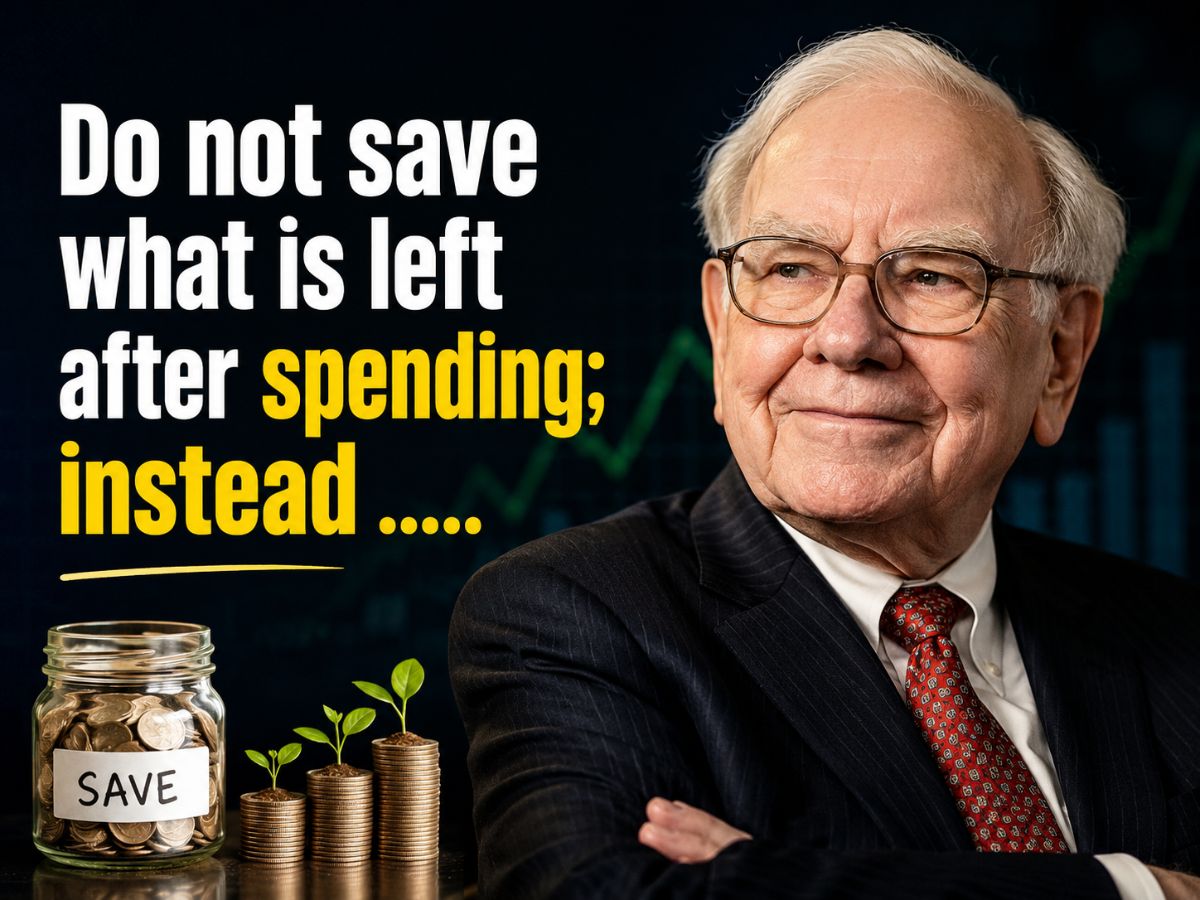
Are you saving what is left at the end of the month? Warren Buffett says you are doing it the wrong way. His simple principle of “pay yourself first, spend later” has helped generations accumulate wealth.
Most people wait until the end of the month to check their bank account balance and see if they can afford to save any money. The catch? By then there’s usually very little left to salvage. And this simple habit may be the number one reason why people struggle to accumulate wealth, according to billionaire investor and chairman and former CEO of Berkshire Hathaway, Warren Buffett. His money management tip is shockingly simple: “Don’t save what’s left after you spend, but spend what’s left after you save.” This one simple sentence rule can change your money game, whether you earn Rs 30,000 or Rs 3 lakh.
Most people think of saving as an afterthought. Money comes in, you pay the bills, you do some online shopping, you enjoy the weekends, and you throw whatever’s left into savings.
Buffett believes the process should work the other way.
Every time you get paid, a set portion should go straight into investments or savings. The money that is left behind is what you can spend. This strategy, often called “paying yourself first,” helps build financial discipline without major lifestyle changes.
The idea isn’t how much you save at first. It’s about making saving part of your daily life.
Let us understand this by a simple example of 2 friends. Let them be Sonia and Aman. Assume both are friends and each is earning a monthly income of Rs 50,000.
Sonia spends freely throughout the month and tries to save whatever is left over in the end. Some months she saves Rs 5,000, some months she does not.
On the other hand, Aman invests Rs 5,000 in a mutual fund SIP the day his salary comes in. He has 45,000 rupees left to plan his monthly expenses.
Fast forward 5 years: Aman has amassed a sizeable corpus of investments, while Sonia is still wondering why her savings account is never growing.
Their difference is not in income. It’s the practice.
Yes, they are.
People delay savings because they consider savings too tiny to make differences, while Buffett has a distinct view towards investment based on tiny sums.
The secret is the discipline. You may begin investing small amounts from Rs 2000 to Rs 3000 per month, but with the power of compounding, it grows to enormous proportions in years and decades.
The longer you let your money invest, the more it earns.
Saving is just the first step. Buffett has repeatedly warned that cash sitting idle can lose its value over time because of inflation. The simple advice he gives most investors is to invest consistently in low-cost index funds and hold for the long term.
As Buffett famously said in 2017, “Consistently buy an S&P 500 low-cost index fund.” He added, “Keep buying it through thick and thin, and especially through thin.”
The point is simple: building wealth usually requires patience and consistency, not chasing the next hot stock.
It is difficult to build wealth when a large portion of income goes to paying interest on debt. Buffett has long-expressed caution about borrowing too much and high-interest credit card debt. Debt works in the opposite direction, eating into future income. Saving and investing help money grow.
Aggressively investing is something to think about after you’ve paid down expensive debt.
Buffett says that one of the best investments you can make is not in stocks or mutual funds. Develop your communication skills, and educate yourself further, and you’ll increase your ability to make money exponentially.
You can’t lose these assets like you can lose money.
Warren Buffett’s advice is not to get rich overnight. It’s about creating a system that saves you by default and spends accordingly. And the goal is simple: put your future as a money priority, not an afterthought.
It doesn’t matter whether you save Rs. 3,000 or Rs. 30,000 a month. The most important thing is that you save. Start today, save consistently, and invest wisely while you let time work for you.
That one change, if implemented correctly, can separate pay cheque-to-pay cheque living from financial security for many people.
(Disclaimer: This article is for informational purposes only and should not be considered investment advice. The views, opinions, and recommendations expressed herein are those of the respective experts. Readers are advised to consult a qualified financial advisor before making any investment decisions.)
Also Read: Can Rs 100 A Day Make You A Crorepati? The SIP Math Tells The Story
Priyanka Roshan is a business writer and assistant editor at the NewsX website who tracks everything from stock market swings and corporate earnings to personal finance trends and policy shifts. Known for turning fast-moving business developments into sharp, reader-friendly stories, she combines speed, accuracy, and a data-driven approach to break down complex financial news for everyday audiences.
With over 9.5 years of newsroom experience, Priyanka has worked with leading media organisations, including Moneycontrol, Times Now, and Ping Digital, covering diverse beats such as business, politics, technology, auto, travel, sports, and the world. From live breaking news desks to SEO-led digital storytelling, she specialises in creating engaging content that keeps readers informed without overwhelming them.
Why Were 94 Sikh Pilgrims Denied Crossing The Attari-Wagah Border?
A 94-member Sikh jatha from Haryana, carrying valid visas to visit Pakistan for Guru Arjan…
Who Was India’s First Nobel Prize Winner? Know the Historic Achievement That Changed History
India's first Nobel Prize came during the colonial era and marked a turning point in…
Most Difficult Treks In The World
The most difficult treks in the world combine extreme altitude, rugged terrain, remote wilderness, and…
