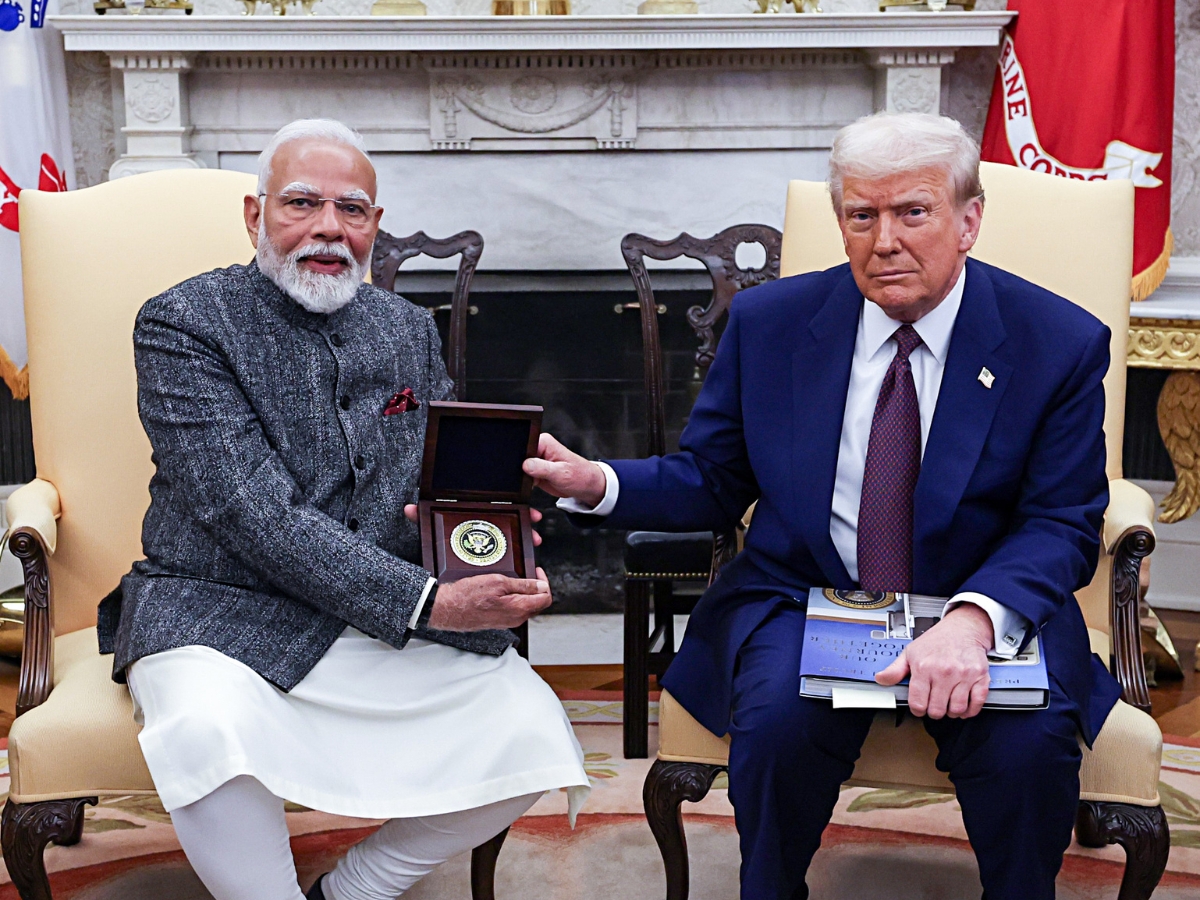
What is the current US tariff on Indian goods after the US Supreme Court struck down President Donald Trump’s earlier tariff regime? Photo: ANI.
A major legal setback to US President Donald Trump’s trade agenda has triggered confusion over tariff rates on Indian exports, just weeks before a proposed bilateral trade agreement is expected to be signed..
In a 6–3 ruling, the US Supreme Court held that Trump exceeded his authority by imposing sweeping tariffs without explicit approval from Congress. Writing for the majority, Chief Justice John Roberts stated that emergency provisions in existing law do not grant the president unlimited power to impose tariffs during peacetime.
Following the ruling, the Trump administration has not clarified what will happen to the billions of dollars already collected from US companies under the now-invalidated tariff regime. While officials have informally and formally suggested that refunds could be issued, neither the administration nor the court has outlined a mechanism for repayment.
Even as the legal fallout continued, Trump moved quickly to maintain tariff pressure. He signed a proclamation imposing a temporary 10% import surcharge on most goods for 150 days, effective February 24, covering imports from about 150 countries.
The administration said the measure was aimed at addressing balance-of-payments deficits and boosting domestic manufacturing, with exemptions included for national interest and economic necessity.
To implement the measure, Trump invoked Section 122, a rarely used provision that allows US presidents to impose tariffs of up to 15% for 150 days without congressional approval.
Despite the court ruling, Trump insisted that the proposed trade arrangement with India remained unchanged.
Speaking on Friday, the US president described bilateral ties as “fantastic” and said India would continue to pay the previously negotiated 18% tariff under the interim framework.
US Trade Representative Jamieson Greer also indicated that policy goals would remain intact despite the legal setback.
“It helped us obtain tons of deals covering half of the world’s population and opening up market access we haven’t enjoyed for 30 years and we have these agreements so we’ll just use a different tool. The tools may change but the policy remains the same and IEEPA was a part of that,” Greer said.
The Supreme Court ruling has created multiple possible tariff scenarios for Indian exports.
Earlier this month, India had negotiated an interim arrangement with the US under which reciprocal tariffs were reduced from 25% to 18%. The agreement, expected to be signed in mid-March, also included the removal of an additional 25% tariff imposed by Trump over India’s purchase of Russian oil, after the US president said New Delhi would halt such imports.
However, the court ruled that Trump could not impose tariffs using the five-decade-old International Emergency Economic Powers Act (IEEPA), effectively eliminating the legal basis for the 18% rate.
If Trump had not announced the new 10% surcharge under section 122, tariffs on Indian goods would likely have reverted to the earlier Most Favoured Nation (MFN) level of about 3.5%.
Trump’s new 10% global tariff order has once again altered the equation. While the president said India would still pay 18%, the White House later clarified that, legally, countries with trade arrangements would temporarily fall under the 10% rate.
“All countries with trade agreements with the US now drop to a 10% tariff rate temporarily,” a White House official said.
Technically, this means Indian exports could face a combined tariff of 13.5%, consisting of the earlier 3.5% MFN duty plus the new 10% surcharge. However, White House has not issued definitive guidance on the final applicable rate.
Certain sector-specific tariffs remain unaffected, including Section 232 duties of 50% on steel and aluminium and 25% on some auto parts, according to a White House fact sheet.
A second possibility remains that the originally negotiated 18% tariff could still apply. According to reports, the Trump administration is exploring alternative legal routes to reinstate the 18% rate agreed with India.
Trump reiterated this position publicly. “Nothing changes; they will be paying tariffs, and we will not be paying tariffs,” he said.
He also praised Indian Prime Minister Narendra Modi while defending the agreement.
“PM Modi is a great gentleman, a great man… India was ripping us off. So we made a deal with India, it’s a fair deal now.”
Zubair Amin is a Senior Journalist at NewsX with over seven years of experience in reporting and editorial work. He has written for leading national and international publications, including Foreign Policy Magazine, Al Jazeera, The Economic Times, The Indian Express, The Wire, Article 14, Mongabay, News9, among others. His primary focus is on international affairs, with a strong interest in US politics and policy. He also writes on West Asia, Indian polity, and constitutional issues. Zubair tweets at zubaiyr.amin
Tecno Camon Slim May Launch Soon With 7,000mAh Battery And 60W Fast Charging
Tecno’s upcoming Tecno camon Slim was spotted on FCC and TUV listings, revealing 8GB RAM,…
The CEE Kerala website faced technical issues and became temporarily inaccessible shortly after the KEAM…
Demi Moore’s Cannes 2026 red carpet appearance sparked viral debate after media praised her toned…
