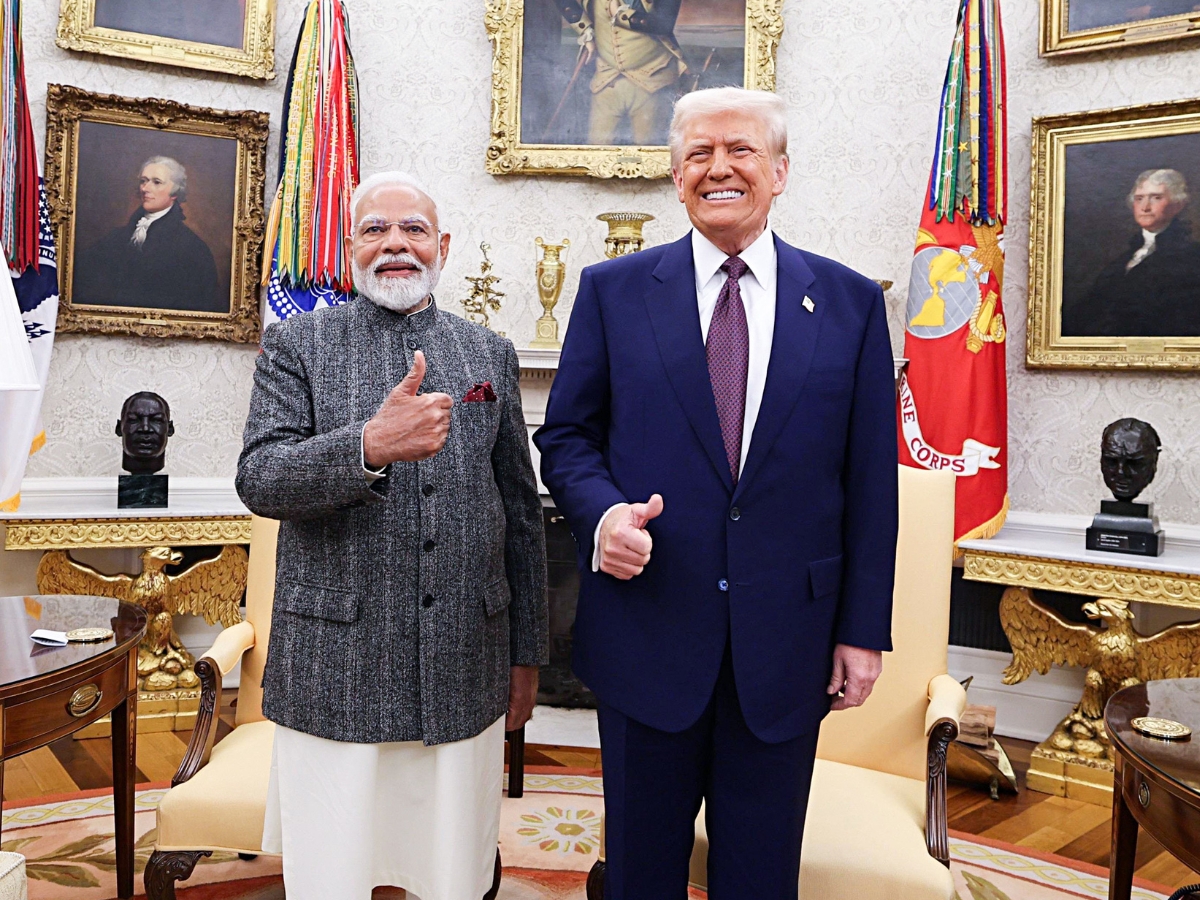
India–US trade deal cuts tariffs, boosts exports, protects farmers, and opens a $30 trillion US market. Photo: ANI.
India and the US have released a joint statement detailing the trade deal announced by US President Donald Trump last week and later hailed by Prime Minister Narendra Modi. Union Commerce and Industry Minister Piyush Goyal described the agreement as a “landmark framework”, saying it opens up access to a USD 30 trillion US market for Indian exporters and has the potential to generate lakhs of jobs, particularly for MSMEs, farmers, and young workers.
One of the most tangible gains for India is the steep reduction in US reciprocal tariffs on Indian exports. The United States has agreed to cut duties from 50% to 18% across several categories.
Until now, the 50% tariff acted as a major barrier, effectively pricing out thousands of Indian businesses from the US market.
Beyond tariff reductions, the joint statement outlines plans for complete tariff elimination in some of India’s strongest export sectors once the interim agreement is fully concluded.
Generic pharmaceuticals, gems and diamonds, and aircraft parts will receive duty-free access to the US market.
According to Goyal, duty-free access for these sectors will “further enhance India’s export competitiveness and Make in India”.
The agreement also deepens cooperation on high-end technology, particularly hardware critical for artificial intelligence and cloud infrastructure. Both sides have committed to expanding trade in graphic processing units (GPUs) and strengthening collaboration on semiconductors and export-control coordination.
The deal places strong emphasis on easing non-tariff barriers. India and the US will coordinate testing standards, certification processes and conformity assessments across mutually identified sectors.
For businesses, this translates into fewer duplicate tests, greater regulatory predictability and faster approval timelines.
India has kept its most politically and economically sensitive agricultural sectors outside the scope of tariff liberalisation. Staples such as wheat, rice, maize, dairy, poultry, and several vegetables remain fully protected.
Goyal said that the agreement “completely protects sensitive agricultural and dairy products”, ensuring rural livelihoods are not disrupted.
The joint statement reveals India has conceded for the deal to materialise.
Of the earlier 50% US tariff on Indian goods, 25% was imposed specifically due to India’s purchases of Russian oil.
A separate order issued alongside the joint statement clarifies that the additional 25% tariff is being revoked only because “India has committed to stop directly or indirectly importing Russian Federation oil, has represented that it will purchase United States energy products from the United States, and has recently committed to a framework with the United States to expand defense cooperation over the next 10 years”.
The order adds that the US “shall monitor whether India resumes directly or indirectly importing Russian Federation oil”, warning that any such finding could lead to “additional action”, including the reimposition of the 25% tariff.
India has consistently maintained that its energy purchases are guided by “market considerations” rather than political alignment and has pointed out that Russian oil imports have already declined sharply in recent months.
India has avoided blanket tariff reductions in agriculture and dairy, sectors it has long treated as livelihood concerns rather than purely trade issues. However, India has allowed certain concessions.
The joint statement lists a “wide range” of US agricultural products that will gain greater access, including dried distillers’ grains (DDGs), red sorghum for animal feed, tree nuts, fresh and processed fruits, soybean oil, wine and spirits.
These categories are unlikely to have a large-scale impact on Indian farming.
From Washington’s perspective, the agreement is anchored in a sharp expansion of exports to India. The joint statement states, “India intends to purchase $500 billion of US energy products, aircraft and aircraft parts, precious metals, technology products, and coking coal over the next 5 years”.
Taken together, the framework delivers substantial market access and tariff relief for Indian exporters, while also extracting commitments from India, on energy sourcing, defence cooperation and import volumes.
Zubair Amin is a Senior Journalist at NewsX with over seven years of experience in reporting and editorial work. He has written for leading national and international publications, including Foreign Policy Magazine, Al Jazeera, The Economic Times, The Indian Express, The Wire, Article 14, Mongabay, News9, among others. His primary focus is on international affairs, with a strong interest in US politics and policy. He also writes on West Asia, Indian polity, and constitutional issues. Zubair tweets at zubaiyr.amin
India has announced zero tariffs on several US products under an interim trade agreement to…
Consortium approaches CM Devendra Fadnavis to push for key School Education Reforms
Mumbai (Maharashtra) [India], February 07: CA Shalesh Ghedia, along with senior SLT (Senior Leadership Team…
From Left to Right: Manas Vora, Rehman Naushad, Uttam Singh, Gurmeet Singh, Bhagirath Bhatt Mumbai…
