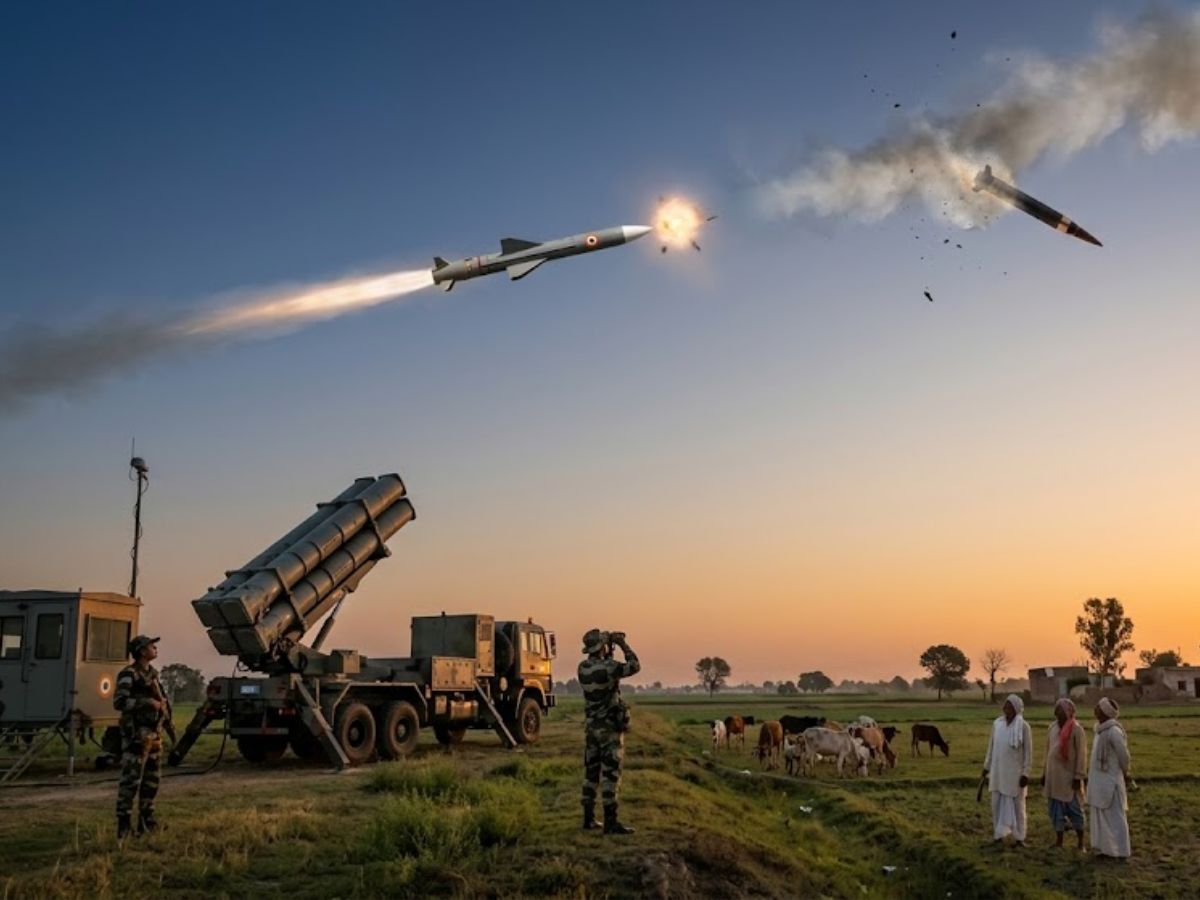
IAF used Barak-8 to intercept Pakistani missile over Sirsa, averting Delhi strike during Operation Sindoor response. Photo: Gemini.
Barak 8: India is mourning the Pahalgam terror attack that took place last year on April 22. However, ne details about India’s response – Operation Sindoor – are emerging now including how Indian Air Force (IAF )averted a major missile strike on the national capital – Delhi – using Barak-8 surface-to-air missile system,. According to reports, IAF intercepted a Pakistani ballistic missile over Haryana before it could reach its suspected target, Delhi. The missile is reported to be from Pakistan’s Fateh or Shaheen series. The interception was carried out by an Indian Air Force (IAF) unit stationed at Sirsa.
The operation was reportedly led by Air Commodore Rohit Kapil, Air Officer Commanding (AOC) of 45 Wing.
The missile was intercepted using the Barak-8 surface-to-air missile system.
Debris recovered from Sirsa in the days following the interception confirmed the magnitude of the threat, with visuals widely circulated at the time.
For his leadership during Operation Sindoor, Air Commodore Kapil was awarded the Yudh Seva Medal in 2025 by President Droupadi Murmu.
Air Commodore Kapil was commissioned into the IAF’s Flying Branch on June 20, 1998, as part of the 161 Course, according to various reports. A fighter pilot by training, he specialises in the Su-30MKI multirole aircraft and has logged over 3,500 hours of operational flying across multiple aircraft types, reports added.
He is a Category ‘A’ Qualified Flying Instructor and has trained successive generations of pilots. He has also completed the Advance Command and Staff Course in the United Kingdom, equipping him with advanced strategic and operational expertise.
The Sirsa interception has since emerged as a defining example of India’s evolving air defence architecture. The government is now working to expand nationwide air defence system under the Sudarshan programme.
The proposed multi-layered shield will integrate existing and advanced systems, including Russian S-400s, Barak-8 MRSAM, and the indigenous Project Kusha interceptor system, to protect cities, strategic assets, and infrastructure from drones, cruise missiles, and hypersonic threats.
On the eve of the Pahalgam attack anniversary, the Indian Army issued a strong message to Pakistan on X, stating, “When boundaries of humanity are crossed, the response is decisive.”
The message was accompanied by a digital poster featuring a silhouetted map of India and the caption, “Some Boundaries should Never Be Crossed.”
FAQs:
Q1: What is the range of Barak 8 defence missile system?
Ans: 100-150 Kms.
Q2: Who designs and produces Barak 8?
Ans: Barak-8 is a joint collaborative air defence system by India and Israel.
Q3: How many Barak 8 missiles India does possess?
Ans: According to reports, India has 5 regiments of Barak-8 for the Army and 9 squadrons for the Air Force.
Zubair Amin is a Senior Journalist at NewsX with over seven years of experience in reporting and editorial work. He has written for leading national and international publications, including Foreign Policy Magazine, Al Jazeera, The Economic Times, The Indian Express, The Wire, Article 14, Mongabay, News9, among others. His primary focus is on international affairs, with a strong interest in US politics and policy. He also writes on West Asia, Indian polity, and constitutional issues. Zubair tweets at zubaiyr.amin
Bandar Box Office Collection Day 2: Bobby Deol’s Film Sees Big Jump Despite Limited Screens
Bandar may have opened to modest numbers at the box office, but the Bobby Deol-led…
Vaibhav Sooryavanshi, India's 15-year-old batting sensation, made history after earning his maiden T20I call-up for…
Samosa, Jalebi, Vada Pav Banned In India? Here's The Truth
Are Samosa, Jalebi And Vada Pav Being Banned? Know the truth behind the viral claims…
