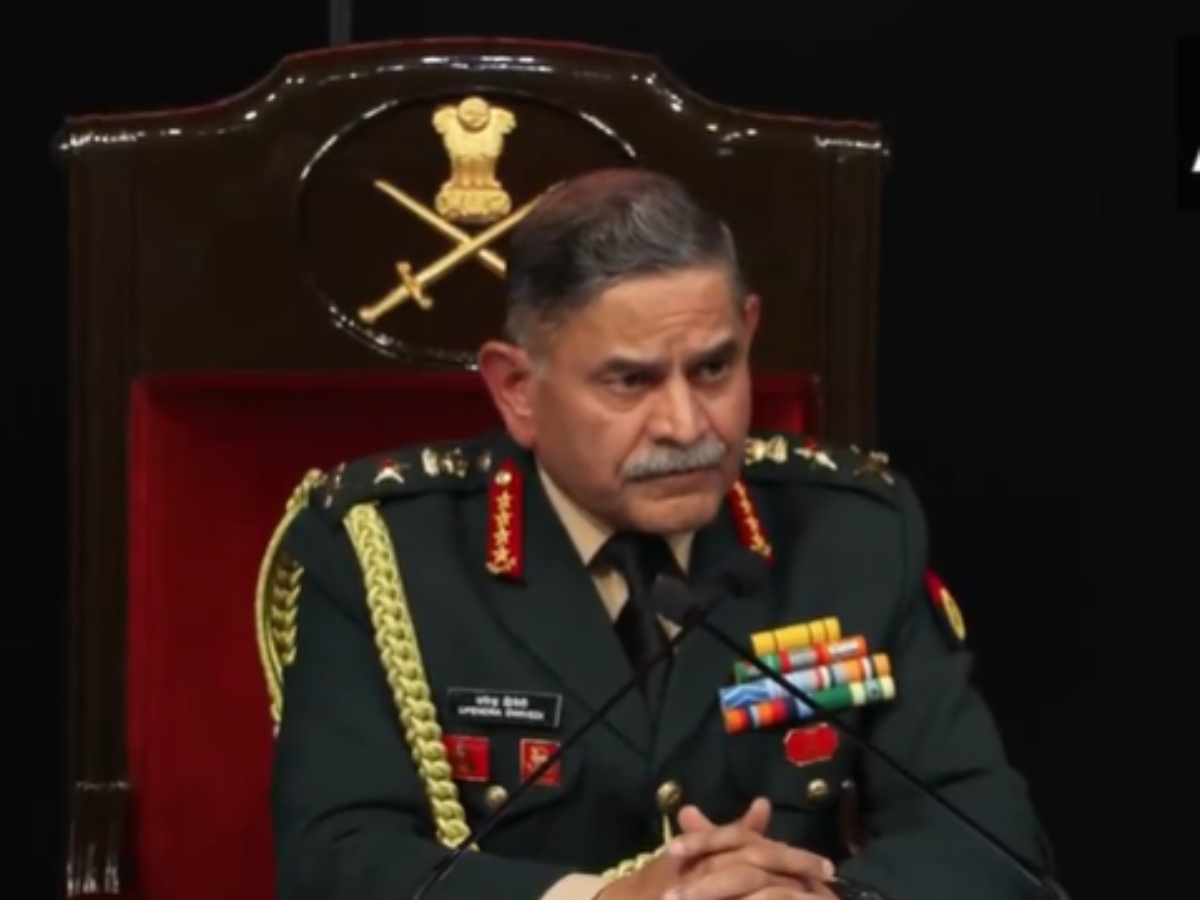
Army Chief Upendra Dwivedi Addresses Press Conference on Operation Sindoor. Photo: ANI.
Chief of Army Staff General Upendra Dwivedi on Tuesday said that Operation Sindoor, carried out in response to the ghastly 2025 Pahalgam terror attack, was the best example of “tri-service synergy under clear-cut political directive”. While addressing the annual press conference in the capital, he said the Armed forces had complete freedom to “act or respond” during Op Sindoor.
“Operation Sindoor was the best example of tri-service synergy under clear-cut political directive and full freedom to act or respond,” General Dwivedi said, adding that the military response operation remains ongoing.
General Dwivedi also said the Indian Army had mobilised its troops during Operation Sindoor and was “fully prepared” for ground operations if Pakistan “made any mistake”.
He asserted that any future misadventures will be “resolutely responded to”.
“As you may be aware, Operation Sindoor remains ongoing, and a future misadventure will be resolutely responded to. I must acknowledge the proactive role of all stakeholders at the national level, including CAPFs, Intelligences, civic bodies, state administration, and other ministries, whether it’s MHA, Railways, and many more,” General Dwivedi added.
The Army chief said that the Operation Sindoor reset strategic assumptions by striking deep, dismantling terror infrastructure, and puncturing the longstanding nuclear rhetoric.
“Following the Pahalgam terror attack, a clear decision to respond decisively was taken at the highest level.
Operation Sindoor was conceptualised and executed with precision. Through 22 minutes of initiation on May 7 and an orchestration that lasted 88 hours up to May 10, the operation reset strategic assumptions by striking deep, dismantling terror infrastructure, and puncturing the longstanding nuclear rhetoric,” General Dwivedi said.
“The Army successfully destroyed seven out of the nine targets and thereafter played a pivotal role in ensuring a calibrated response to Pak actions,” he added.
General Dwivedi further pointed out the growing armed conflict across the globe and said that “nations that stay prepared prevail.”
“The past year saw a sharp rise in the number and intensity of armed conflicts worldwide. These global shifts underline a simple reality. Nations that stay prepared prevail. In this backdrop, Operation Sindoor, India’s calibrated and resolute response to cross-border terrorism, demonstrated our readiness, precision, and strategic clarity,” he said.
He assured that the Indian Army remains satisfied with the progress it made in 2025 through various initiatives under “Jointness, Atmanirbharta, and Innovation”.
“Through our various initiatives, as part of ‘JAI’, that is, Jointness, Atmanirbharta, and Innovation, a clarion call given by the Prime Minister in September 2025, a year of reforms given by the Raksha Mantri in January 2025, and the Indian Army’s own decade of transformation. We can be justifiably very satisfied with the progress made during the year 2025,” General Dwivedi said.
COAS said that the situation along the Western Front as well as Jammu and Kashmir since May 10, after India launched Operation Sindoor targeting nine terror outfits deep in Pakistani territory, remains “sensitive but firmly under control”.
While addressing a press conference here, he said that there was a clear indication of positive change in Jammu and Kashmir as the number of terrorist recruitments in 2025 remains almost “non-existent”.
General Dwivedi informed that 31 terrorists were eliminated in 2025. 65 per cent of them were of Pakistani origin, he added.
“Since May 10, the situation along the Western Front and J&K remains sensitive but firmly under control. In 2025, 31 terrorists were eliminated, of which 65 per cent were Pakistan origin, including the three perpetrators of the Pahalgam attack neutralised in Operation Mahadev. Active local terrorists are now in single digits,” the Army chief said.
“Terrorist recruitment is almost non-existent, with only 2 in 2025. Clear indicators of positive change in J&K include robust development activity, the revival of tourism, and the peaceful Sri Amarnath Yatra, which saw more than 4 lakh pilgrims, exceeding the five-year average. The theme of terrorism to tourism is gradually taking shape,” he added.
General Dwivedi also apprised about a security grid comprising the Assam Rifles, the Army, and the Home Ministry, working to insulate the Northeast from the “spillover effects” of events unfolding in Myanmar.
“In response to turbulence in Myanmar, a comprehensive multi-agency security grid comprising Assam rifles, the Army, and Home Ministries is working towards insulating the Northeast from spillover effects. With the successful conduct of phase two elections in Myanmar, we should be able to engage each other more effectively now,” he said.
The Army chief said that the situation along the Northern Front remains “stable but needs constant vigil”.
“The situation along the Northern Front remains stable, but needs constant vigil. Apex-level interactions, renewed contact, and confidence-building measures are contributing to the gradual normalisation of the situation that has also enabled grazing, hydrotherapy camps, and other activities along the Northern Borders,” he said.
“With our continued strategic orientation on this front, our deployment along the Line of Actual Control remains balanced and robust. Concurrently, capability development and infrastructure enhancement are progressing through a whole-of-government approach,” he added.
General Dwivedi said that the situation in Manipur has witnessed “marked improvement” due to many proactive government initiatives.
“As regards the Northeast, neutral, transparent and decisive action by security forces, along with many proactive government initiatives, has led to a marked improvement in the situation in Manipur during 2025. Peaceful conduct of the Durand Cup, resumption of cultural festivals and renewal of suspension of operations, that is, SoO, with Kuki insurgent groups in September 2025, have been key markers of stability,” he said.
He further said that the Army operated across two neighbouring countries and 10 states with regard to the Humanitarian Assistance and Disaster Relief (HADR), and rescued over 30,000 people.
“As regards the HADR, the Army operated across two neighbouring countries and 10 states. It rescued over 30,000 people, and during the Punjab floods in Pathankot, some of you would recollect the daring rescue of the CRPF personnel by an Army aviation helicopter from a collapsing building,” General Dwivedi said.
“In the border states, the Army was able to act even before formal requests were received from states. These three affirm our role as the natural first responder during HADR crisis,” he added.
(With inputs from ANI)
Zubair Amin is a Senior Journalist at NewsX with over seven years of experience in reporting and editorial work. He has written for leading national and international publications, including Foreign Policy Magazine, Al Jazeera, The Economic Times, The Indian Express, The Wire, Article 14, Mongabay, News9, among others. His primary focus is on international affairs, with a strong interest in US politics and policy. He also writes on West Asia, Indian polity, and constitutional issues. Zubair tweets at zubaiyr.amin
Online video content features panicked travelers pressing around information boards and airlines offices to seek…
The governments in the Gulf have shut down their airspace, and most airlines canceled flights…
The lack of verification of their deaths highlights the subjective nature of the intensifying war,…
