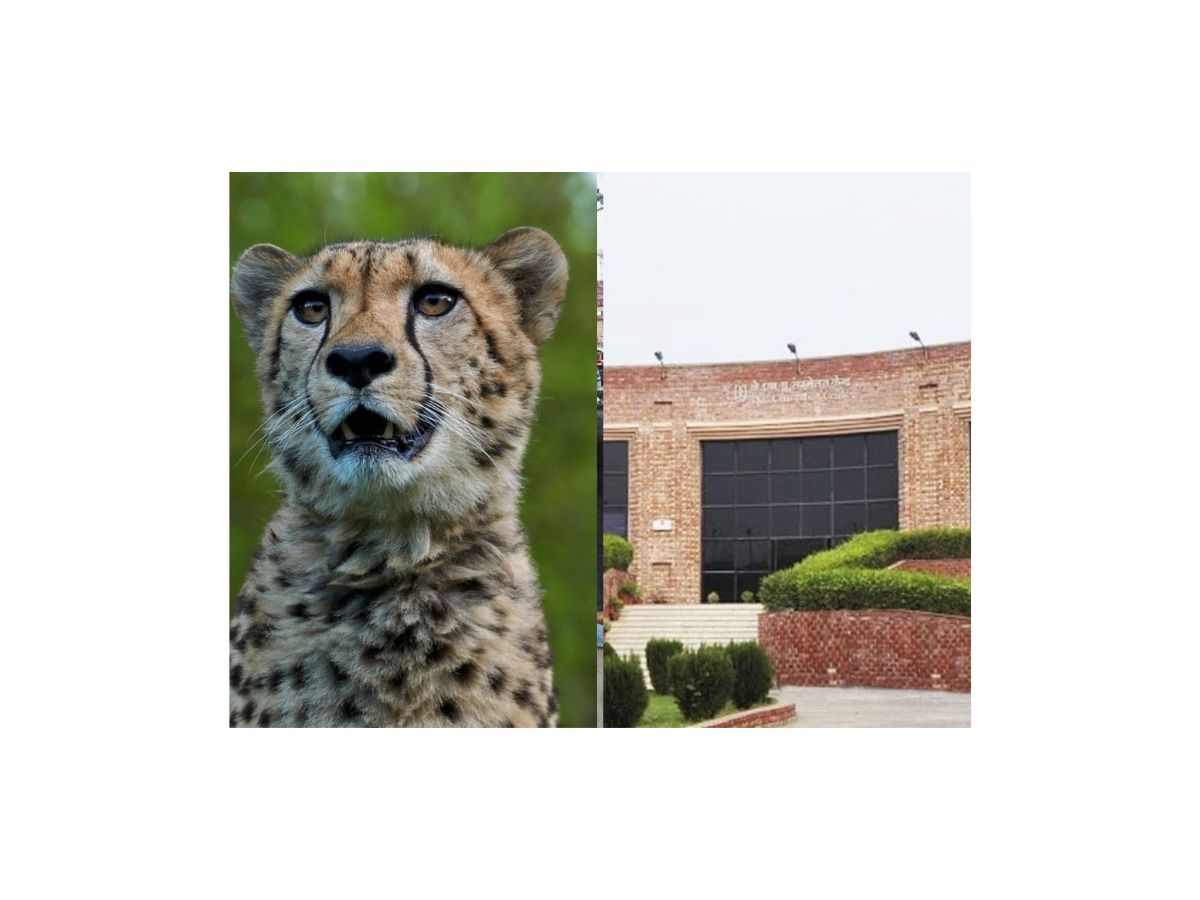
Is A Leopard Sighted In JNU? A Student’s Claim Sparks Panic In The Campus (Source - PIB, JNU)
A student claimed on Saturday that he had spotted a leopard near Aravalli Guest House in the Jawhar Lal University. He encountered the incident while feeding stray dogs and cats. He immediately alerted the university administration and security personnel.
His claim led to panic on the campus. However, forest department officials have ruled out the presence of the leopard following spot verification, officials said.
JNU officials added that forest officials did not confirm the presence of the big cat in JNU after conducting spot verification, ANI reported.
Initially, it was suspected that the animal was present on the campus. The forest department officials reached the university. After observing the footprints, forest officials confirmed that no leopard was present on the campus and subsequently left the spot.
Last year, on February 29th, Union Minister for Environment, Forest and Climate Change, Bhupender Yadav, released the report on the Status of Leopards in India.
As per a PIB release, India’s leopard population is estimated at 13,874 (Range: 12,616-15,132), representing a stable population in comparison to the similar area being sampled in 2018 with 12852 (12,172-13,535). This estimate represent population of 70% of leopard habitat, the Himalayas and semi-arid parts of country which are not tiger habitat were not sampled.
Madhya Pradesh houses the largest population of leopards in the country – 3907 (2018: 3421), followed by Maharashtra (2022: 1985; 2018: 1,690), Karnataka (2022: 1,879; 2018: 1,783) and Tamil Nadu (2022: 1,070; 2018: 868). Tiger Reserves or sites with the highest leopard population are Nagarajunasagar Srisailam (Andhra Pradesh), followed by Panna (Madhya Pradesh), and Satpura (Madhya Pradesh).
iPhone 18 Pro Max is expected to launch around September 2026 with a similar price…
NEET UG 2026 was rated moderate and slightly easier than last year, with Physics and…
Can women delay their menstrual cycle or extend fertility? Chinese scientist Hongmei Wang is exploring…
