'The Day Democracy Paused': 49 Years Since India’s Emergency Began, What Are Some Commonly Asked Questions
On June 25, 1975, India witnessed a shocking news that Prime Minister Indira Gandhi declared a state of emergency under Article 352 of Indian Constitution.
The darkest days of India continued from 1975 to 1977 as the emergency continued for 2 years. These toughest 21 months led to the subversion of all democratic institutions, Fundamental rights of citizens were suspended, press had to face censorship, opposition leaders were arrested and put in jail for protesting and voicing against the government’s emergency order. One of the major setbacks was the crackdown on opposition parties in India. However, after 21 months the national emergency was lifted and Indira Gandhi lost when general elections were held in 1977 and later Morarji Desai came to power.
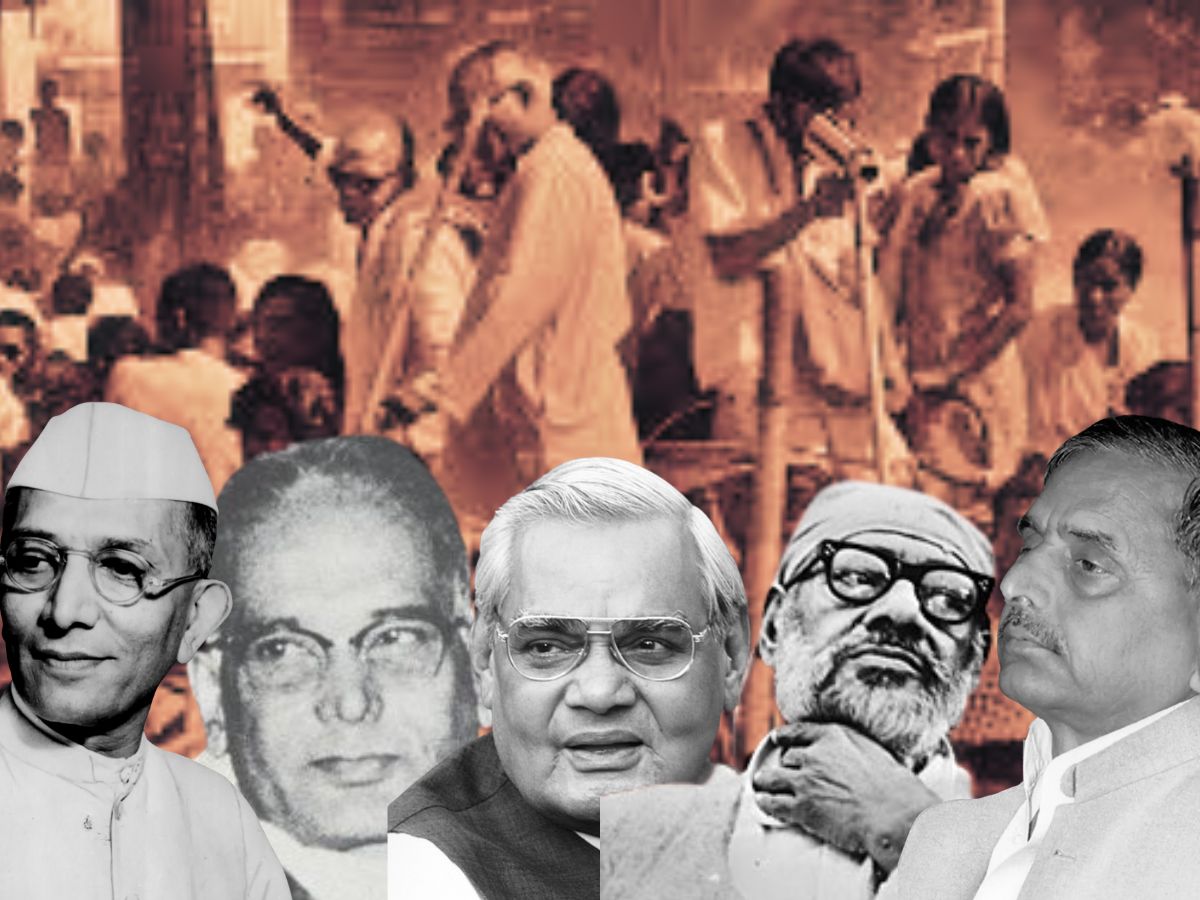
Raj Narain, Jayaprakash Narayan,Morarji Desai, Lalu Yadav, and Atal Bihari Vajpayee, are among those opposed to the brutalities of India’s darkest years.
As India commemorates 50 years of national emergency, let us have a closer look at the leaders who opposed national emergency. They not just opposed the Indira government but emerged as the strongest ever after.
The most popular face of Indian politics. Raj Narain defeated Indira Gandhi by a margin of 52,000 votes in the 1977 Lok Sabha elections from Rae Bareli. Prominently, before that, in 1971 elections he had lost to her but subsequently petitioned the Allahabad High Court on charges of electoral malpractice.
In 1975, the court gave its verdict in Narayan’s favour, holding that Indira Gandhi’s election was void and disqualified her from being in public office for 6 years. This judgment created a political crisis, and the Emergency was imposed.
Morarji Desai was considered one of Gandhi’s main rivals during the Emergency. He became Prime Minister after the Janata Party’s victory in the 1977 elections by defeating the much celebrated Indira Gandhi. He further introduced constitutional amendments to prevent the future misuse of Emergency powers. He reversed many of Indira Gandhi’s Emergency era decisions.
Those who know Indira Gandhi will definitely know about the era of Morarji Desai and that is how Indian politics was built.
Commonly referred to as JP or Loknayak, Jayaprakash Narayan was the loudest critic of the Emergency imposed by Indira Gandhi in 1975. JP spearheaded the ‘Total Revolution’ movement in India. He was put behind bars for his resistance against the Emergency and is known as the father of the JP Movement. JP was also instrumental in establishing the Janata Party in 1977.
During emergency time, Atal Bihari Vajpayee was jailed for 18 months. He strongly condemned Prime Minister Indira Gandhi’s move in his poetry. As the Emergency ended in 1977, he became Foreign Minister under the Janata Party government with Morarji Desai’s leadership.
The National Emergency was a turning point in Lalu Yadav’s political career. He was jailed during this darkest era and had continued in prison until 1977. His daughter Misa Bharti was born during those years and she was interestingly named after the MISA Act (Maintenance of Internal Security Act) under which he was kept in jail.
Advani, one of the co-founders of BJP was also imprisoned under the Emergency for raising his voice against the policies of the government. He was a major political figure in breaking Congress’s stronghold in Gujarat in June 1975. Eventually he emerged as a leading figure in oppositional politics.
The former General Secretary of the Communist Party of India (Marxist) Sitaram Yechury was detained in 1975 when he was a Jawaharlal Nehru University (JNU) student. He went underground before his detention to mobilise opposition against national Emergency. Later he became the President of the JNU Students’ Union three times between 1977 and 1978. Sitaram Yechury died on September 12, 2024.
Mulayam Singh Yadav, who is the founder of Samajwadi Party, was also jailed during the Emergency period. After the tension years, he served as the Defence Minister of India and was the Chief Minister of Uttar Pradesh for many times. He was a major part of Janata Party formed after Indira’s Emergency declaration and was fondly known as ‘Netaji’ by his supporters.
George was one of the strongest critics of the Emergency. He organized a number of protests against the Indira government. Even though he went underground for a while during the 1975 emergency, he was finally arrested in June 1976. Later George fought the 1977 Lok Sabha elections from jail and captured the seat at Muzaffarpur in Bihar by a landslide margin.
Nitish Kumar, the known face in today’s politics was also the then Bihar Chief Minister. He was detained on the night of June 9-10, 1976, during the Emergency. Later with George Fernandes Nitish co-founded the Samata Party in 1994. The party merged with Janata Dal (United) in 2003.
The founder of the Lok Janshakti Party (LJP), Ram Vilas Paswan, was also jailed during the National Emergency. He created a world record in the 1977 Lok Sabha polls by winning the Hajipur seat with a record margin of 4.25 lakh votes and it marked as one of the largest margins in electoral history.
Sofia Babu Chacko is a journalist with over five years of experience reporting on Indian politics, crime, human rights, gender issues, and stories about marginalized communities. She believes journalism plays a crucial role in amplifying unheard voices and bringing attention to issues that truly matter. Sofia has contributed articles to The New Indian Express, Youth Ki Awaaz, and Maktoob Media. She is also a recipient of the 2025 Laadli Media Awards for gender sensitivity. Beyond the newsroom, she is a music enthusiast who enjoys singing. Connect with Sofia on X: https://x.com/SBCism
A powerful 7.6 magnitude earthquake struck near the Pacific island nation of Tonga, triggering tsunami…
Maa Kalratri: The seventh day of Chaitra Navratri, dedicated to Maa Kaalratri, is being observed…
Drones targeted a fuel tank at Kuwait International Airport, causing a fire but no casualties,…
