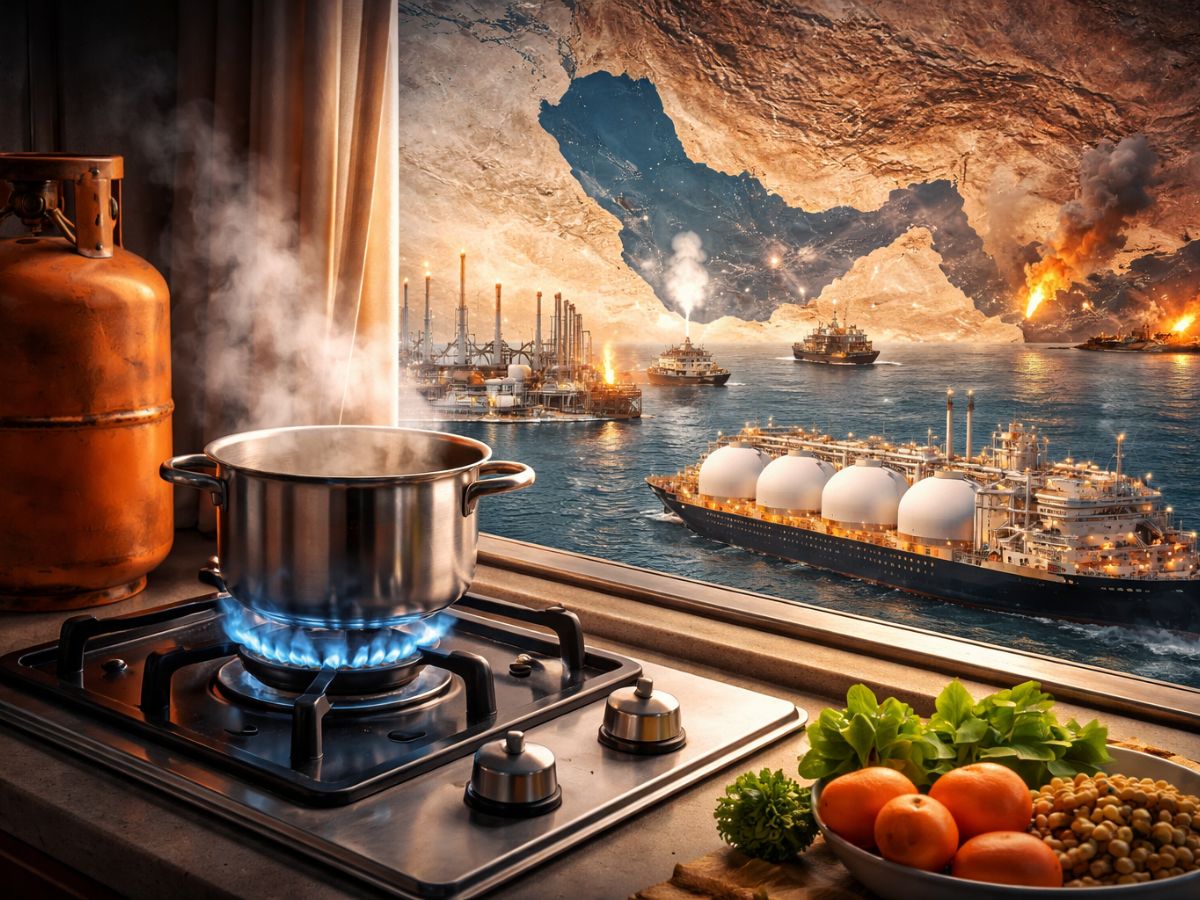
Where Does Piped Gas Come From and Will It Run Out? (Image: AI generated)
India relies heavily on gas supply for use throughout its urban centers and in order to create meals at home; however many people may be unaware that the ‘blue flame’ coming from the cooker is generated using CNG sourced from either underwater or underground locations (Many of Which are in Conflict Zones). Currently, global conflicts and supply-chain challenges have created uncertainty as it pertains to where the gas we consume comes from, whether or not it will exist within our planet’s lifetime
India receives its gas primarily from production of Domestic Natural Gas and from imported LNG. Domestic production in KG has produced much of India’s current NG supply but India also imports additional LNG from many Countries (such as Qatar and USA) to be used as Fuel for Industrial, Energy Production and transportation purposes.
The LPG crisis in India has created significant challenges for the country’s energy security by relying on one main import route for gas from abroad – through the vulnerable Strait of Hormuz in the Middle East. Much of India’s liquefied natural gas (LNG) is stored and transported via this route. The supply chain for LNG is particularly fragile when there are tensions in the region (most notably because of the ongoing conflict with Iran).
If shipping routes are disrupted or insurance costs rise due to tensions with Iran during times of conflict, it can slow down or delay shipments of gas to India. This does not necessarily mean gas stops being delivered to India completely, they are simply unable to be delivered on a regular basis, creating a gap between supply and demand for gas. When there is a gap between supply and demand for gas in India due to transportation issues, it creates pressure on India’s energy security because the demand for gas in India is extremely high and continuous.
The piped gas (PNG) network in India relies heavily on steady imports of LNG to help meet the ongoing demands for both domestic and industrial users of gas in India; imported LNG must first be delivered to India as a liquid and then converted back into gaseous form at re-gasification facilities, after which it is delivered via pipelines to consumers throughout the country.
A lot of people may not know about the journey of their cooking gas from the source to their kitchens. There is some production, such as in the KG Basin, but that alone will not suffice to satisfy our needs. As such, we import approximately 60% of the LPG we use daily, and we also are extremely reliant upon imports of Natural Gas also.
When it comes to the actual movement of the gas we use for cooking, we are still reliant on imports. This imported gas is moved on large vessels as either Liquid Natural Gas (LNG) or Liquified Petroleum Gas (LPG), and these vessels then offload the LNG or LPG at various terminals in India, such as Dahej or Kochi. These terminals are then used by companies like Petronet LNG Limited to convert the LNG or LPG back into a gaseous form and to distribute it through their pipeline system.
Any delays or disruptions along any part of this chain can result in an immediate tightening of supply. Therefore, if there is any news or talk regarding conflict in the Gulf region, it will ultimately have ripple effects within the industrial cooking gas supply system in India.
Natural gas is produced in India but not at a level sufficient to satisfy current use. Resources such as the KG Basin have reduced dependence on foreign sources of natural gas, but this resource has not been able to keep up with usage.
Industry, electricity generation and transportation systems are growing much more rapidly than domestic supply. Therefore, Lng is being imported to satisfy any deficiencies. As a result, global events – and even those on the other side of the globe – will have an immediate impact on the availability and price of natural gas in India.
If imports were to be significantly reduced, the government would initially protect residential households. Therefore, the first users of any import cutbacks, based on previous experience, would be industrial, thus causing factories, hotels and commercial businesses to be impacted first before household users.
There is also an economic risk of natural gas running out; however, there is also an economic risk of becoming too expensive and being unable to physically transport it. In reference to shipping over the Strait of Hormuz, it is a choke point to energy; where the majority of LNG and oil is transported.
If shipping were to become slow or difficult through this area, the immediate impact would be an international price increase due to supply shortages, and even if supply of natural gas continues; residential households may not have any shortages of natural gas, and industrial businesses, may require limited access to natural gas or pay a higher price for natural gas.
Recent events in the world of supply chain disruptions will show the speed with which supply chains react. Supply chain-based disruptions lead to the delay or rerouting of all supply chain-based goods. Tankers will be delayed, Insurance will increase due to the increase in freight charges. All of this will eventually become involved in domestic pricing.
The short answer is NO. Gas is not likely to disappear, however, it is likely the system will become stressed.
India has long term contracts for supply and pressure from suppliers like Qatar with which they have long-term contracts have given some element of long-term stability for India. Additionally, Domestic source of gas continues to meet demand. However, the real issue is flexibility of the system as compared to the gas.
Gas cannot be readily rerouted or stored as oil can be and there is a significant difference between supply and demand of gas, therefore even short term interruptions will create immediate pressure within the supply chain. For this reason many governments will respond to interruptions in the Supply Chain by prioritising households for piped gas services and speeding up pipeline expansion and diversifying the sources of gas.
The LPG crisis will also highlight the larger energy shift in the Indian Energy Story. India is looking to increase domestic supplies of natural gas, expedite expansion of its natural gas pipeline system, and assist in the transition to using cleaner fuels (PNG, CNG, etc.).
Until domestic natural gas production is going to remain dependent on the global natural gas market and; therefore, will continue to be impacted by geopolitical activities, including the unresolved geopolitical tension in the Middle East, will continue to adversely impact the fuel supply used for cooking and industrial use.
Khalid Qasid is a media enthusiast with a strong interest in documentary filmmaking. He holds a Master’s degree in Convergent Journalism from AJK MCRC. He has also written extensively on esports at Sportsdunia. Currently, he covers world and general news at NewsX Digital.
The finale reveals a deadly soulmate curse where belief determines survival, leading to a shocking…
Elon Musk unexpectedly joined a high-level call between Donald Trump and Narendra Modi on the…
PSL 2026: Hasan Ali and Moeen Ali Power Karachi Kings to Thrilling 14-Run Win Over Quetta Gladiators
Karachi Kings beat Quetta Gladiators by 14 runs in PSL 2026. Hasan Ali bags 4…
