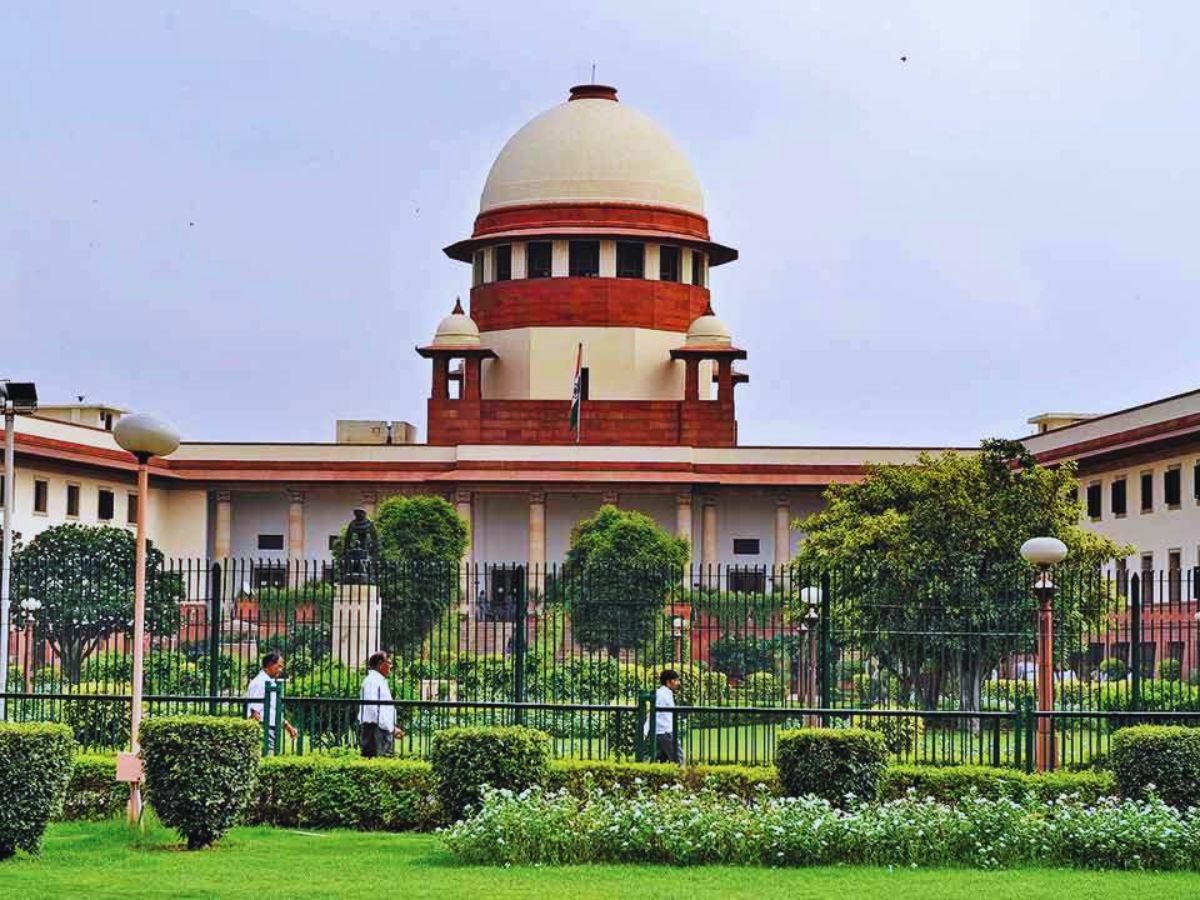
Supreme Court Permits Hindu, Muslim Friday Prayers At Madhya Pradesh’s Bhojshala (Photo Credits: X)
Basant Panchami: The Supreme Court on Thursday issued detailed directions to ensure that Basant Panchami poojas and Friday Juma Namaz are conducted peacefully at the Bhojshala-Kamal Maula complex in Dhar, Madhya Pradesh, a site claimed by both Hindu and Muslim communities.
The directions were passed by a bench comprising Chief Justice of India Surya Kant, Justice Joymalya Bagchi and Justice Vipul Pancholi while hearing an application seeking permission for day-long Basant Panchami rituals on January 23.
Bhojshala, an 11th-century ASI-protected monument, is viewed differently by the two communities. Hindus believe the site to be a temple dedicated to Vagdevi (Goddess Saraswati), while Muslims consider it the Kamal Maula Mosque.
Under a 2003 arrangement, Hindus are allowed to perform puja at the complex on Tuesdays, while Muslims offer namaz on Fridays.
Advocate Vishnu Shankar Jain, appearing for the Hindu Front for Justice, told the court that pujas and havans would be performed from sunrise to sunset on Basant Panchami.
Senior advocate Salman Khurshid, representing the mosque committee, submitted that Juma Namaz takes place between 1 pm and 3 pm, after which members of the Muslim community vacate the premises. He opposed any change in the timing, stating that Friday prayers follow a fixed religious schedule.
The Additional Solicitor General KM Nataraj, appearing for the Union government and the Archaeological Survey of India (ASI), along with the Madhya Pradesh Advocate General, assured the court that law and order would be strictly maintained.
The Supreme Court accepted a proposal under which separate enclosures with distinct entry and exit points would be created within the complex to allow both communities to worship without interference.
The court recorded that namaz would be held between 1 pm and 3 pm in a designated area, while a separate space would be provided for Hindu rituals throughout the day.
The mosque committee agreed to submit the number of persons expected to attend the namaz, enabling the district administration to issue passes or adopt other security measures to prevent any untoward incident.
In its order, the bench urged both communities to maintain mutual respect and cooperate with the state and district administration to ensure peace at the disputed site.
The application was moved in a Special Leave Petition filed in 2024 by the Maulana Kamaluddin Welfare Society, Dhar, challenging a Madhya Pradesh High Court order directing the ASI to conduct a survey of the Bhojshala complex.
In April 2024, the Supreme Court had allowed the survey to continue but barred any physical excavation or change to the character of the structure. The court had also restrained authorities from acting on the survey findings without its permission.
On Thursday, the apex court disposed of the SLP, directing that the matter pending before the High Court be heard by a division bench led by one of its senior-most judges.
After being informed that the ASI has completed the scientific survey and submitted its report in a sealed cover, the Supreme Court said the High Court may unseal the report and provide copies to all parties.
The court added that objections may be filed, and if any portion of the report cannot be made public, parties may be allowed to inspect it in the presence of their advocates.
In 2026, the United Arab Emirates will grant unified Eid holidays for public and private…
The Central Board of Secondary Education (CBSE) has issued a clarification after claims went viral…
Xiaomi has launched the Xiaomi Pad 8. The pad features an 11-inch display with 144Hz…
