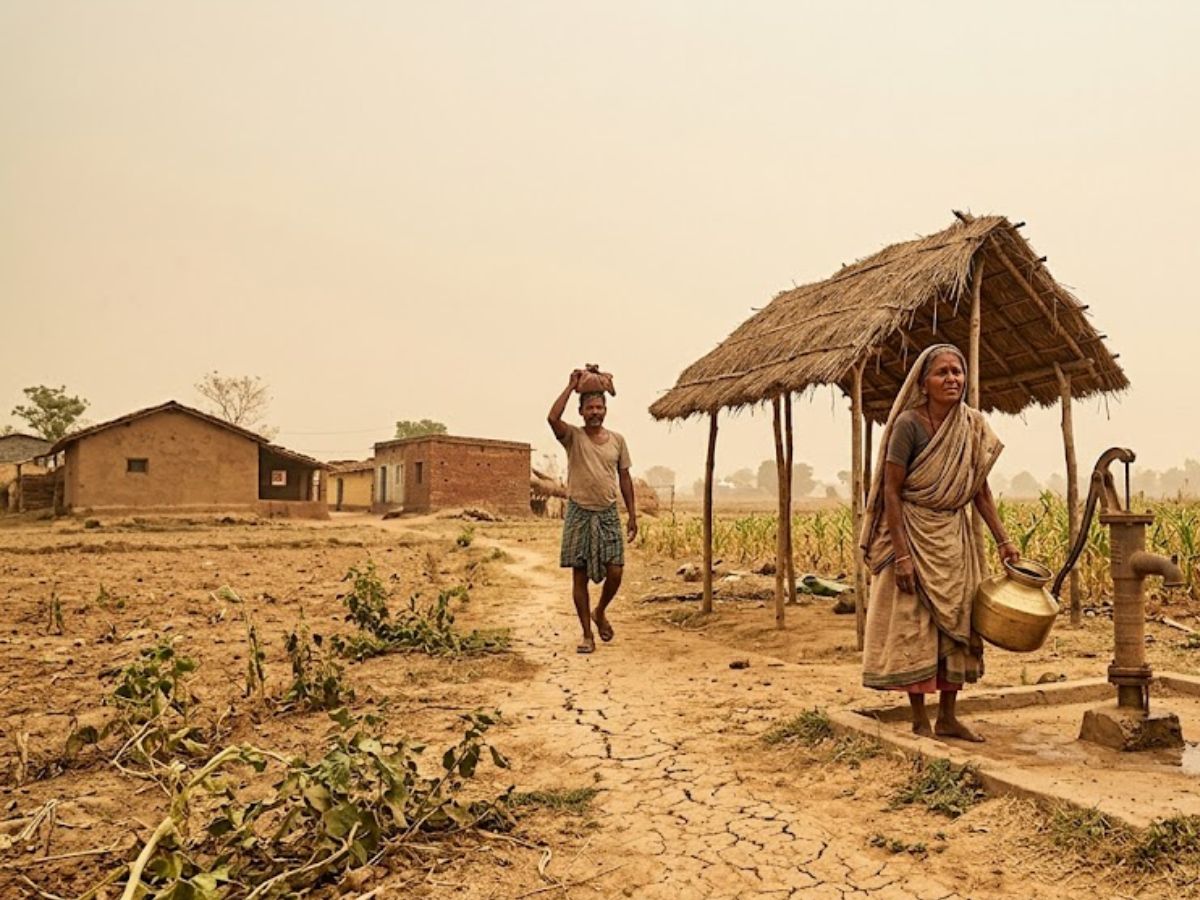
Temperature Today: IMD warns of heatwave across India as temperatures hit 45°C. Photo: Gemini.
Today Temperature: The India Meteorological Department (IMD) has warned that heatwave conditions are likely to prevail across northwest and central parts of the country over the next three days, with several regions already witnessing a sharp rise in temperatures. The alert includes parts of Delhi and multiple northern states, where temperatures have continued to climb steadily. Delhi remained under heatwave conditions for the second straight day on Saturday, leading the IMD to issue a yellow alert for the national capital. The department had earlier cautioned that isolated pockets of the city could experience heatwave conditions following a marginal rise in minimum temperatures.
Beyond Delhi, several states including Rajasthan, Odisha, Andhra Pradesh and Uttar Pradesh reported temperatures exceeding the 40-degree Celsius mark at multiple locations.
According to the IMD bulletin, maximum daytime temperatures across most parts of the country ranged between 40°C and 45°C, sparing only the western Himalayan region, northeast India adjoining east India, and the West Coast.
“Maximum/day temperatures were in the range of 40-45℃ over most parts of the country except western Himalayan region, northeast India adjoining east India and West Coast. The highest maximum temperature of 45.2°C was reported at Prayagraj (Uttar Pradesh),” the IMD stated.
The weather department has forecast continued heatwave conditions between April 25 and April 27 across several regions, including Jammu and Kashmir, Himachal Pradesh, Uttar Pradesh, Punjab, Haryana, and parts of central India.
In addition to heatwave warnings, the IMD has predicted hot and humid weather in isolated pockets across various states, “Hot & humid weather conditions very likely to prevail in isolated pockets over Gangetic West Bengal on 25th; Odisha during 25th -27th; Tripura, Konkan & Goa, Gujarat State, Coastal Karnataka, Kerala & Mahe on 25th & 26th; Tamil Nadu, Puducherry & Karaikal during 25th -29th April,” the IMD bulletin stated.
Temperatures remained significantly above normal across north, central and eastern India.In Uttar Pradesh’s capital Lucknow, the mercury touched 42.5°C, which is 3.4 degrees above the seasonal average.
Rajasthan experienced intense heat, with Barmer recording a high of 44.8°C, while most parts of the state reported temperatures above 40°C.
In Odisha, Rourkela and Jharsuguda recorded maximum temperatures of 42°C.
In Malkangiri district, although the recorded temperature was 37°C, the “feels like” temperature surged to 52°C, highlighting the severity of heat stress in the region.
Global climate indicators are pointing towards a potentially challenging weather year for India in 2026. The World Meteorological Organisation (WMO) has warned of a possible return of El Niño conditions.
Early indicators suggest rising ocean temperatures in the Pacific, increasing the likelihood of El Niño developing between May and July. Climate agencies have also flagged the possibility of the phenomenon strengthening later in the year, which could impact rainfall, temperature patterns, and water systems globally.
El Niño is a natural climate pattern characterised by warmer-than-usual sea surface temperatures in the central and eastern Pacific Ocean. While the temperature shift may appear minor, it significantly disrupts global wind and rainfall patterns.
It forms part of the broader El Niño-Southern Oscillation (ENSO) cycle, which alternates between three phases: El Niño (warm phase), La Niña (cool phase), and a neutral phase.
The WMO has indicated that while current conditions remain neutral, climate models are increasingly pointing towards a transition to El Niño in the coming months.
Wilfran Moufouma Okia, Chief of Climate Prediction at the WMO, said, “After a period of neutral conditions at the start of the year, climate models are now strongly aligned, and there is high confidence in the onset of El Niño, followed by further intensification in the months that follow.”
He added, “Models indicate that this may be a strong event, but the so-called spring predictability barrier is a challenge for the certainty of forecasts at this time of year. Forecast confidence generally improves after April.”
India remains particularly vulnerable to El Niño events due to their direct influence on the monsoon system. The IMD has already indicated that the 2026 southwest monsoon could be below normal, estimated at around 92% of the long-period average.
Historically, El Niño years in India are associated with, weaker monsoon rainfall, uneven distribution of precipitation, prolonged dry spells between rainfall events and increased stress on agriculture and rural incomes.
Zubair Amin is a Senior Journalist at NewsX with over seven years of experience in reporting and editorial work. He has written for leading national and international publications, including Foreign Policy Magazine, Al Jazeera, The Economic Times, The Indian Express, The Wire, Article 14, Mongabay, News9, among others. His primary focus is on international affairs, with a strong interest in US politics and policy. He also writes on West Asia, Indian polity, and constitutional issues. Zubair tweets at zubaiyr.amin
Another vessel carrying Indian mariners has reportedly been attacked near Oman, marking the fourth such…
Jaishankar Raises Strong Protest with Rubio Over US Navy Attack That Killed Three Indian Mariners
External Affairs Minister S. Jaishankar conveyed India's strong protest to US Secretary of State Marco…
Substitute Cyle Larin rescued co-hosts Canada with a dramatic 78th-minute equalizer to secure a 1-1…
