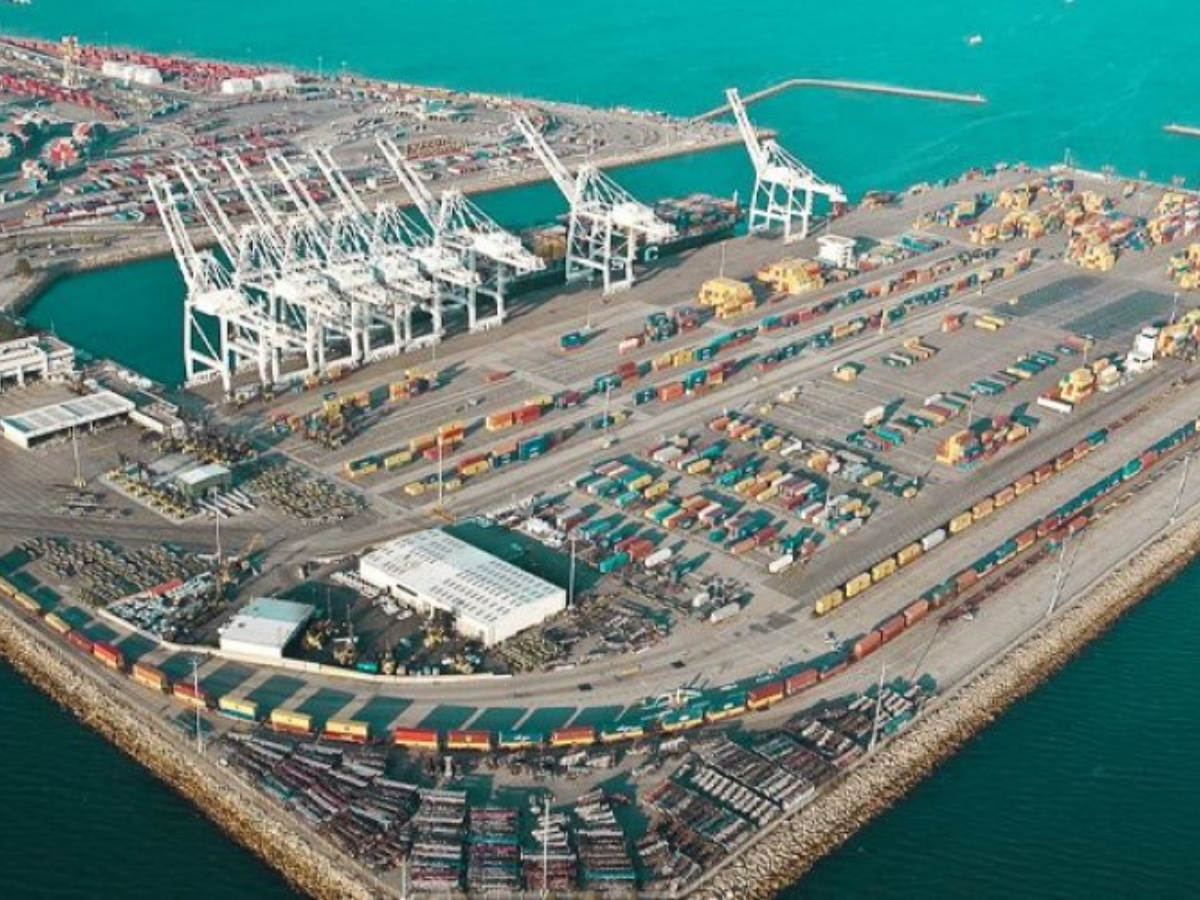
Chabahar Port
India is closely monitoring the ongoing conflict between Israel and Iran for any potential impact on the Chabahar Port and the International North-South Transport Corridor (INSTC)—two key connectivity initiatives that are vital to its strategic and economic interests.
New Delhi views these projects in Iran as essential gateways to access Afghanistan, Central Asia, and Russia. India has made significant investments in Chabahar Port, which plays a central role in its regional outreach.
Although Israel has not struck any Iranian ports so far, reports have surfaced indicating some attacks occurred along the Iranian coastline.
In 2023, India signed a 10-year agreement with Iran, giving India Ports Global Ltd. (IPGL) responsibility for managing Chabahar Port. IPGL, a joint venture between Jawaharlal Nehru Port Trust and Kandla Port Trust, operates the port in collaboration with Iran’s Aria Banader company. India has committed $85 million for upgrading berths and extended a $150 million line of credit through the Exim Bank to support the port’s development.
Chabahar Port is a deep-water seaport located in southeastern Iran along the Gulf of Oman. It lies in Iran’s Sistan-Baluchestan province, near the border with Pakistan.
The port has two terminals: Shahid Kalantari and Shahid Beheshti. India has been helping Iran develop the Shahid Beheshti terminal under a long-term agreement.
One of India’s biggest challenges in reaching Afghanistan and Central Asia is Pakistan’s denial of overland transit.
Chabahar Port provides India an alternative sea-land route:
From Indian ports → to Chabahar (Iran) → by road/rail to Zaranj (Afghanistan) → connects to Delaram Highway, built by India.
This allows uninterrupted trade and strategic access to Afghanistan, avoiding the geopolitical blockade by Pakistan.
Chabahar is a crucial link in the INSTC, a 7,200 km multi-modal trade route that connects:
India → Iran → Azerbaijan → Russia → Europe.
This corridor reduces travel time and shipping costs by 30–40% compared to traditional routes via the Suez Canal.
Through Chabahar, India can access resource-rich Central Asian nations like Turkmenistan, Kazakhstan, and Uzbekistan.
Just 90 km away, China has developed the Gwadar Port in Pakistan as part of the China-Pakistan Economic Corridor (CPEC).
Gwadar gives China strategic access to the Arabian Sea and Indian Ocean, and a gateway to West Asia and Africa.
India’s presence at Chabahar serves as a strategic counterweight to China, helping New Delhi secure its own maritime and economic interests.
Chabahar boosts India’s trade potential with Iran, Afghanistan, Central Asia, and Europe.
It allows for the smooth export of Indian goods, especially:
Agriculture products
Pharmaceuticals
Machinery
It also facilitates import of energy resources, minerals, and dry fruits from Central Asia and Afghanistan.
India has already shipped wheat and humanitarian aid to Afghanistan via Chabahar.
Despite U.S. sanctions on Iran, India has maintained strong diplomatic relations with Tehran.
By investing in Chabahar, India reinforces:
Bilateral ties with Iran
Its long-term energy and security interests in the region.
The port has been exempted from U.S. sanctions due to its humanitarian and developmental importance.
Chabahar gives India a naval and logistical footprint in the region—just outside the Strait of Hormuz, a chokepoint for global oil trade.
It improves India’s maritime security and enhances its capacity to respond to developments in the Arabian Sea, Persian Gulf, and West Asia.
It strengthens India’s role in regional security architecture, especially amid rising China-Iran cooperation and instability in Afghanistan.
Ram Navami 2026: Confusion over whether Ram Navami will be celebrated on March 26 or…
Two people died while several others were injured after a bus lost control and overturned…
A powerful 7.6 magnitude earthquake struck near the Pacific island nation of Tonga, triggering tsunami…
