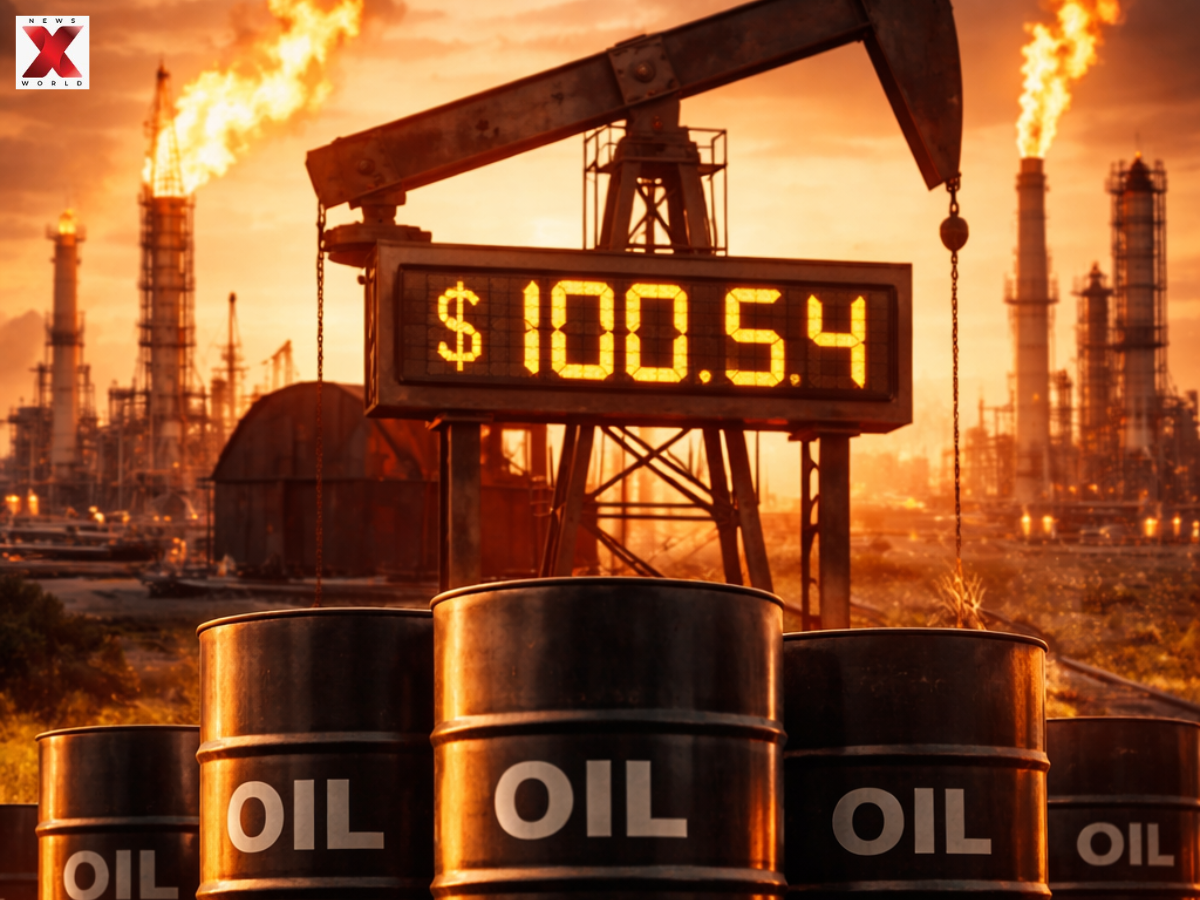
Brent crude oil prices (AI IMAGE)
The cost of Brent crude oil has gone back over $100 a barrel, following its drastic drop on Monday, since conflicting reports about any possible negotiations between the US and Iran were posted.
On Monday, oil prices fell, following the announcement by US President Donald Trump that the US would delay attacks on Iranian energy infrastructure.
On his Truth Social site, Trump indicated that the US and Iran had a fruitful discussion.
Tehran, however, denied that it had been in contact with Washington, terming this as an effort to control markets.
Trump had said on Saturday that he would destroy the power plants in Iran unless the most important shipping route, Strait of Hormuz, was opened within 48 hours, and Iran said it would retaliate by destroying major infrastructure in the area.
Such remarks shook markets and the cost of Brent fell to $113 a barrel.
Oil prices crashed and stock markets recovered on Monday when Trump said he would not impose strikes, said Iran and the US had negotiated a global solution, a COMPLETE and TOTAL solution.
Since the US and Israel invaded Iran on 28 February, there has been volatile trading in global energy markets.
By Tuesday, the world oil benchmark price had soared back to $104 a barrel after it on Monday had dropped to as low as $102.
But Asian stock markets, which have also been over the past few weeks shaken by the conflict, were fairly steady on Tuesday.
The Nikkei 225 in Japan had increased 0.8% in morning trading, the Hang Seng in Hong Kong increased 1.6 and South Korea Kospi increased 2.2. They plummeted drastically on Monday because the Asian states greatly rely on oil and gas that would otherwise flow through the strait.
The UK FTSE 100 and Germany Dax were fairly subdued, dropping 0.3 percent and 0.9 percent respectively, but then rebounded in the middle of the day.
In early trading, the US S&P 500 fell by 0.8 percent then recovered.
Over three weeks since the conflict began, key business survey, the S&P Global Purchasing Managers Index (PMI) has recorded the highest monthly increase in business input costs since 1992 by UK businesses.
The war commenced 28 February and Iran has been successful in closing the Strait of Hormuz. Approximately one-fifth of global oil and liquefied natural gas typically travels along the waterway, and the war has propelled global fuel prices sky high.
Nations globally have acted to cushion the effect of increased energy costs and shortages.
The US has already temporarily lifted restrictions on Russian and Iranian oil at sea to alleviate shortages.
On Tuesday, China scaled back intended increases in fuel prices in an attempt to ease the load on drivers as energy prices rise because of the Iran war.
With 13 years on the line, Ashish Kumar Singh loves everything when it comes to movies, music, travel and pop culture. Formerly employed at ANI, Pinkvilla, India Today and HT, Ashish has interviewed some of the top celebrities of India, including Shah Rukh Khan, Aamir Khan, Ranveer Singh, Ranbir Kapoor and Hrithik Roshan, among others. Breaking news excites him and deadlines are what he chases. Interviewing comes naturally to him. Hit him up at ashish.kumar02singh@gmail.com.
The Central Board of Secondary Education is set to release the CBSE Class 12 Result…
Guillermo del Toro returned to Cannes with a 4K restoration of Pan’s Labyrinth, reflecting on…
Prateek Yadav Death Reason: How Did Mulayam Singh Yadav’s Son And Aparna Yadav’s Husband Die?
Prateek Yadav, the younger son of Mulayam Singh Yadav and stepbrother of Akhilesh Yadav, passed…
