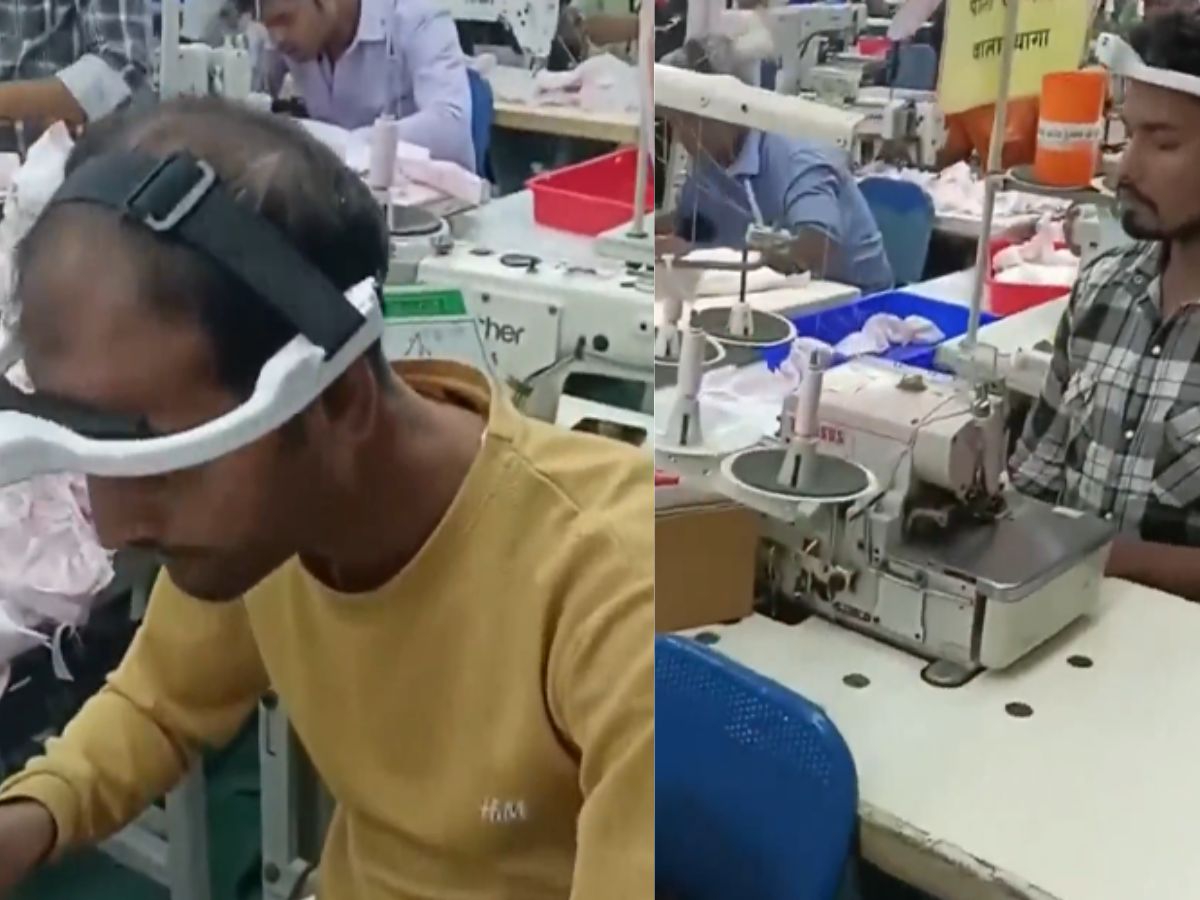
Viral Video Shows Indian Workers Training AI With Head Cameras
The viral video, which has spread through social media networks, shows people working in data capture labs, which create new types of gig economy work. The footage, which shows Indian factory workers using head-mounted cameras, has started intense discussions on platforms like X and Instagram. The system operates as a safety instrument that also functions as a quality control device because it uses advanced technology to record human movement skills, which serve as training material for Western artificial intelligence research facilities. The system operates at maximum efficiency because it requires workers to perform every minor movement using their fingers and wrists, along with their towel-folding and box-stacking actions.
The workers who use this technology create robotic teleoperation data, which enables engineers to construct robots that function in real-world environments. The companies Tesla Figure AI and Agility Robotics experience an increased need for human-in-the-loop training because they develop general-purpose humanoids.
In India and Nigeria and Argentina, workers must attach iPhones to their foreheads while they repeat physical tasks, which pay them between 230 and 250 US dollars each month. Workers who receive immediate pay will face a future expense that leads to automated systems that take over all their competencies. The hands that create the modern world now train machines to build everything without any human assistance, which creates an ironic situation in contemporary society.
The data farms exist to enable the human-to-Robot knowledge transfer process. Unlike traditional coding, which relies on rigid logic, training a humanoid requires “soft data,” the messy, intuitive adjustments a human makes when a box is slightly heavier or a fabric is slippery. AI developers use head-mounted vision systems to create brain activity maps that show how humans process information and move their bodies.
The workers act as biological sensors that produce detailed datasets that enable neural networks to learn by imitating human behavior. The process of imitation learning converts a basic laundry task into a detailed mathematical model, which enables a Palo Alto laboratory robotic actuator to duplicate the “human touch” digitized from the task.
The development of robotics that can perform various tasks has created a major transformation in how society evaluates workers because their worth now depends on their behavioral information instead of their physical work. The current situation presents a contradiction regarding displacement, as people must work on artificial intelligence development while simultaneously preparing to become obsolete in the future. Through their participation in high-volume data-labeling marathons, workers unintentionally sell the rights to their physical movements because they treat their bodily movements as intellectual property.
As AI systems require less “cost-per-task” to operate, they create decreasing economic value for manual work positions. A feedback loop is created because the worker who trains the camera with greater efficiency will achieve quicker progress towards the employment of humanoid workers who will make their current job position and all future career options completely obsolete.
A recent media graduate, Bhumi Vashisht is currently making a significant contribution as a committed content writer. She brings new ideas to the media sector and is an expert at creating strategic content and captivating tales, having working in the field from past four months.
Maryam Faisal viral MMS sparks debate; sharing or downloading such leaked videos may lead to…
JEE Main 2026 Answer Key Objection Last Date Today, Check Steps To Challenge And Fee Payment Details
The National Testing Agency (NTA) will close the objection window for the JEE Main 2026 Session…
Gold and Silver Price in Pakistan Today (13 April, 2026): Gold and silver gold and…
