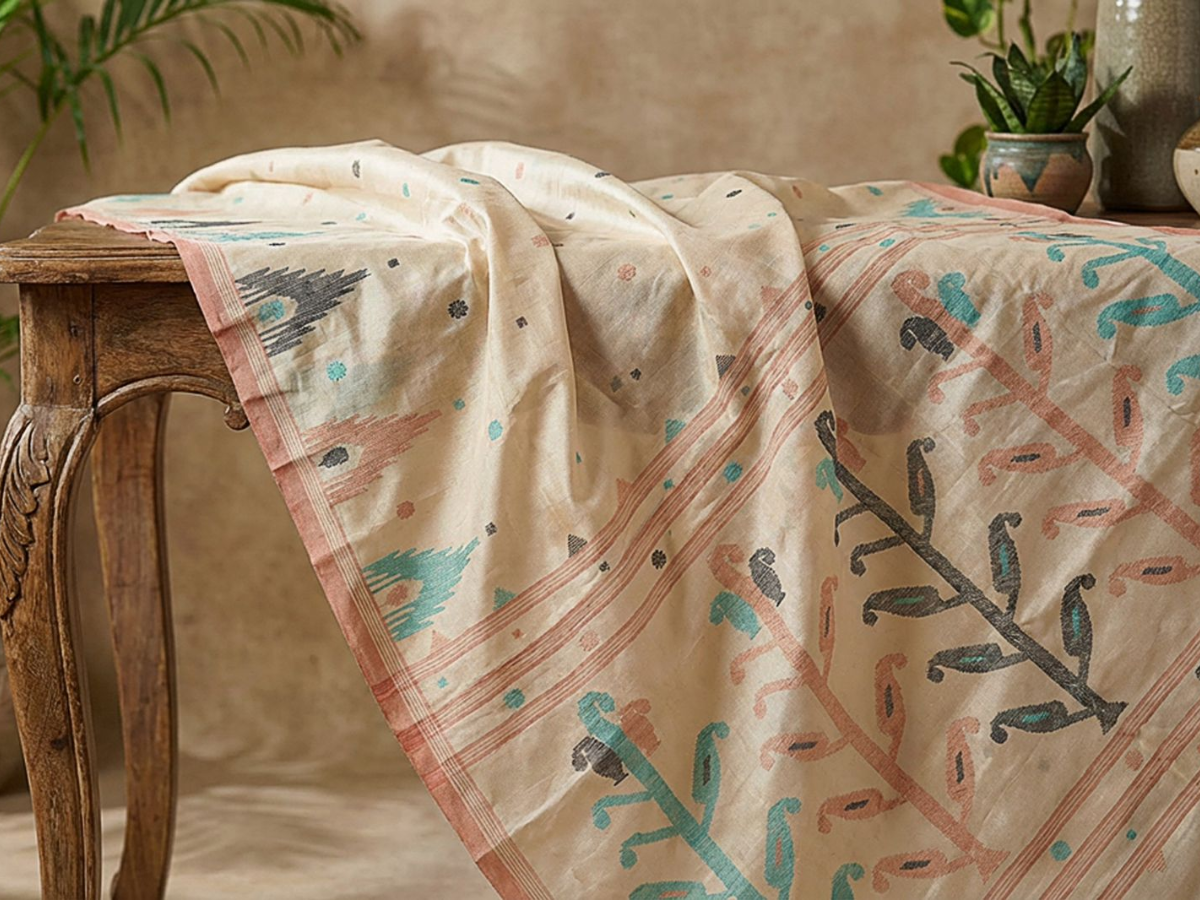
The Bangladesh High Commission in New Delhi will host a landmark exposition celebrating the country’s rich handloom heritage, with a special focus on Tangail and Pabna sarees, two traditional hub that embody centuries of craftsmanship, cultural memory, and artistic excellence.
Building on the success of the widely acclaimed Jamdani exposition held in New Delhi in September 2025, this new showcase continues a compelling cultural narrative shifting the lens from the ethereal muslin-based Jamdani to the refined, versatile elegance of Tangail and Pabna weaving traditions. Together, these initiatives seek not only to display textiles, but to bring the lives, histories, and creative legacies of weavers into public consciousness.
The exposition will be inaugurated on 17 April 2026 (5:00 pm – 7:00 pm) in the presence of diplomats, cultural figures, media representatives, and distinguished guests. It will open to the public from 18 to 21 April 2026, daily from 10:00 am to 8:00 pm.
Tangail sarees trace their origins from centuries ago, carrying with them refined techniques that would evolve uniquely in the riverine landscapes of Bangladesh. Over time, Tangail became synonymous with fine cotton sarees featuring delicate motifs, airy textures, and an understated sophistication ideal for both everyday elegance and ceremonial wear.
Pabna, another historic weaving hub, developed its own identity often characterized by durability, subtle patterns, and an emphasis on comfort without compromising aesthetic appeal. Together, Tangail and Pabna represent a harmonious blend of tradition and adaptability in Bangladesh’s textile history.
An interesting facet of Tangail sarees lies in their weaving technique, where extra weft is used to create intricate motifs directly on the loom, an approach that shares philosophical kinship with Jamdani weaving, though expressed in a more structured and accessible form. This connection highlights a broader continuum within Bengal’s textile traditions, where innovation emerges from deeply rooted practices.
The exposition comes at a particularly significant moment. In November 2025, Tangail saree weaving received international recognition as an Intangible Cultural Heritage by UNESCO, affirming its cultural importance and the resilience of the artisan communities who sustain it.
This recognition has renewed global interest in Bangladesh’s handloom sector, which remains a vital source of livelihood for thousands of rural families. Events like this exposition play a crucial role in connecting these traditions to wider audiences, ensuring their continuity in a rapidly changing world.
The exhibition will feature more than 300 carefully curated sarees, showcasing a wide spectrum from heritage pieces that echo age-old designs to contemporary interpretations reflecting evolving tastes.
In addition to the textiles, visitors will experience a visual documentation of the saree-making process, offering insight into each stage of creation from spinning fine cotton threads and natural dyeing to the rhythmic precision of loom weaving and final finishing. This immersive presentation brings forward the human stories behind the fabric. It is the patience, skill, and generational knowledge embedded in every weave.
The exposition is curated by Chandra Shekhar Saha (Bangladesh) and Chandra Shekhar Veda (India), both veterans of the textile and handicrafts sectors. Their collaboration reflects a cross-border commitment to preserving and promoting South Asia’s shared textile heritage. Their previous work on the Jamdani exposition was widely appreciated for its depth and narrative richness, setting the stage for this new chapter.
More than an exhibition, this initiative is part of Bangladesh’s broader cultural diplomacy aimed at strengthening the historic and cultural bonds between Bangladesh and India. Textile traditions, often
passed silently through generations, serve as a powerful medium of connection, reflecting shared histories, climates, and aesthetics.
By presenting Tangail and Pabna sarees in New Delhi, the High Commission invites audiences to engage with a living tradition, one that continues to evolve while remaining deeply anchored in its roots.
Event Details
• Inauguration (By Invitation): 17 April 2026 | 5:00 pm – 7:00 pm
• Public Exhibition: 18–21 April 2026 | 10:00 am – 8:00 pm
• Venue: Bangladesh High Commission, New Delhi
________________________________________
For media inquiries and further information, please contact:
Bangladesh High Commission, New Delhi
I am a seasoned writer with 2.5 years of experience who presently works at ITV Digital. I specializes in entertainment journalism, reporting on the newest Bollywood news as well as compelling healthy lifestyle pieces. I am master at creating material around popular issues and internet buzz, bringing unique, reader-friendly viewpoints to every item i write
Adani Portfolio Reports Highest Ever Capex by Any Indian Corporate
The Adani Portfolio reported record FY26 EBITDA of ₹94,834 crore and historic capex of ₹1.53…
End Of Melbourne Derby! Stars and Renegades Set to Merge in Historic BBL Overhaul
End of the Melbourne Derby! The Melbourne Stars and Renegades are set to merge into…
Sikh Man Jailed For Life After Stabbing Teen Over Racial Abuse Claims
A British Sikh man has been sentenced to life in prison for the fatal stabbing…
