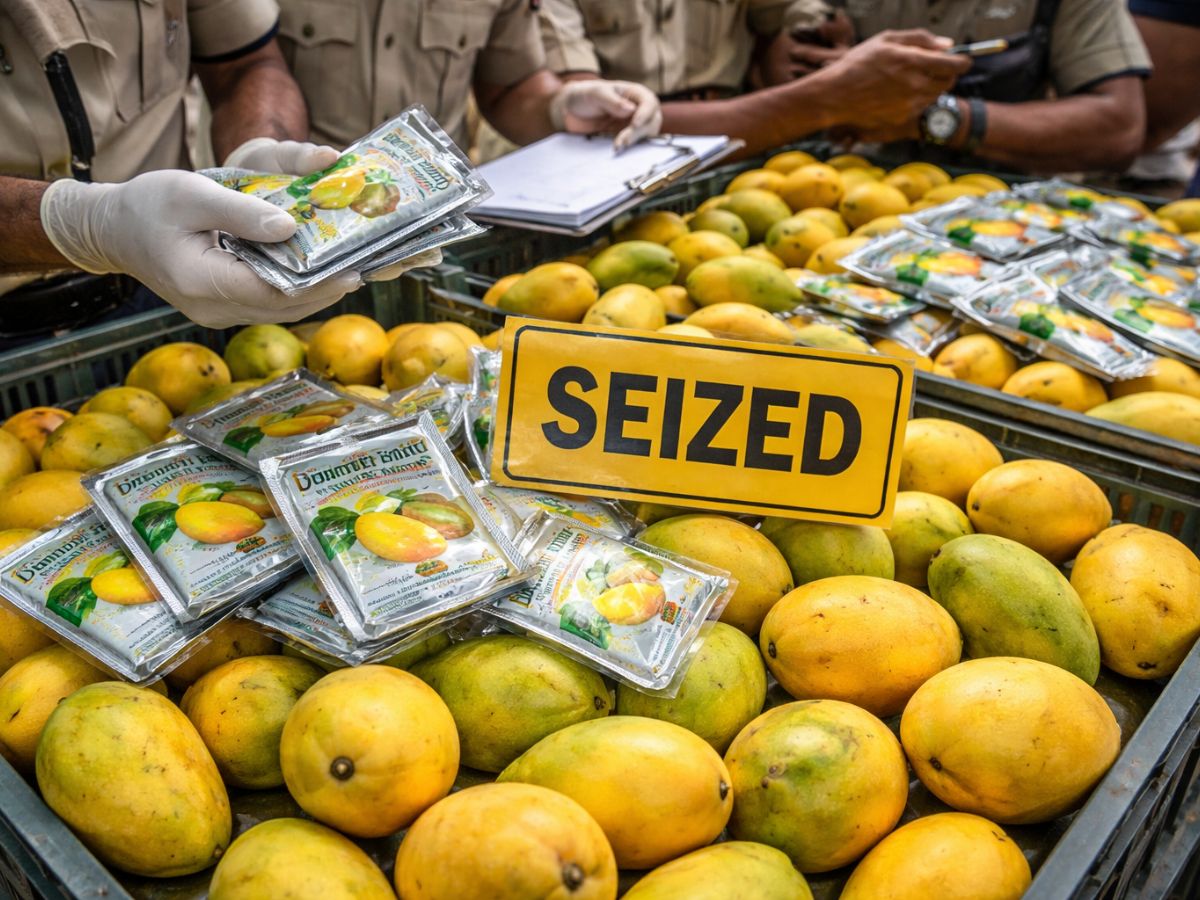
How to identify artificially ripened mangoes? (Image: AI-generated)
A major food safety scare has come to light in Hyderabad just as mango season begins, with authorities discovering that a large amount of chemically treated fruit was being prepared for sale in local markets. The incident has raised serious concerns about how widely these artificial ripening methods are abused, and what hazards consumers might be unknowingly exposed to when purchasing their favorite summertime fruit.
According to officials, approximately 200 kilograms of mangoes were seized during a raid, along with numerous sachets of a chemical ripening agent called “Diamond Ripe – Ethylene Ripener.” Investigators found that the trader was using these chemicals in excess his fruits ripen and quickly sell them at an accelerated rate, contrary to food safety standards.
The police crackdown occurred during a market inspection conducted by Hyderabad police. During the raid, not only were the mangoes confiscated, but also 25 opened packets and/or sachets containing the chemical ripening agent were also taken. The trader reportedly had used these to artificially ripen mangoes.
According to the statutory guidelines regarding food safety, only 5 sachets of ethylene ripener medication may be applied to mangoes at a rate of 20 kg of mangoes. However, investigators have determined that the defendant used 6 sachets in each 20 kg tray of mangoes thus exceeding the limit set by the Food Safety and Standards Authority of India (FSSAI). A case has been filed under various statutes concerning food adulteration, fraud and jeopardising public safety.
Officials are warning the public that this is not only against the law but poses a danger to your health. A police official involved with the investigation stated, “The defendant was using more than the permissible amounts of chemicals to ripen mangoes quickly to make an illegal profit. These illegal acts can put the health of a number of people at risk. We will continue to present a strong response to these sorts of illegal practices at markets and storage facilities”.
The Commissioner of Police of Hyderabad also issued an urgent public warning regarding his remarks, “The king of the fruits should not be a fruit of fear to purchase; do not purchase mangoes solely based on appearance, they may be ripe on the outside but not be safe to eat on the inside”.
Doctors and other healthcare specialists caution that eating fruit which has been chemically ripened may cause adverse health effects including throat irritation, nausea, vomiting, abdominal pain, and/or diarrhea. Long-term consumption of these fruits could have long-term effects on the nervous system and the ability to breathe.
According to the FSSAI guidelines, artificial ripening is not prohibited, however it must be done in a safe manner and in controlled amounts. The use of carbide and/or acetylene gas for this purpose is prohibited due to the potential for harm to consumers who eat fruit which has been ripened in this way.
Ethylene gas is allowed for use in the ripening of mangoes and is a naturally occurring plant hormone that aids in the maturation process, but must be used in open-air environments and must be supplied at controlled rates. Experts also indicate that any source of ethylene gas should not be allowed to come in contact with the mangoes and that all processes involving ethylene gas must comply with appropriate safety protocols.
Furthermore, consumers should purchase mangoes and other fruit only from reputable and trustworthy sources that have verified that their fruit was not ripened using harmful or illegal chemicals.
The authorities and experts provide some very easy tips on how to recognize chemically ripened mangoes. The color is a good indicator; artificially ripened mangoes tend to be uniformly colored and bright yellow or orange, while naturally ripening mangoes are more varied in coloration.
The fragrance can also help in determining whether a mango was artificially or naturally ripened. An artificially ripened mango may have a chemical odor, while the aroma of a naturally ripened mango is sweet and fruity. The texture is also important, as artificially ripened mangoes feel overly soft or mushy due to destroyed cell walls.
There are many easy tests that people can do at home to determine if a mango has been chemically treated. One way to tell is by placing mangoes in water; naturally ripened mangoes tend to sink, while chemically treated mangoes generally float. Another test is to wash a mango with a baking soda solution; if the color of the mango changes while washing with the baking soda, then it is probably chemically treated. Lastly, if you taste a mango and it tastes strange or bland, this is another indication that it was artificially ripened.
Khalid Qasid is a media enthusiast with a strong interest in documentary filmmaking. He holds a Master’s degree in Convergent Journalism from AJK MCRC. He has also written extensively on esports at Sportsdunia. Currently, he covers world and general news at NewsX Digital.
DMK and AIADMK are using freebies fridges, TVs, laptops, cash coupons to woo voters in…
Gemini said Donald Trump has issued a high-stakes ultimatum to Iran, claiming he can either…
Explosive knocks from Tim David, Devdutt Padikkal and skipper Rajat Patidar helped defending champions Royal…
