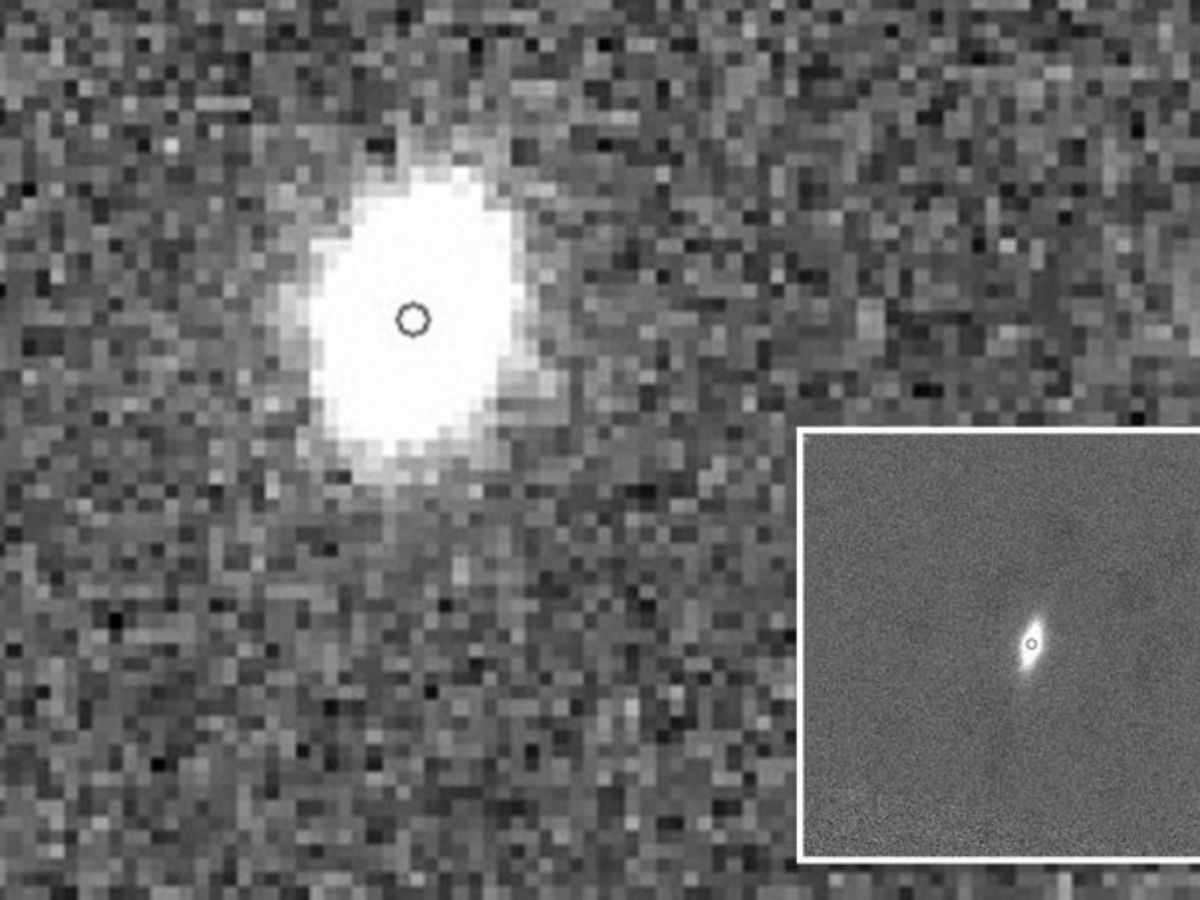
Astronomers have discovered KiDS J0842+0059, a rare fossil galaxy three billion light-years away, offering new insights into early galaxy formation and cosmic history. (Image courtesy: x/@nypost)
Fossil galaxies are rare cosmic structures that stopped evolving billions of years ago. After a short but intense star-forming phase, they remain frozen in time, unlike typical galaxies that keep growing and merging.
This newly discovered fossil galaxy, named KiDS J0842+0059, lies three billion light-years from Earth, a recent report published by CNN stated. It’s the most distant and the first of its kind found outside our local universe, according to a study led by the Italian National Institute for Astrophysics (INAF).
“These objects are very rare,” CNN quoted lead researcher Crescenzo Tortora of INAF as saying. “They did not merge with any other galaxy, remaining more or less intact through time.”
Coauthor Chiara Spiniello of the University of Oxford revealed that these galaxies have “an early burst of star formation” and that they formed when “the universe was really, really young… and did absolutely nothing thereafter,” as reported by CNN.
Relic galaxies are incredibly compact and dense. “They contain (billions) of stars as massive as the sun… and are not forming any new stars,” Spiniello explained.
According to astrophysicist Michele Cappellari, these galaxies “avoided chaotic mergers, thereby allowing us to “reconstruct conditions from the universe’s infancy.”
Cappellari suggested supermassive black holes might have halted star formation by blasting out gas: “This remains an active area of research.”
Originally spotted in 2018 with Chile’s VLT Survey Telescope, KiDS J0842+0059 was later confirmed using Arizona’s Large Binocular Telescope, known for its sharp imaging.
“It’ll be super crowded,” Spiniello reportedly said, adding, “We don’t know what keeps it from merging with others… without that, we can’t predict what’s going to happen in the future.”
“These galaxies are one in millions,” Spiniello stressed, per CNN. Thanks to ESA’s Euclid telescope, scientists hope to find many more. “Euclid will be transformational,” she added.
An Indian LPG carrier, Shivalik, carrying about 40,000 metric tonnes of liquefied petroleum gas, reached…
Cooking gas prices across India remain high as of March 16, 2026, after a recent…
Indian-origin software engineer Aman Gottumukkala, founder of AI coding startup Firebender, has joined xAI, the…
