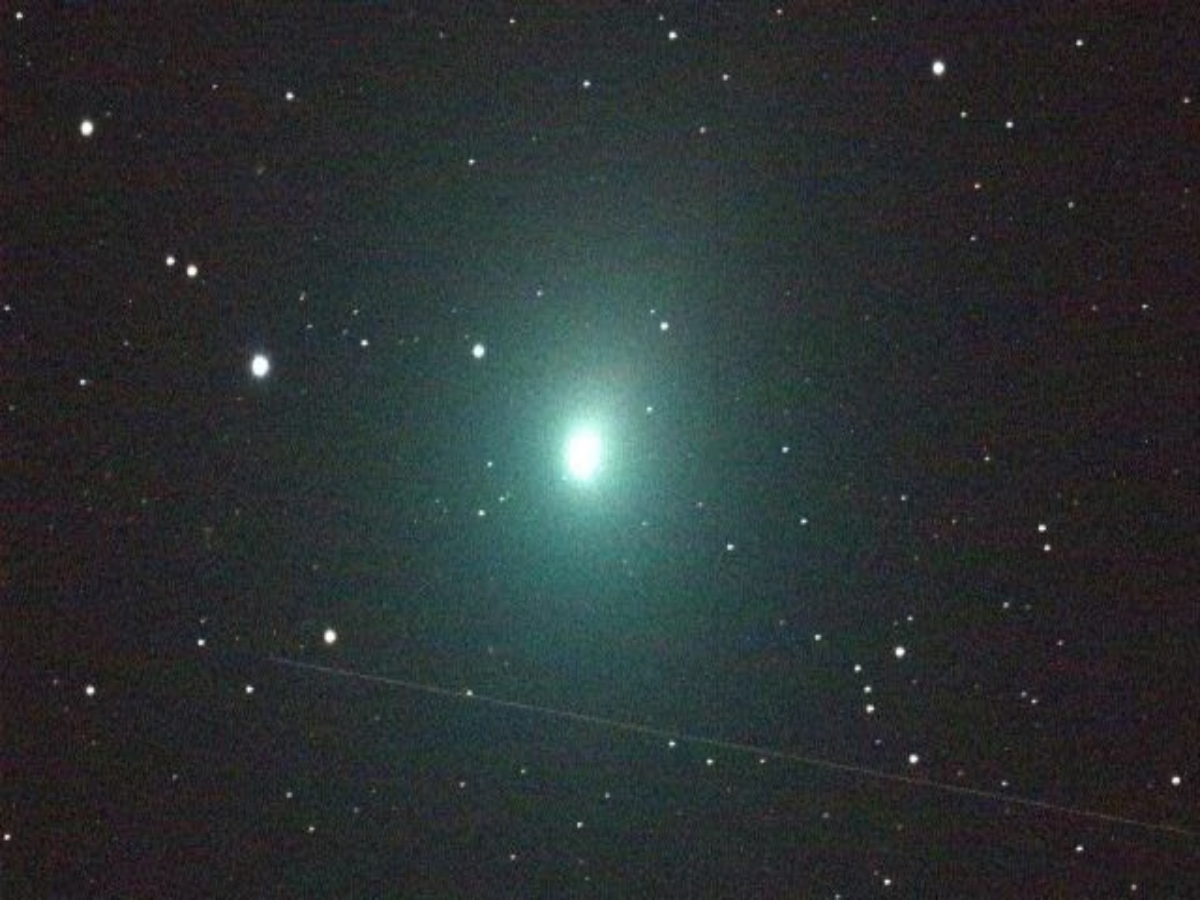
Representational image
The mysterious interstellar comet 3I/ATLAS, only the third known object to enter our solar system from beyond, has left astronomers puzzled after new images suggested it may have exploded or broken apart into several pieces.
Recent photographs captured by British astronomers Michael Buechner and Frank Niebling show 3I/ATLAS developing a massive “anti-tail” and a long, smoky trail of jets stretching millions of kilometers through space. These jets, scientists say, indicate that the comet-like body is losing material at an extraordinary rate, according to Economic Times report.
Harvard astrophysicist Avi Loeb, who has been studying the object, said that the comet likely suffered a catastrophic breakup as it made its closest approach to the Sun, known as perihelion. “The dramatic mass loss and brightening at perihelion could mean that 3I/ATLAS disintegrated,” Loeb said. “A breakup into fragments would have increased its surface area and explained the sudden outburst of brightness,” according to ET report.
According to Loeb’s analysis, the comet’s energy absorption at its closest distance to the Sun was far greater than expected for a natural object. He estimated that its effective absorbing area was about 617 square miles, nearly four times larger than earlier measurements, suggesting it might have broken into multiple pieces.
Data also shows that between August and perihelion, 3I/ATLAS’s rate of mass loss jumped from 150 kilograms per second to nearly two million kilograms per second. Loeb believes the only natural explanation for such extreme activity is that the comet fragmented into at least 16 parts.
However, Loeb has also raised the possibility that 3I/ATLAS might not be a natural comet at all. He suggested it could be a technological object, perhaps an ancient or active alien spacecraft using advanced propulsion.
Astronomers are now waiting for more evidence. The comet will make its closest approach to Earth on December 19 and to Jupiter in March 2026.
ALSO READ: First-Ever Radio Signal Detected from Interstellar Comet 3I/ATLAS as It Passes Close to the Sun
Shivam Verma is a journalist with over three years of experience in digital newsrooms. He currently works at NewsX, having previously worked for Firstpost and DNA India. A postgraduate diploma holder in Integrated Journalism from the Asian College of Journalism, Chennai, Shivam focuses on international affairs, diplomacy, defence, and politics. Beyond the newsroom, he is passionate about football—both playing and watching—and enjoys travelling to explore new places and cuisines.
A viral video circulating on social media has sparked outrage after showing a woman placing…
Biggest Cricket Franchise in the World: From RCB to CSK — Top 5 Teams and Their Net Worth
The franchise structure has been instrumental in providing opportunities for the players in modern-day cricket…
India is facing a major LPG shortage, affecting cities like Delhi, Mumbai, and Bengaluru, with…
