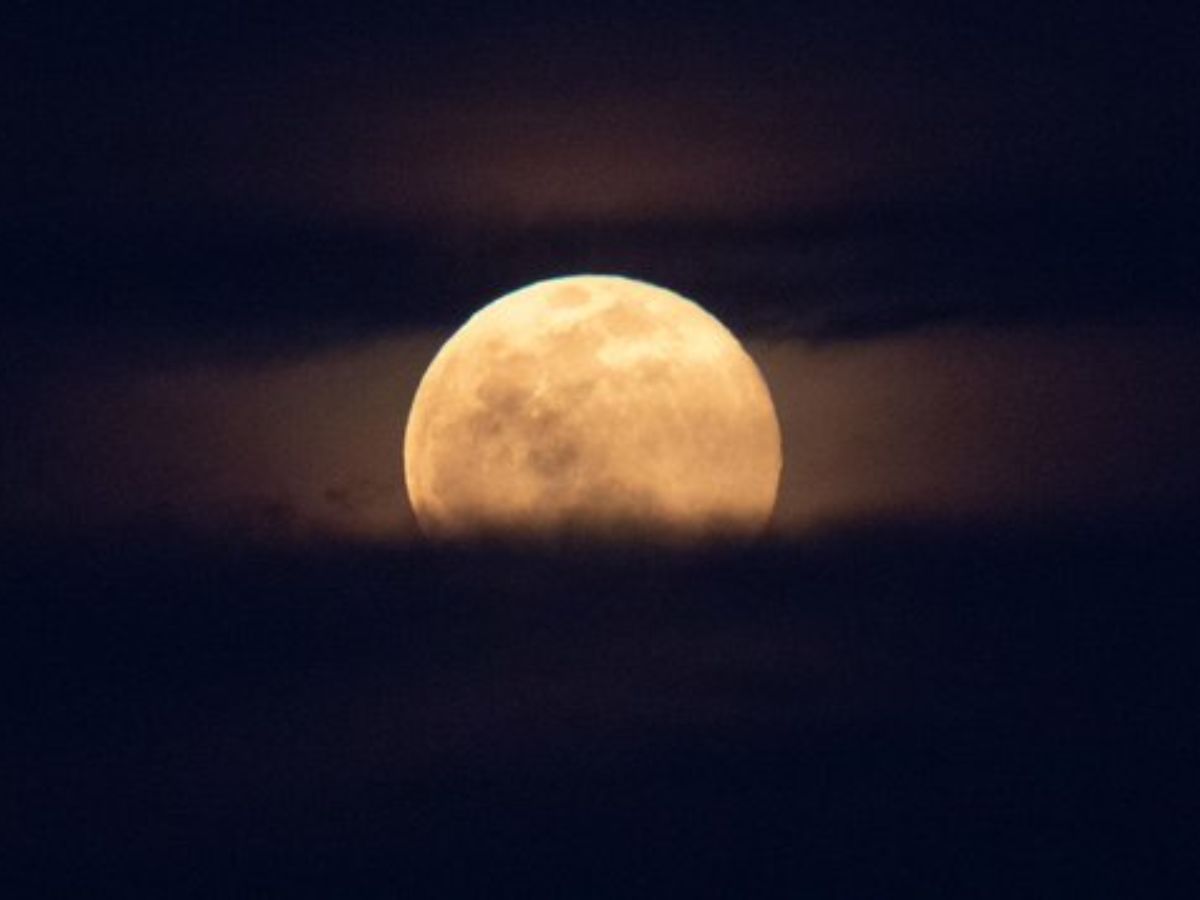
July’s Buck Moon rises July 10, 2025, named for growing deer antlers, it will be visible southeast after sunset to naked eye or with binoculars.Photo/ NASA.
July’s Full Moon: As summer is here and in full swing, it brings a series of celestial event that stargazers and sky-watchers can enjoy. Th upcoming months bring eclipses, meteor showers and planetary sightings, and next on the calendar is July’s full moon.
The July’s full moon, also known as the “Buck Moon,” can be witnessed on July 10, 2025. The nickname for this month’s full moon is derived from the nature and history like other full moons.
The name “Buck Moon” is said to have its roots in the Indigenous peoples of North America, according to the Farmers’ Almanac. The name refers to a natural occurrence at this time of year when the antlers of male deer,called bucks, are growing after they shed them each year.
Also Read: Mysterious Interstellar Comet 3I/ATLAS: Everything NASA Has Revealed So Far
The antlers begin to groworiginate in spring and then grow rapidly during this period at a rate of about one-fourth of an inch per day or up to one-and-a-half inches per week.
July’s full moon is also known by various other traditional names. These include “Thunder Moon,” the “Salmon Moon,” and the “Berry Moon,” with each signifying different seasonal events or natural phenomena.
According to the experts, Buck Moon will be visible to the naked eye. They add that for the best view of the July’s full moon, sky-watchers should look toward the southeast after sunset.
According to the observers, while the full moon is easily visible without any equipment, a good telescope or a pair of binoculars can enhance the July moon viewing experience.
After the Buck Moon, there are five more full moons left this year. According to the reports the next full moon will be the Sturgeon Moon on Saturday, August 9 which will be followed by the Corn Moon on September 7. The Hunter’s Moon on October 6 will be next followed by the Beaver Moon on November 5, and finally, the Cold Moon on December 4.
Also Read: Mars Exploration In 2025: Why The Red Planet Still Captures Scientific Curiosity
Zubair Amin is a Senior Journalist at NewsX with over seven years of experience in reporting and editorial work. He has written for leading national and international publications, including Foreign Policy Magazine, Al Jazeera, The Economic Times, The Indian Express, The Wire, Article 14, Mongabay, News9, among others. His primary focus is on international affairs, with a strong interest in US politics and policy. He also writes on West Asia, Indian polity, and constitutional issues. Zubair tweets at zubaiyr.amin
Kushmanda Mata Ki Aarti: Chaitra Navratri 2026 enters its fourth day on March 22, dedicated…
The International Atomic Energy Agency indicated that it knew about the strike at Dimona but…
Dhurandhar 2 earned Rs 404.57 crore in India with Rs 96.50 crore overseas, which creates…
