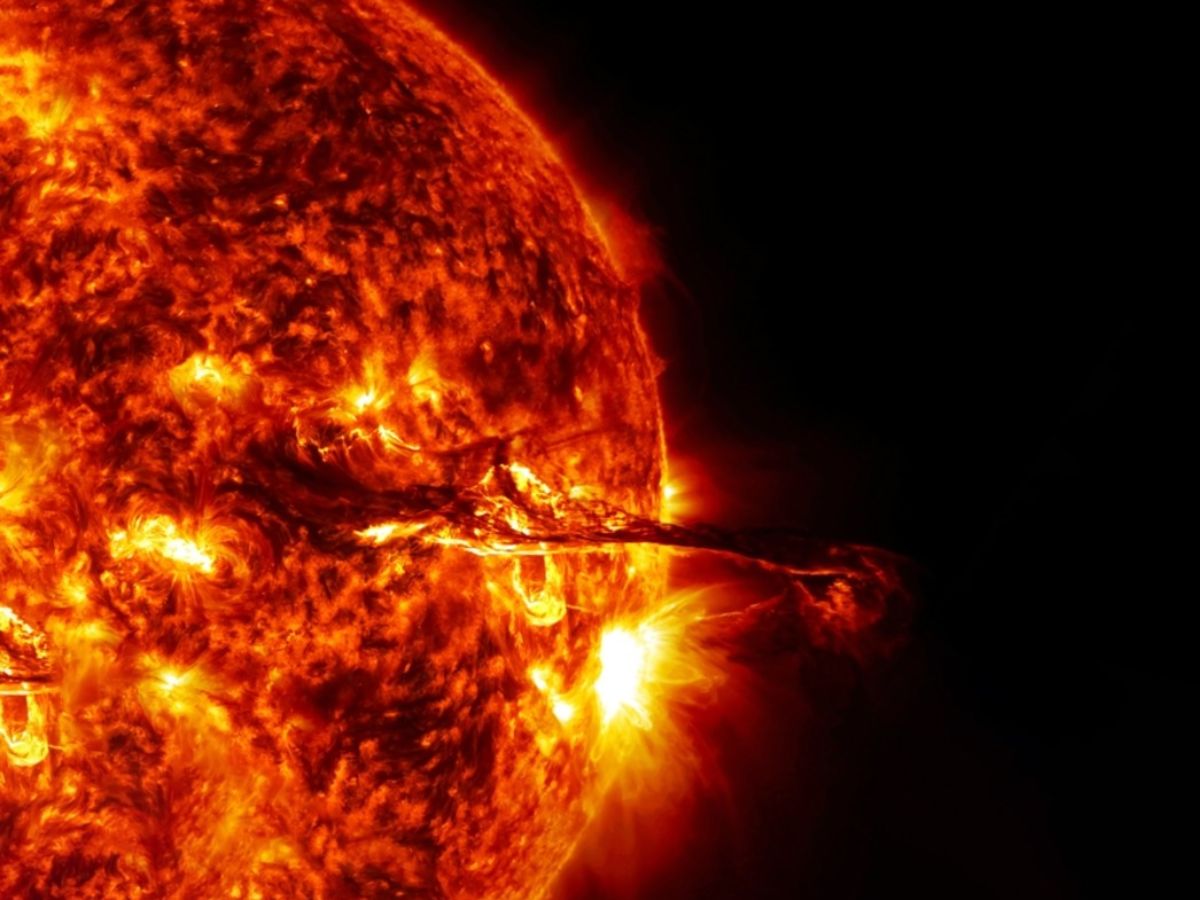
Strongest Solar Storm In 20 Years Hits Earth (Picture Credits: X)
Solar Storms: A powerful burst of energy from the Sun has struck Earth, triggering what scientists say is the most severe solar radiation storm in nearly 20 years. While the phenomenon has raised concerns among space-weather experts, it has also produced breathtaking aurora displays across regions that rarely witness the natural light show.
Space agencies have been tracking the storm for days as solar activity intensified. Authorities are now evaluating its possible effects on satellites, aviation routes and communication networks, even as skywatchers share dramatic visuals from across the globe.
The US National Weather Service’s Space Weather Prediction Center (SWPC) confirmed that Earth is experiencing a severe S4-level solar radiation storm, the strongest recorded since October 2003. Solar radiation storms are graded on a five-point scale, with S4 classified as “severe” and rarely observed.
Such storms occur when the Sun releases high-energy particles at extreme speeds. When these particles reach Earth, they interact with the planet’s magnetic field, potentially interfering with satellite operations, space missions and high-frequency radio communications, especially in polar regions. Officials warned that radio blackouts could occur along some polar flight paths during the storm’s peak.
Beyond its technical impact, the storm has delivered striking auroral displays. In Alaska, residents of Anchorage witnessed vibrant green and red lights illuminating the early morning sky, drawing crowds of commuters, joggers and dog walkers.
The spectacle was not limited to the far north. Social media users shared images of auroras from locations including San Francisco, Chicago, parts of Canada and several European countries. Similar events in recent months have pushed auroras as far south as Texas in the United States and parts of the United Kingdom and Hungary.
Auroras form when charged solar particles collide with gases in Earth’s upper atmosphere, releasing energy as shimmering bands of light in shades of green, pink and purple. During intense solar storms, disturbances in Earth’s magnetic field allow these displays to spread to lower latitudes than usual.
Experts say elevated radiation levels could persist for several days, with intensity fluctuating as the storm evolves. Space-weather agencies are continuing to monitor conditions closely and are expected to issue updated advisories if the situation changes.
West Bengal Yuva Sathi scheme offers ₹1500 monthly aid to unemployed youth. Here’s how to…
Bihar Civil Court Peon Admit Card 2026 Out: Check Exam Details, And Direct Link To Download
The Bihar Civil Court has issued the Peon (Attendant) Admit Card 2026 for candidates who…
In Delhi’s Uttam Nagar, a dispute between two families escalated into a violent clash that…
