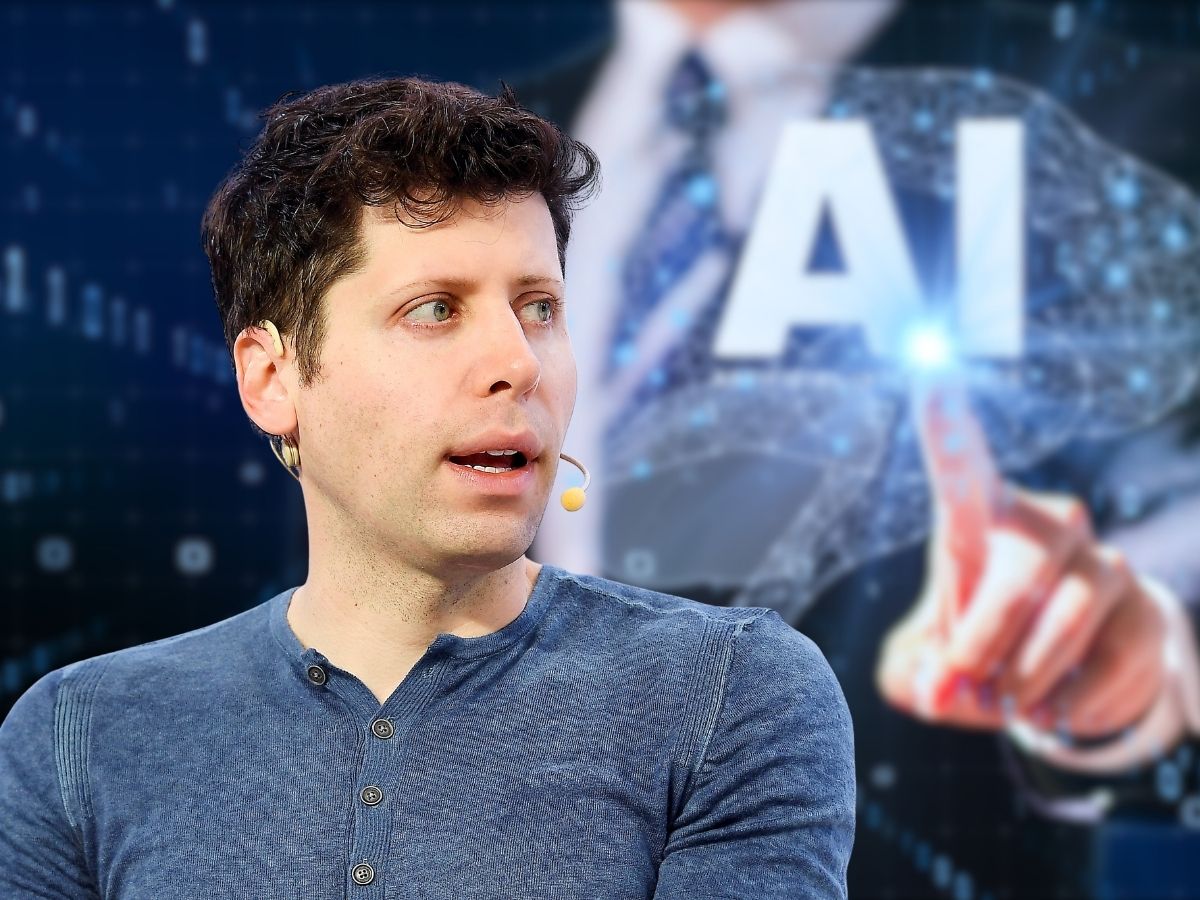
OpenAI CEO Sam Altman warned of an "impending fraud crisis" as AI advances. He urged caution on voice-based security and superintelligent systems. (Photo: Canva modified)
OpenAI CEO Sam Altman has raised serious concerns about the dangers artificial intelligence could pose, especially when it comes to fraud, misuse, and societal disruption, according to a report published by CNN on Tuesday. Speaking at a Federal Reserve event, Altman reportedly said the world could be heading into a “significant, impending fraud crisis,” driven by the misuse of AI tools that can convincingly imitate human voices and faces.
“A thing that terrifies me is apparently there are still some financial institutions that will accept a voice print as authentication… AI has fully defeated most of the ways that people authenticate currently, other than passwords,” Altman said, per CNN.
He emphasised how easily people could now be tricked, with voice cloning already being used to scam parents by impersonating children. The latest example being US Secretary of State Marco Rubio’s faked voice in calls to public officials. “Right now, it’s a voice call; soon it’s going be a video or FaceTime that is indistinguishable from reality,” he warned.
Altman further warned about the potential dangers associated with AI “superintelligence” falling into the wrong hands, for instance, adversarial governments possibly using AI in an attempt to attack power grids or even create bioweapons.
The OpenAI CEO backed a tool called The Orb, developed by Tools for Humanity, which aims to provide “proof of human” identity online.
Altman also cautioned against giving AI too much control or decision-making authority too soon.
ALSO READ: What Is Dark Web? Everything You Need To Know About The Internet’s Hidden Side
Reflecting on AI’s impact on employment, Altman said, “No one knows what happens next.”
Noting that it is “too complex of a system, and “too new and impactful of a technology”, he further said, “It’s very hard to predict,” as reported by CNN.
He also underlined that the “entire classes of jobs will go away,” while expressing belief that new forms of work will emerge.
Altman even suggested that future workers might not have “real jobs” as we define them today. “You’re making up a job to play a silly status game and to fill your time and to feel useful to other people.”
Amid rising concerns, OpenAI is reportedly expanding its presence in Washington, D.C. The company, only recently, announced plans to open a new office in early 2026, housing its government affairs team and research on AI’s economic impacts.
As part of this expansion drive, OpenAI’s first chief economist, Ronnie Chatterji, released a new report comparing AI to the transformative power of electricity. Chatterji pointed out that ChatGPT has 500 million users worldwide, with 20% of American users treating it as a personalised learning tool.
Chatterji, the report said, is planning to collaborate with economists Jason Furman and Michael Strain on a deeper study of AI’s effects on the workforce—research that will take place at the new D.C. office.
Meanwhile, OpenAI has also warned of AI risks, urging the Trump administration to avoid overregulation. The company recently opposed a provision that would have stopped the US states from enforcing AI laws for 10 years. The Senate recently struck that measure from the bill.
ALSO READ: What Is A ‘Zero-Day’ Exploit? Microsoft SharePoint Hack Putting Govts at Risk | Explained
The Karnataka Lokayukta police intensified their crackdown on corruption after a Bengaluru police inspector was…
Novak Djokovic underlined his GOAT status by defeating defending champion Jannik Sinner in a gripping…
Rajkot (Gujarat) [India], January 30: Anchored in the principles of the National Education Policy (NEP)…
