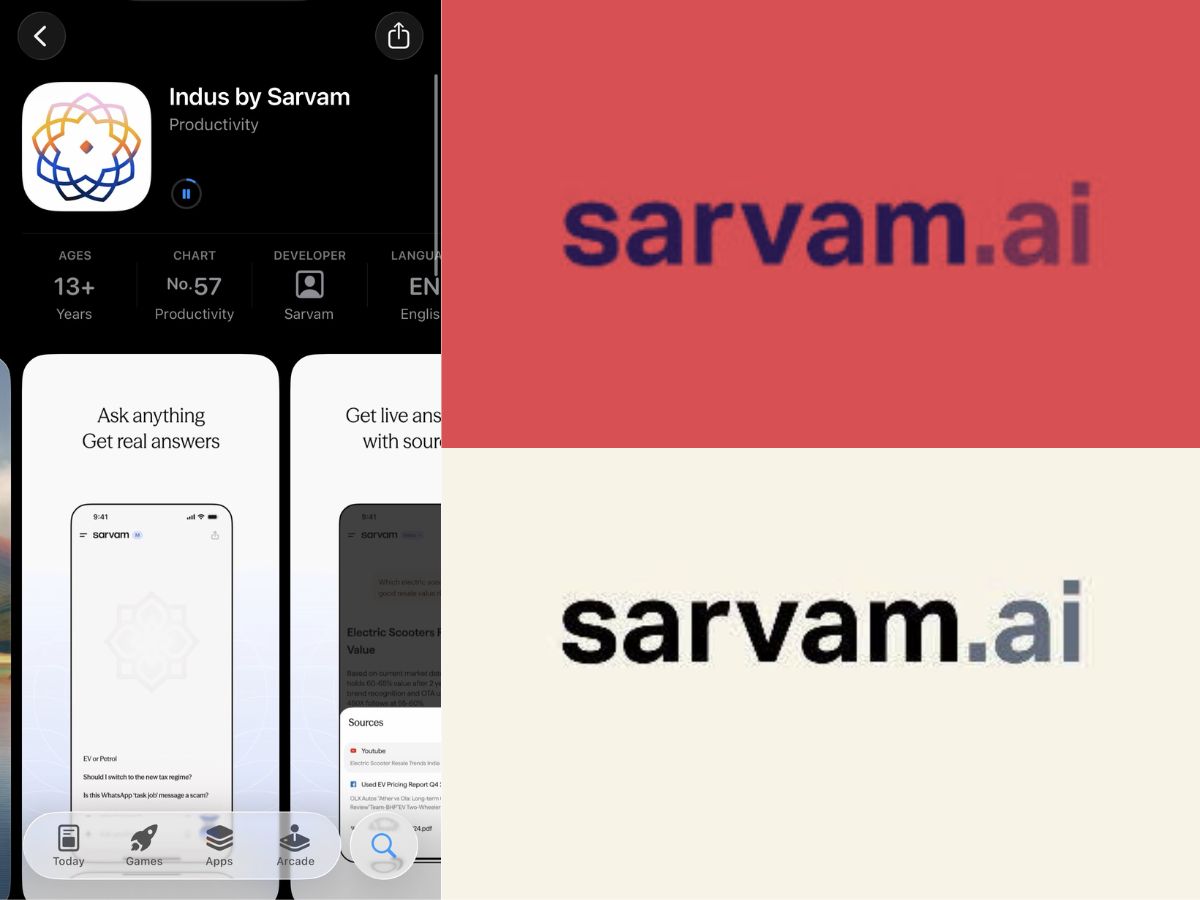
Sarvam launches Indus AI. (Photo: X)
India’s artificial intelligence race has gained fresh momentum as Bengaluru-based startup Sarvam AI launched its homegrown AI chatbot app, Indus AI.
Positioned as a rival to global platforms like ChatGPT and Google Gemini, Indus aims to offer an India-first AI experience with strong regional language support and locally trained models.
The company says Indus is built entirely in India and designed specifically for Indian users.
At a time when AI tools are increasingly shaping education, governance, and enterprise, Sarvam’s latest move is being seen as a step toward strengthening India’s technological self-reliance under the Atmanirbhar Bharat vision.
One of Indus AI’s biggest highlights is its support for multiple Indian languages. Users can chat in Hindi, English, and several regional languages, and even switch between languages seamlessly within the same conversation. This code-mixed flexibility addresses a major gap in global AI tools that often struggle with Indic scripts and blended speech patterns.
Indus allows users to speak their queries instead of typing them. The voice-enabled feature is expected to improve accessibility, especially for users more comfortable with verbal communication.
Users can upload PDFs, images, and documents. The AI can read and analyse these files to answer related questions a feature useful for students, researchers, and professionals.
Like its global competitors, Indus helps users draft, edit, and refine content directly within the app.
The platform may include AI agents capable of automating routine tasks, signalling Sarvam’s ambition to move beyond a simple chatbot into a productivity ecosystem.
While Sarvam has not officially confirmed the exact engine behind Indus, the company recently unveiled two large language models Sarvam-30B and Sarvam-105B at the India AI Impact Summit 2026. If Indus runs on these indigenous models, it could become one of India’s first consumer AI apps powered by a fully homegrown AI stack.
Beyond chat, Sarvam also introduced Sarvam Vision, a multilingual document intelligence model, and Bulbul V3, a text-to-speech engine tailored for Indian languages. These developments signal the company’s broader ambition to build a sovereign AI ecosystem optimised for 22 Indian languages, governance applications, and population-scale deployment.
Indus is available on the Google Play Store and Apple App Store. However, access is currently limited through a waitlist system:
Download the app from Android or iOS stores
Sign up using your phone number
Join the waitlist and wait for approval or an invite
The limited rollout suggests Sarvam is testing the platform before a wider public release.
India’s AI ecosystem has largely relied on global models developed in the US and China. A successful homegrown alternative could reduce technological dependence and promote data sovereignty.
By focusing on Indic languages, governance use cases, and local challenges, Sarvam AI is positioning Indus as more than just another chatbot. If the app delivers competitive performance against ChatGPT and Gemini, it could mark a significant milestone in India’s push for digital self-reliance.
While its real-world performance will become clearer over time, Indus represents an important shift from AI adoption to AI creation. And in the broader context of Atmanirbhar Bharat, that shift could prove transformational.
Sofia Babu Chacko is a journalist with over five years of experience covering Indian politics, crime, human rights, gender issues, and stories about marginalized communities. She believes that every voice matters, and journalism has a vital role to play in amplifying those voices. Sofia is committed to creating impact and shedding light on stories that truly matter. Beyond her work in the newsroom, she is also a music enthusiast who enjoys singing.
Vijay Raghavendra shines in Second Case of Seetharam X, a dark, twisty crime thriller with…
Tanya Mittal has set social media buzzing after sharing photos in bridal-style lehengas with captions…
UP couple Rambhawan and Durgawati sentenced to death for sexually assaulting 33 children in “rarest…
