
Categories: Viral NewsWorld

Historic Rewind: For First Time After Independence, Pakistan Brings Back Sanskrit And Plans Epic Studies In Gita and Mahabharat – But Why Now?

Pakistan’s LUMS introduces Sanskrit for the first time since Partition, offering courses on the Mahabharata and Bhagavad Gita, reclaiming cultural heritage, exploring ancient texts, and bridging historical and linguistic divides.

Add NewsX As A Trusted Source
Add as a preferred
source on Google
Published by Aishwarya Samant
Published: December 13, 2025 10:37:46 IST

Pakistan Brings Back Historic Sanskrit Course At LUMS

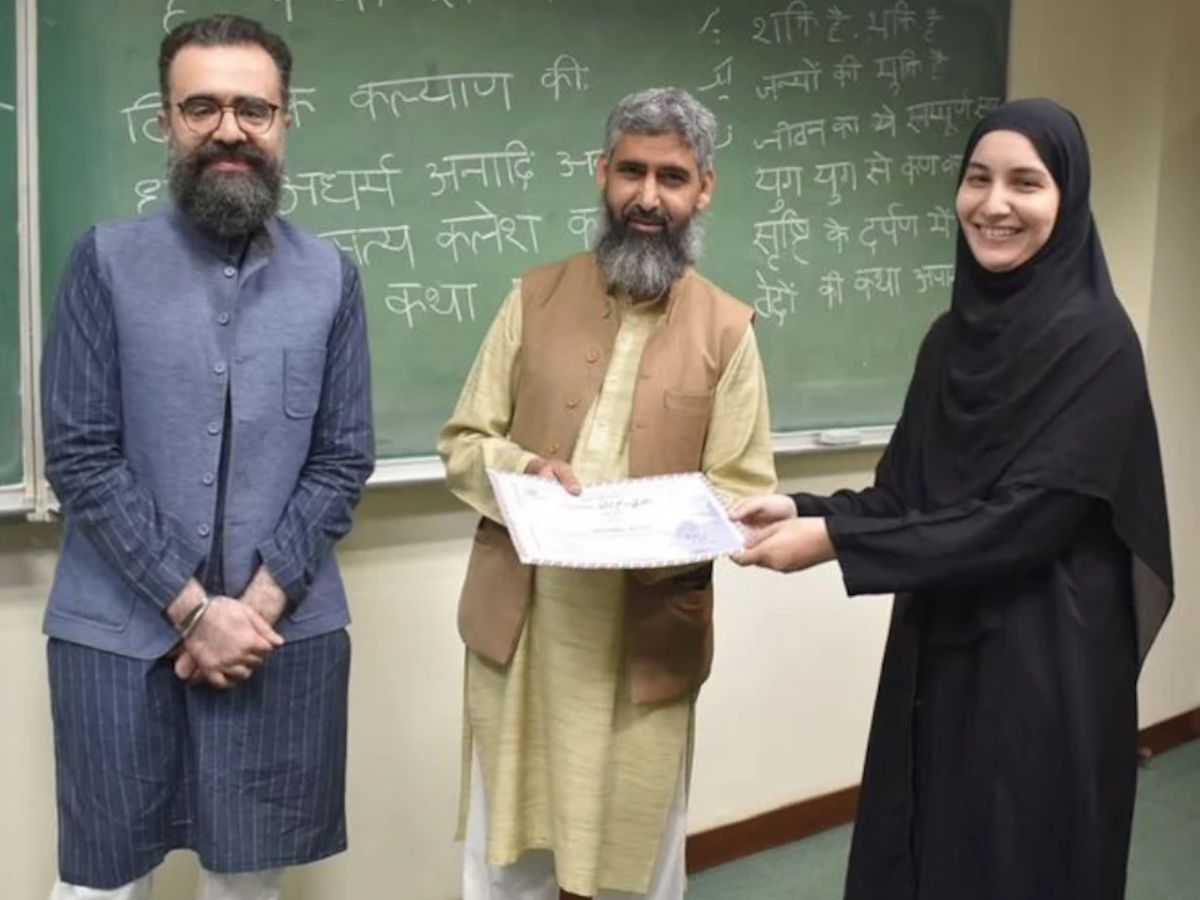
For the first time since the 1947 Partition, the Lahore University of Management Sciences (LUMS) has introduced a formal, credited course in Sanskrit. What began as a three-month weekend workshop, met with an overwhelming response from students and professionals, has now been upgraded to a four-credit university course, with plans to expand it into a year-long program by 2027.

What Is Making All Of Us Curious?

Almost after so decades of denial, the neighbouring country seems to have finally woken up in its education system , and guess what? It has started with Sanskrit, claiming it as “theirs too.”

But the major question that arises is, why NOW? Wasn’t it the language for so many years after independence or before that as well?

From what history tells us, the region’s academic languages were primarily Sanskrit and Urdu , English came much later with the Britishers. Since 1947, India continuously updated its syllabus, embracing Sanskrit’s legacy as a classical language. Meanwhile, Pakistan seemed to be in denial about Sanskrit being a base language in its own soil.

Isn’t it funny that now, when the world has recognised Sanskrit’s value, history, and authenticity, Pakistan suddenly says, “HUMARI BHI HAI”? It’s dramatic, it’s witty, and undeniably a jibe at the timing , finally acknowledging a shared cultural heritage, decades too late, but better late than never!

Why Has Pakistan Introduce Sanskrit Again? To Focus On Ancient Epics Now

The very bold and interesting decision of the Gurmani Centre for Languages and Literature at LUMS to offer courses on the Mahabharata and Bhagavad Gita,  these are the two most important epics of South Asia and are deeply rooted in India, has already created a lot of interest and got a lot of people talking.
However, the students will not be told how to interpret the literature religiously, and that is the main point of this lecture series. This means soon the students will be able to read these texts through a literary, philosophical, and historical lens, unpacking the very stories that have been told in the region for ages.
What is even more interesting? 

They are making cultural and linguistic connections , like, for example, looking into the Urdu version of the Mahabharat TV series’ theme song. It is a smart, fun way to show how narratives and notions go around, change, and find their place in different languages.

Just think about this, classroom following the path of Arjuna’s chariot and Krishna’s advice through the mists of time and realizing that these ancient stories are not only Indian , they are world culture’s shared treasures. 

Cultural Reclamation: Why Sanskrit Matters

The LUMS Sanskrit initiative is not just an academic course but an audacious act of cultural and intellectual reclamation, ending a 70-year silence since Partition. Experts like Dr. Shahid Rasheed and Dr. Ali Usman Qasmi point out that Sanskrit is a common heritage of South Asia that transcends religious divides. The language of the great grammarian Panini, whose birthplace is located in present-day Pakistan, is a stark reminder of the intertwined history of the region. 

According to a media report by The Tribune, Dr. Ali Usman Qasmi, Director of the Gurmani Centre, said, “Pakistan has one of the richest yet most neglected Sanskrit archives at the Punjab University library. A significant collection of Sanskrit palm-leaf manuscripts was catalogued in the 1930s by scholar J.C.R. Woolner, but no Pakistani academic has engaged with this collection since 1947. Only foreign researchers use it. Training scholars locally will change that.”

By declaring Sanskrit to be “ours too,” LUMS invites students and scholars to delve into the ancient world of knowledge, to uncover the literary treasures, to trace the historical continuity which leads to the present day, thus creating a region of pride and awareness around a culture that has been long forgotten, and a legacy that has been deep-rooted in ancient times.

(With Inputs From ‘X’ And Media Reports)

Also Read: Delhi Weather Update: Rain To Return In Delhi? UP On Yellow Alert, Check Weather…

Recent Posts

Billion-Dollar Birthday: A Look At Taylor Swift’s $1.6B Net Worth On Her 36th Birthday

Taylor Swift is celebrating her 36th birthday. She is the richest female musician in the…

December 13, 2025

‘Once Again, Mismanagement And Sheer Incompetence…’: BJP Slams TMC After Chaos At Lionel Messi’s Stadium Visit

Fans were left disappointed when Lionel Messi left the Salt Lake Stadium and started throwing…

December 13, 2025

Delhi 13 Districts: Full List Of New Districts, Map Changes And Key Benefits

The Delhi Cabinet has approved a plan to increase districts from 11 to 13. The…

December 13, 2025