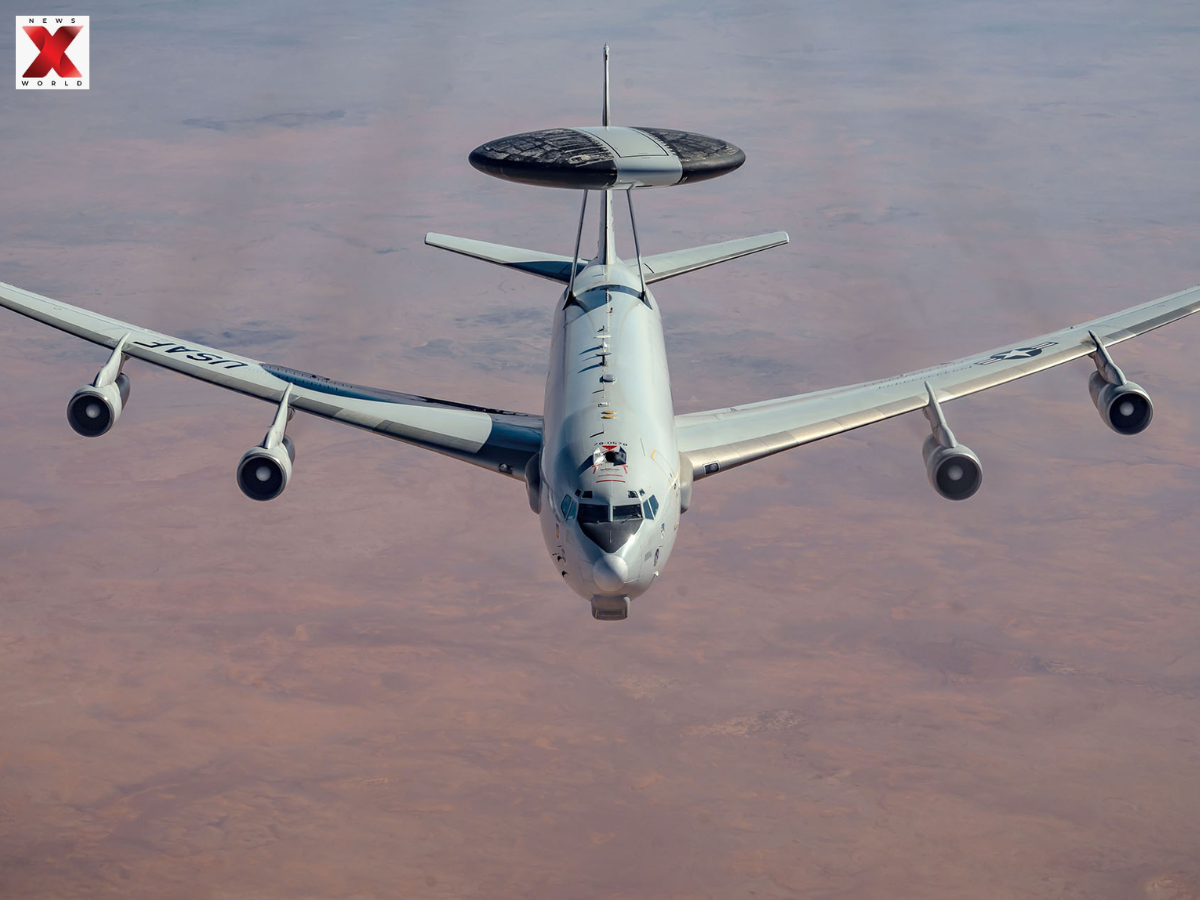
E-3 Sentry AWACS (IMAGE: X)
On Friday, Iran stepped up its missile attacks against Israel and Gulf Arab nations, even hitting a military base in Saudi Arabia. U.S. officials say the strike at Prince Sultan Air Base wounded at least 10 U.S. service members, with two in serious condition.
The attack didn’t just injure people; it also damaged several U.S. refuelling aircraft, according to two officials who shared details on background because of the sensitivity of the situation. One of them emphasised that two troops are seriously hurt.
Satellite photos back this up. Images from March 27, 2026, show visible damage on a section of the base used by U.S. planes. At first, analysts thought these images might be linked to an earlier incident.
But then European satellite Sentinel-2, using short-wave infrared imaging, picked up a clear heat signature right at the damaged spot likely from fires or burning wreckage.
There’s also talk that an E-3 Sentry AWACS surveillance plane took a hit, though so far, nobody’s confirmed it for sure. The U.S. Central Command hasn’t made any public statements yet.
The E-3 Sentry AWACS isn’t just a regular plane—it’s a tricked-out Boeing 707 that works as an airborne command center. Picture that big radar dome spinning on top. That’s how it keeps watch, scanning the skies in any weather. It can spot targets, identify what’s out there, and keep tabs on battlefield chaos for up to 250 miles all around.
Surveillance & Early Warning: The E-3 can pick out enemy planes, figure out exactly what they are, and track where they’re headed. Its radar sees in every direction, so nothing sneaks by, not even low-flying threats hugging the terrain.
Battle Management & Control: This thing isn’t just a flying sensor; it’s a boss in the sky. The crew coordinates air battles by sending interceptor jets to the right spots, overseeing air operations, and even helping ground troops with support and reconnaissance.
Sharing the Big Picture: The Sentry’s not greedy with information. It scoops up intel about both enemy and friendly forces, then shares all that in real time with command centers on the ground, ships at sea, and other planes in the air.
Staying Power: On its own, the E-3 can stay airborne more than 8 hours, and with in-flight refueling, it can keep going much longer. So when the battle drags on, it doesn’t have to head back anytime soon.
On March 25, the commander of CENTCOM, Adm. Brad Cooper, reported that more than 90 percent of Iranian missile and drone attacks reduced since the conflict began on Feb. 28.
Cooper, in a video statement, has said that they have destroyed or damaged more than 2 of the Iranian missile, drone, and naval production facilities and shipyards. We are heading toward destroying the extended military production complexes of Iran totally.
Nevertheless, Iran is still able to fire missiles as this episode demonstrates and still manages to strike U.S. bases and targets directly and indirectly even at the cost of diminishing assets.
One of the key U.S. military bases in the Middle East is Prince Sultan Air Base which serves as a location of various aircraft that contribute to the operations against Iran.
U.S officials have reported more than 300 service personnel who have been injured in Operation Epic Fury. It has already killed thirteen service members, among them a Soldier who had been killed in Prince Sultan Air Base in an earlier attack on the base in early March.
Vijay faced chaos outside the Tamil Nadu State Secretariat in Chennai as crowds mobbed him…
Christopher Cooter says Mark Carney visit boosted India-Canada ties, with focus on education, culture &…
Both Royal Challengers Bengaluru (RCB) and SunRisers Hyderabad are wearing black armbands in the ongoing…
