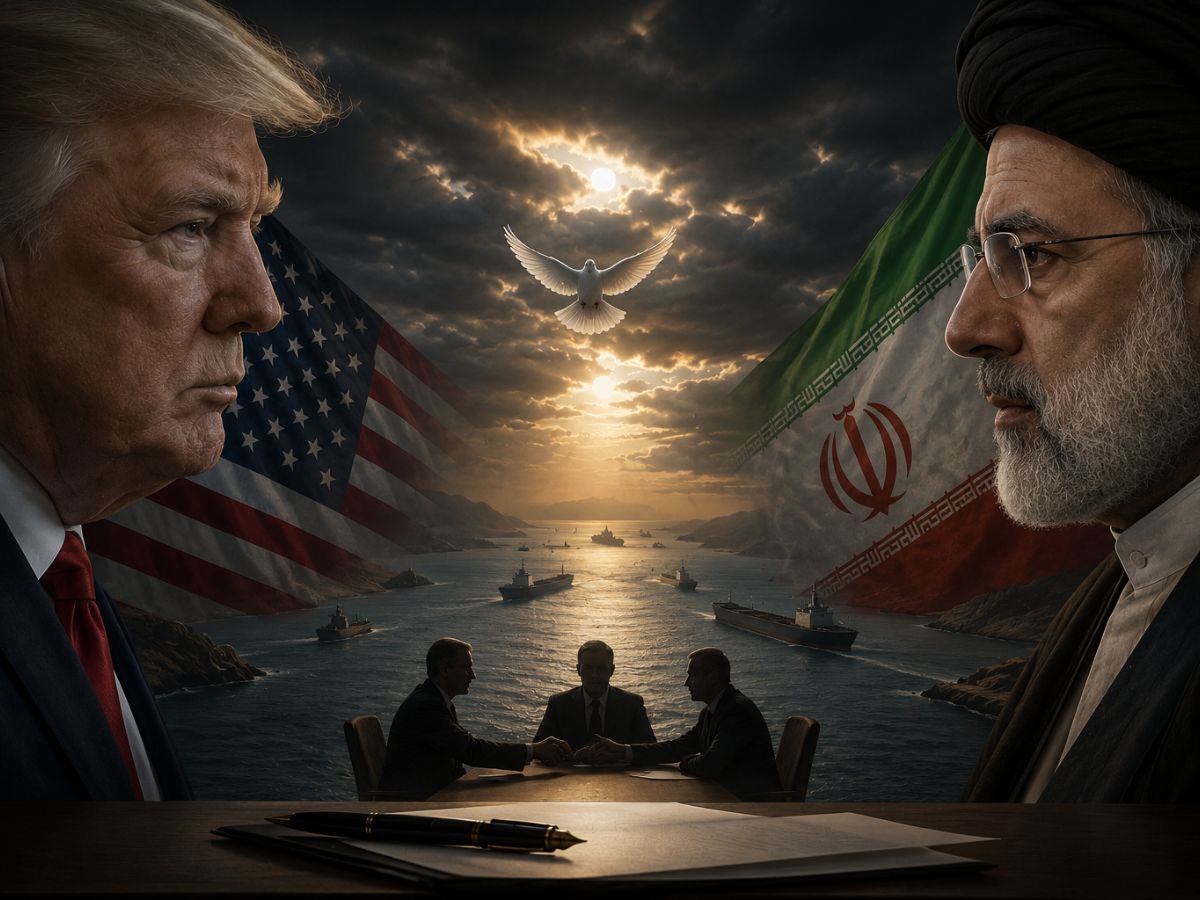
US-Iran peace deal may be signed soon, but Tehran’s trust deficit with Trump clouds final breakthrough. Photo: AI
The United States and Iran appear to be edging closer to a peace agreement that could potentially end a conflict that has continued for more than three months. But despite public announcements and diplomatic signals, uncertainty remains over whether the deal will actually be signed on Sunday and whether Tehran is prepared to trust Washington’s commitments. US President Donald Trump announced on Saturday that the agreement between Washington and Tehran is scheduled to be signed on Sunday (local time). Adding to expectations around a breakthrough, Pakistani Prime Minister Shehbaz Sharif said the agreement could be finalised within the next 24 hours, after which both countries would move toward an electronic signing process.
“With finalisation likely expected in the next 24 hours, Pakistan is preparing for the electronic signing of the peace deal immediately after, followed by technical level talks next week,” Sharif was quoted as saying by The Associated Press.
Trump also claimed that Iran “no longer” wants to pursue a nuclear weapon and said that once the agreement is completed, the Strait of Hormuz would become “open to all.” Despite growing optimism from Washington, Tehran has adopted a noticeably more restrained position.
Iranian foreign ministry spokesperson Esmail Baghaei said no final date had been confirmed and cautioned against premature conclusions.
“We must wait for the exact timing of the agreement’s signing. It will not happen tomorrow, but it could take place in the coming days. Due to the other side’s inconsistency, we must remain cautious in commenting on the process,” IRIB quoted Baghaei as saying.
Publicly, disagreements between the United States and Iran continue to revolve around familiar issues, nuclear enrichment, sanctions, regional influence and broader security concerns. But beneath those disputes lies a recurring obstacle – trust. Iran has long viewed the United States through a lens of strategic inconsistency and deception, shaped by previous rounds of diplomacy that later collapsed.
Indirect high-level talks between the two countries began in April 2025 in Muscat, Oman. The discussions were mediated by Oman and involved US special envoy Steve Witkoff and Iranian Foreign Minister Abbas Araghchi. Several rounds of negotiations followed through June 13, 2025.
However, the diplomatic process collapsed after Israel and the United States launched strikes targeting Iranian nuclear and military facilities.
Talks resumed in February 2026. New meetings took place in Oman and later in Geneva. Mediators described the third round held on February 26 as the “most intense” stage of discussions, pointing to “significant progress” and outlining plans for technical follow-up discussions in Vienna.
Yet less than 48 hours later, on February 28, coordinated strikes by the United States and Israel triggered the conflict that evolved into the current war. For Tehran, these events are not viewed as isolated breakdowns but as part of a broader historical pattern.
Iran’s mistrust of Washington has roots that extend well beyond the current conflict. During Trump’s first term, the United States withdrew from the 2015 Iran nuclear agreement. formally known as the Joint Comprehensive Plan of Action (JCPOA), on May 8, 2018.
The withdrawal came despite international inspectors confirming that Iran was complying with the terms of the agreement. Following the exit, Washington reinstated extensive sanctions under what became known as the “maximum pressure” campaign.
Tensions escalated again in early 2020 after the US assassination of Iranian General Qassem Soleimani, an action Tehran regarded as an act of war and one that prompted Iran to move away from JCPOA limits on uranium enrichment. Iranian officials now point to the events of 2026 as another example of what they describe as a recurring sequence: diplomatic engagement followed by military escalation.
That uncertainty has made full engagement with the process more difficult.
The central question remains: Trump has said the agreement is “scheduled to get signed” on Sunday and has projected that it would reopen the Strait of Hormuz. But until signatures are exchanged and commitments are tested over time, the larger question remains unresolved: will Iran trust Donald Trump enough to believe this deal will hold?
Also Read: Iran-US-Israel War LIVE and Latest Updates
Zubair Amin is a Senior Journalist at NewsX with over seven years of experience in reporting and editorial work. He has written for leading national and international publications, including Foreign Policy Magazine, Al Jazeera, The Economic Times, The Indian Express, The Wire, Article 14, Mongabay, News9, among others. His primary focus is on international affairs, with a strong interest in US politics and policy. He also writes on West Asia, Indian polity, and constitutional issues. Zubair tweets at zubaiyr.amin
India Approves 100% Ethanol Fuel: What It Means For Your Car, Petrol Prices
Union Minister for Road Transport and Highways Nitin Gadkari announced that India has approved legal…
Chennai Power Cut Today (14 June, 2026)
Chennai Power Cut News: Frequent outages across several areas have disrupted daily life, prompting complaints,…
Bengaluru Horror: Sikkim Woman Murdered Over Friendship Suspicion
Two separate murder cases in Karnataka have led to arrests. In Bengaluru, a 22-year-old Sikkim…
