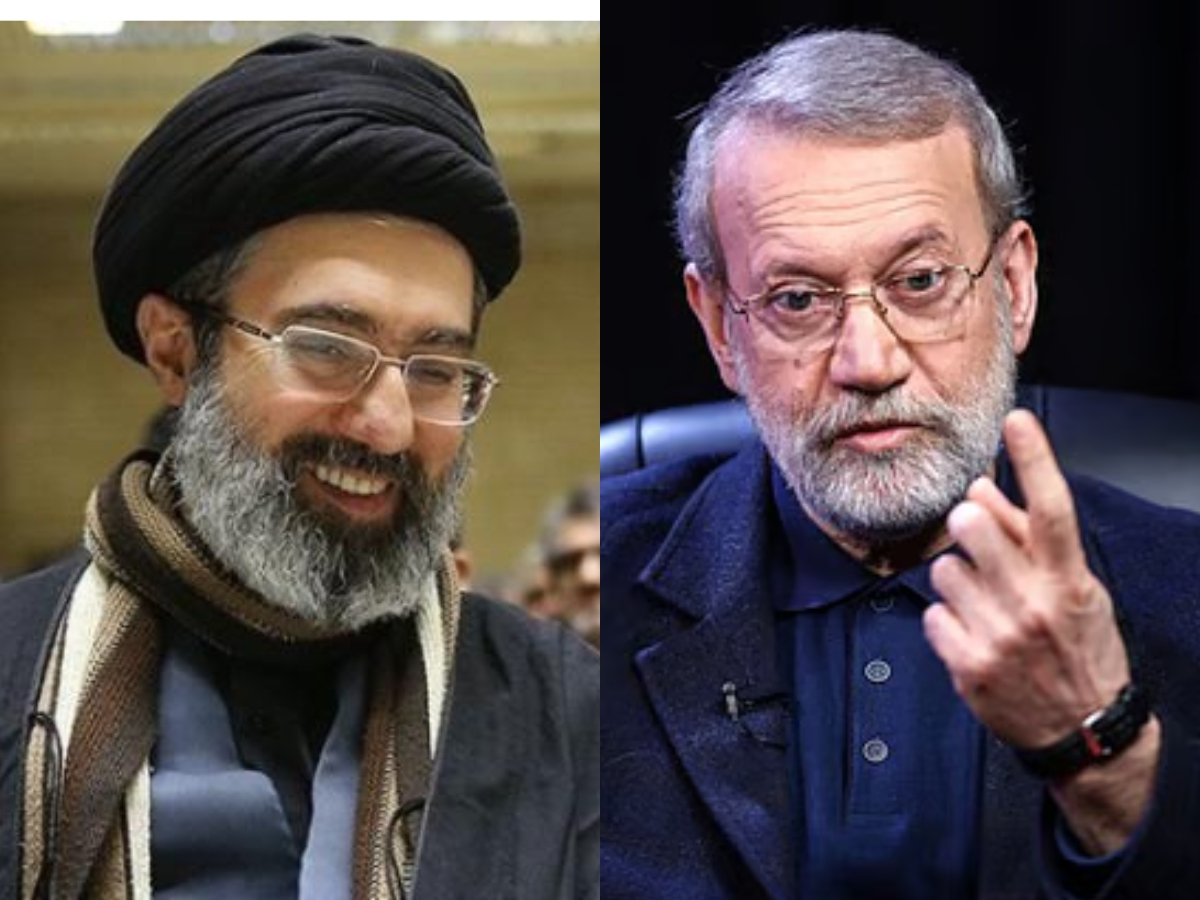
Mojtaba Khamenei named Iran’s Supreme Leader after Ali Khamenei’s death, but Ali Larijani’s camp sparks power struggle. Photos: X.
Iran’s military and political leadership has pledged allegiance to Mojtaba Khamenei, who has been named the new Supreme Leader following the death of his father, Ali Khamenei, in a joint US-Israeli strike on Tehran.
The succession comes as the United States and Israel continue to bombard Iranian targets. Explosions were reported in Qom and Tehran, hours after Israeli attacks on oil facilities triggered toxic smoke across the Iranian capital.
Despite Mojtaba Khamenei’s elevation, reports say the move may not resolve the deepening power struggle within the Islamic Republic’s political and security establishment.
According to reports, the decision to elevate Mojtaba Khamenei has exposed divisions within Iran’s ruling elite.
Several Iranian clerics and officials have privately indicated that voting within the Assembly of Experts had already taken place and that the leadership transition had been finalised earlier.
Reports say that the official announcement was complicated by factional rivalries and growing concerns about regime stability during wartime.
While key clerical bodies internally moved toward Mojtaba, divisions among Iran’s political and security elites are likely to persist. Observers warn that the internal contest for influence could continue even after the succession decision.
At the centre of the internal conflict is Ali Larijani, a long-time regime insider whose political network and clerical standing continue to give him significant influence across Iran’s executive and security establishment.
Tensions reportedly intensified between Larijani and Iran’s parliament speaker Mohammad Bagher Ghalibaf, who is widely viewed as a supporter of Mojtaba Khamenei.
According to reports, the rivalry between the two camps, both deeply embedded within Iran’s political and security institutions, has been a key factor complicating the leadership transition.
Reports describe the situation as a “deep rift” within the regime over how the succession should unfold and who will ultimately control the levers of power after the transition.
Mojtaba Khamenei’s elevation has also triggered ideological concerns among sections of Iran’s clerical establishment.
According to reports, some senior clerics fear that appointing the son of the late Supreme Leader could appear as a dynastic transfer of power. Such a perception, they warn, could undermine the Islamic Republic’s long-standing claim of clerical legitimacy and revolutionary governance.
The Islamic Revolutionary Guard Corps remains central to both Iran’s war effort and its domestic political balance.
While the country is engaged in an expanding regional confrontation, the IRGC has also played a major role in the succession debate.
Reports indicate the powerful security force has strongly backed Mojtaba Khamenei despite constitutional sensitivities and resistance from sections of the clerical establishment.
Ali Larijani has also reportedly intervened in the deliberations to promote his brother Sadeq Larijani as a candidate for the position of Supreme Leader.
The Larijani family represents more than a single political figure. Over decades, five brothers from the family have occupied key positions across Iran’s security, judicial, legislative and bureaucratic institutions.
Research by the Clingendael Institute, a Dutch think tank, has highlighted how family relationships within Iran’s clerical and political elite often serve as channels of confidence in sensitive appointments.
Ali Larijani re-emerged prominently in August 2025 when he was reinstated as Secretary of the Supreme National Security Council.
The position grants oversight of the country’s nuclear file, regional coordination and internal crisis management.
Zubair Amin is a Senior Journalist at NewsX with over seven years of experience in reporting and editorial work. He has written for leading national and international publications, including Foreign Policy Magazine, Al Jazeera, The Economic Times, The Indian Express, The Wire, Article 14, Mongabay, News9, among others. His primary focus is on international affairs, with a strong interest in US politics and policy. He also writes on West Asia, Indian polity, and constitutional issues. Zubair tweets at zubaiyr.amin
Sanju Samson played three very crucial knocks for India in the T20 World Cup 2026…
Israeli airstrikes hit around 30 Iranian fuel depots in Tehran, triggering massive fires and thick…
Bahrain’s state-owned oil company declared force majeure after Iranian strikes hit its refinery complex, disrupting…
