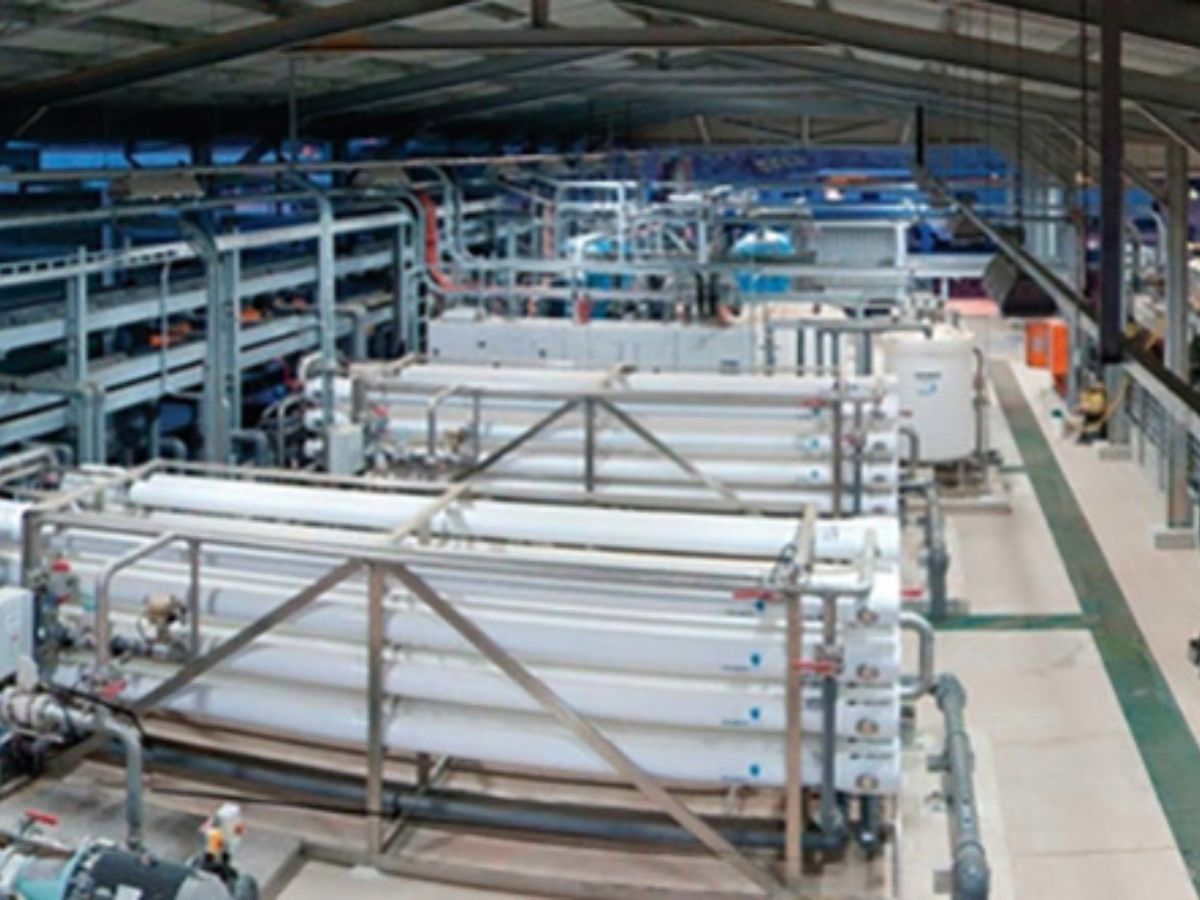
Japan unveils its first osmotic power plant in Fukuoka, a breakthrough in renewable energy after Denmark’s 2023 project. Photo/Kanadevia.
Japan has officially entered the global race to generate energy from the meeting of saltwater and freshwater, unveiling its first osmotic power plant in Fukuoka earlier this month.
The facility, operated by the Fukuoka District Waterworks Agency, is only the second in the world after Denmark’s pioneering project in 2023.
Experts see it as a crucial development in the search for renewable energy sources that can function continuously without weather limitations or carbon emissions.
Here’s a rewritten, professional version of the article with full factual accuracy, structured subheadings, and natural journalistic flow:
The plant, located in Fukuoka, produces electricity by exploiting the salinity difference between seawater and freshwater. According to the waterworks agency, the installation is expected to generate approximately 880,000 kilowatt-hours annually. This much energy is enough to cover the consumption of around 220 Japanese households.
Instead of supplying households directly, the electricity will be directed to a desalination facility that delivers clean water to residents of Fukuoka and nearby areas.
Also Read: Denmark: Three Americans Linked To Trump Accused Of A Covert Greenland Operation
The agency described osmotic generation as “a next-generation renewable energy source that is not affected by weather or time of day and emits no carbon dioxide.”
By relying on the natural flow of water molecules through a semipermeable barrier, the system avoids the intermittency issues common with solar and wind power.
Akihiko Tanioka, professor emeritus at the Institute of Science Tokyo and a long-time researcher in osmotic energy, welcomed the achievement.
Speaking to Kyodo News, he said, “I feel overwhelmed that we have been able to put this into practical use. I hope it spreads not just in Japan, but across the world.”
At the heart of the process lies osmosis, a principle understood by scientists for centuries. When freshwater and saltwater are placed on either side of a semipermeable membrane, water molecules naturally move toward the saltier side to balance concentrations.
Osmotic plants harness this by placing two water streams with different salinities opposite one another.
In Fukuoka, the freshwater source is treated wastewater from a sewage plant, while the saltwater stream comes from concentrated seawater produced during desalination.
As freshwater crosses the membrane, pressure builds on the saltwater side, driving a turbine linked to a generator. This generates electricity.
Although the concept appears simple, the technology is highly demanding. It requires large volumes of water, robust membranes capable of withstanding high pressures, and mechanisms to prevent impurities from passing through.
Recent advances in hollow-fibre forward-osmosis membranes have enhanced both durability and efficiency, features reflected in the design of the Fukuoka facility.
The idea of osmotic power dates back to the mid-20th century. In 1954, researcher R.E. Pattle first proposed that mixing freshwater with seawater could yield electricity.
In the 1970s, Professor Sidney Loeb – co-inventor of reverse osmosis desalination – developed pressure-retarded osmosis (PRO) after observing how the Jordan River naturally mixed with the Dead Sea.
Since then, multiple countries have attempted to bring osmotic power to life. Pilot projects were conducted in Norway, South Korea, Spain, Qatar, and Australia. Most, however, faced technical barriers and high costs, preventing commercial rollout.
The breakthrough came in 2023, when Danish company SaltPower opened the world’s first commercial osmotic power plant in Mariager. Using Toyobo’s hollow-fibre membranes, the facility demonstrated osmotic energy production at scale.
Japan’s new plant, while matching Denmark in annual output, is larger in scale and marks Asia’s first step into osmotic power generation.
Dr. Ali Altaee, an osmotic energy expert at the University of Technology Sydney, emphasized the significance of Japan’s progress.
He told The Guardian, “the electricity generated is the equivalent of powering about 220 Japanese households.”
Also Read: Greece Golden Visa: How Indians Can Live, Work, And Invest In Europe’s Dream Destination
Zubair Amin is a Senior Journalist at NewsX with over seven years of experience in reporting and editorial work. He has written for leading national and international publications, including Foreign Policy Magazine, Al Jazeera, The Economic Times, The Indian Express, The Wire, Article 14, Mongabay, News9, among others. His primary focus is on international affairs, with a strong interest in US politics and policy. He also writes on West Asia, Indian polity, and constitutional issues. Zubair tweets at zubaiyr.amin
NCERT Admit Card 2026 Released: Check Exam Dates And Key Details Here
The National Council of Educational Research and Training (NCERT) has released the NCERT admit card…
With the IPL 19th season approaching, AB de Villiers backs Virat Kohli's legendary trait to…
The National Commission for Women (NCW) has summoned actor Nora Fatehi, Sanjay Dutt, Raqueeb Alam,…
