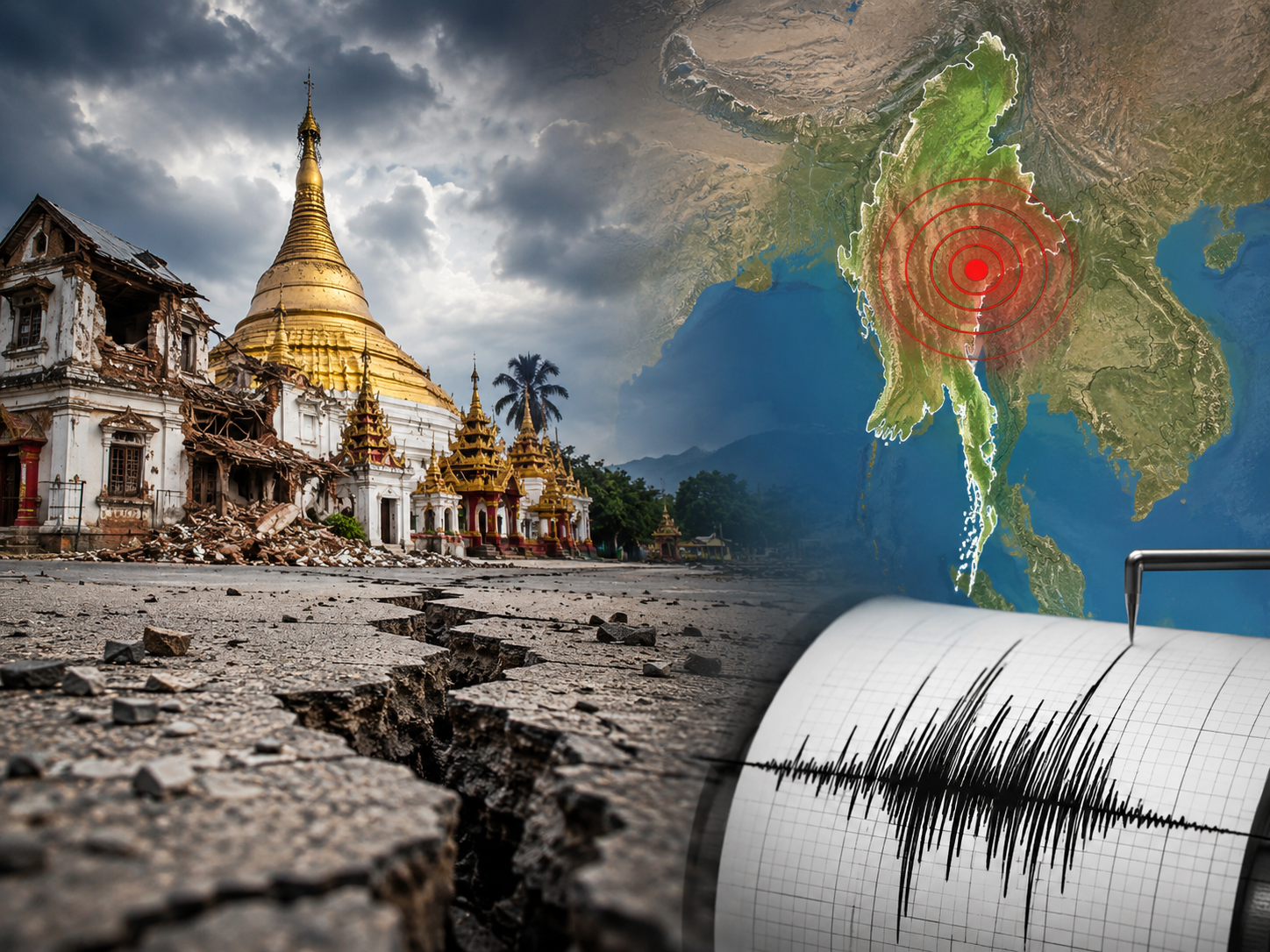
Mild Earthquake Of Magnitude 3.8 Hits Myanmar (Photo generated by AI)
An earthquake of magnitude 3.8 hit Myanmar, as reported by the National Centre of Seismology (NCS). The NCS on Saturday said the quake occurred at 11:31 pm Indian Standard Time. Its epicentre was located at latitude 22.258 N and longitude 96.092 E, at a depth of 10 kilometres. The relatively shallow depth of 10 kilometres suggests that the tremor may have been felt in nearby regions, although no immediate reports of damage or casualties have been confirmed. Earthquakes at shallow depths often release energy closer to the surface, which can increase the intensity of ground shaking in local areas.
A week earlier, an earthquake of magnitude 3.5 also hit Myanmar on Saturday, according to the National Centre of Seismology (NCS). Sharing the details in a post on X, the NCS said, ‘EQ of M: 3.5; On: 06/06/2026 01:33:34 IST; Lat: 23.930° N; Long: 94.568° E; Depth: 107 km; Location: Myanmar.’
The earlier quake was notably deeper at 107 kilometres, which typically reduces surface impact compared to shallow earthquakes. However, it still highlights ongoing tectonic activity in the region, which lies in one of the most seismically active zones in Southeast Asia.
Myanmar sits in a complex tectonic setting where four major plates interact, including the Indian, Eurasian, Sunda, and Burma plates. This constant movement makes the region prone to frequent seismic events of varying magnitudes. A major geological structure, the Sagaing Fault, runs for about 1,400 kilometres through the country, linking the Andaman spreading centre to a collision zone in the north. This fault significantly increases earthquake risk in cities such as Sagaing, Mandalay, Bago, and Yangon, which together account for nearly half of the country’s population.
Although the main fault line is farther from Yangon, the city remains vulnerable due to its dense population. Historical records show that in 1903, a magnitude 7.0 earthquake in Bago also affected Yangon, demonstrating how strong seismic events can impact wider regions.
Experts note that continued small and moderate tremors indicate ongoing stress release along active fault lines. While these recent earthquakes were not major, the underlying tectonic conditions suggest that preparedness remains important, especially in densely populated urban centres.
(Inputs From ANI)
ALSO READ: 5.2 Magnitude Earthquake Hits Southern Mexico’s Guerrero State | Watch
Harshita is a journalist and digital content writer specializing in breaking news, current affairs, travel, education, and trending stories. She is focused on delivering accurate, timely, and engaging content with a strong emphasis on clarity and audience relevance.
Bengaluru Weather Today: Heavy monsoon activity continued to lash Bengaluru on Saturday, with intense evening…
Iran Denies Trump Claim That Nuclear Deal Will Be Signed On Sunday
Iran has said a nuclear-related agreement is unlikely to be signed immediately, while Donald Trump…
Switzerland pays the price for a wasteful frontline despite unleashing 26 shots and registering a…
