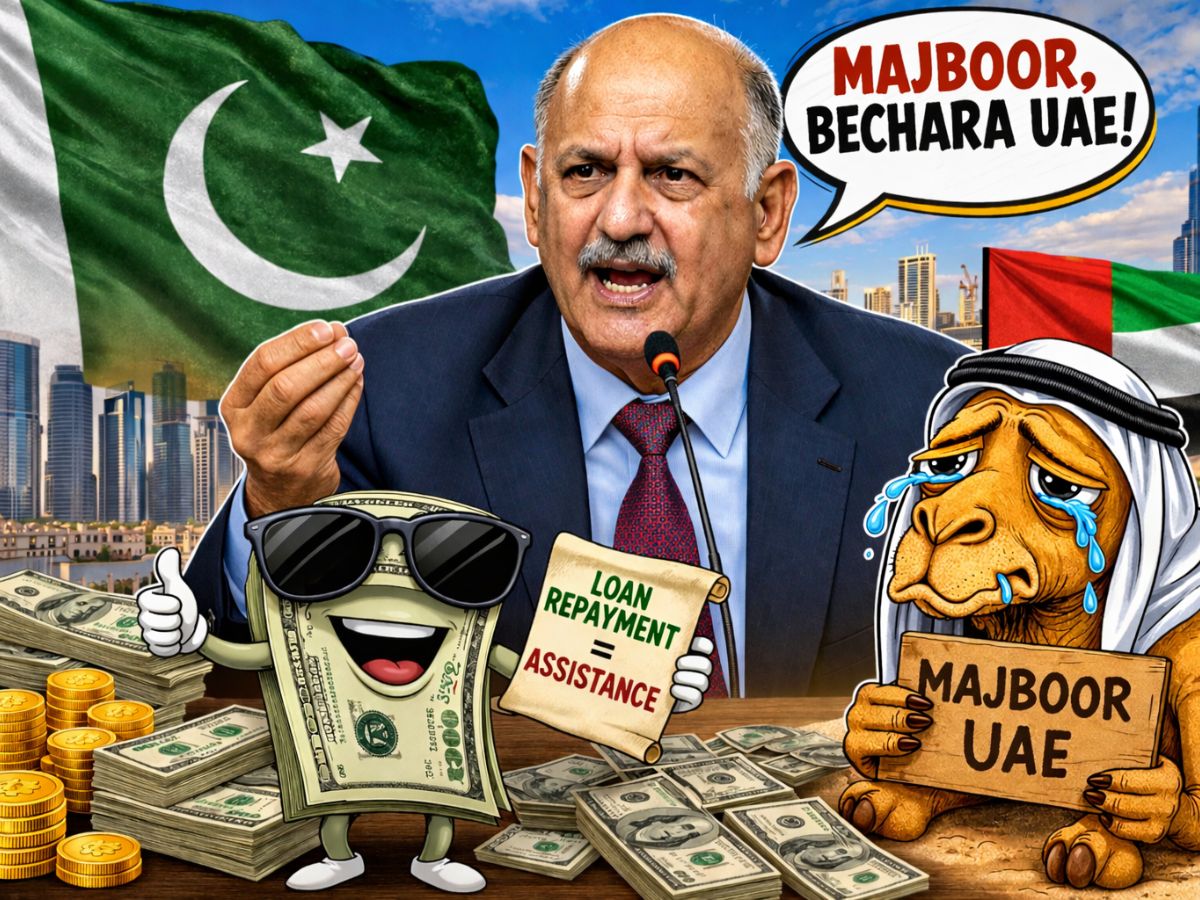
WATCH: Pakistani Senator’s ‘Majboor, Bechara UAE’ Remark Goes Viral On Social Media, Claims Loan Repayments Are 'Islamabad’s Assistance' (AI Generated Image)
In an outrageous explanation of Pakistan’s decision to pay back its multibillion-dollar debt to the United Arab Emirates, Senator Mushahid Hussain framed the return as an act of “brotherly rescue” for a country that he believes is currently “stuck and helpless.”
In an interview with Dunya News, Senator Mushahid Hussain discussed the rising tension between Pakistan’s recent strategic changes, particularly with regard to Iran, and its longstanding diplomatic alliances. In what he called the UAE’s “time of crisis,” he maintained that Pakistan has a moral obligation to assist the country. Critics of the payback were ignored by Hussain, who claimed that Pakistan is helping a brother in need. He emphasised Pakistan’s historical contribution to the establishment of the United Arab Emirates, which dates back to Sheikh Zayed bin Sultan Al Nahyan’s time.
“Pakistan made the right choice. Our brothers in the UAE are defenceless and in need. They gave us loans, which we are paying back during difficult times. We have consistently assisted them. We trained Pakistan’s military, which was crucial to the development of the UAE. Since the founding father and first president of the United Arab Emirates, Sheikh Zayed bin Sultan Al Nahyan, we have maintained cordial connections,” Hussain stated. Hussain reminded the audience that Pakistan was crucial in “building the UAE,” pointing out that Pakistani knowledge was especially helpful in preparing the UAE’s military. To justify his description of the UAE’s “crisis,” Hussain pointed to massive financial outflows and regional instability: He alleged that the UAE gave $150 billion (Dedh Kharab) to U.S. President Donald Trump, implying a significant drain on their reserves.
He went on to say that the UAE’s involvement in the ongoing hostilities in Sudan and Yemen has depleted their finances and put them in a precarious situation. “They are now stuck and powerless. US President Donald Trump received USD 150 billion from them. They are also embroiled in conflicts in Sudan and Yemen. We have an obligation to assist them,” Hussain stated. The Senator’s “brotherly advice” on the UAE’s demographics and its improving ties with India was the most contentious aspect of his comments. Hussain cited the substantial number of Indian expatriates as a possible long-term danger to the sovereignty of the UAE.
“Your population is 10 million; out of that, 4.3 million are from India,” Hussain noted. “Pay attention that the friendly ties with them do not land you up as part of Akhand Bharat.” The Senator’s remarks come at a delicate time for Pakistan-UAE relations, as the Gulf nation has shifted toward a more transactional foreign policy, demanding the repayment of $3.5 billion in loans.
By framing the repayment as “Pakistan helping a struggling friend,” Hussain appears to be attempting to flip the narrative from one of Pakistani economic weakness to one of Pakistani moral and historical superiority. The decision comes as Pakistan prepares to return USD 3.5 billion in loans to the UAE before the month’s end, according to a senior Pakistani official cited by Dawn. The official described the repayment as a matter of “national dignity,” emphasising that it takes precedence over potential financial strain. “The amount will be returned as soon as possible,” the official added, highlighting that “national dignity could not be compromised for financial considerations.” The funds in question were part of external financial assistance provided in 2019 through the Abu Dhabi Fund for Development, aimed at stabilising Pakistan’s balance of payments.
Reports indicate that Abu Dhabi has requested immediate settlement, prompting Islamabad to expedite the repayment process despite potential domestic economic consequences. Pakistan is currently participating in an International Monetary Fund (IMF) programme that requires it to secure approximately USD 12.5 billion in rollovers from key international partners, including China, Saudi Arabia, and the UAE. These funds are crucial to maintaining adequate reserve levels and meeting ongoing external financing obligations.
Pakistan’s central bank reserves are now estimated to be around USD 16.3 billion. These reserves might be reduced by about 18% if USD 3.5 billion is repaid, severely undermining the nation’s import cover and external buffer. According to Dawn, officials acknowledged the hardship but emphasised that the repayment choice is in line with bilateral concerns and the UAE’s need for prompt settlement. In a post on X, Pakistan’s Finance Ministry told the public that it is “continuously monitoring and managing Pakistan’s external flows to ensure stable foreign exchange reserves,” demonstrating the government’s attempt to preserve financial stability in the face of difficult conditions.
(With Inputs From ANI)
New Delhi [India], April 07: India is confronting a health crisis that does not spread…
Samsung will discontinue its Samsung Messages app by July 2026, urging users to switch to…
One attacker killed and two wounded in an extended gunfire that happened outside the Israeli…
