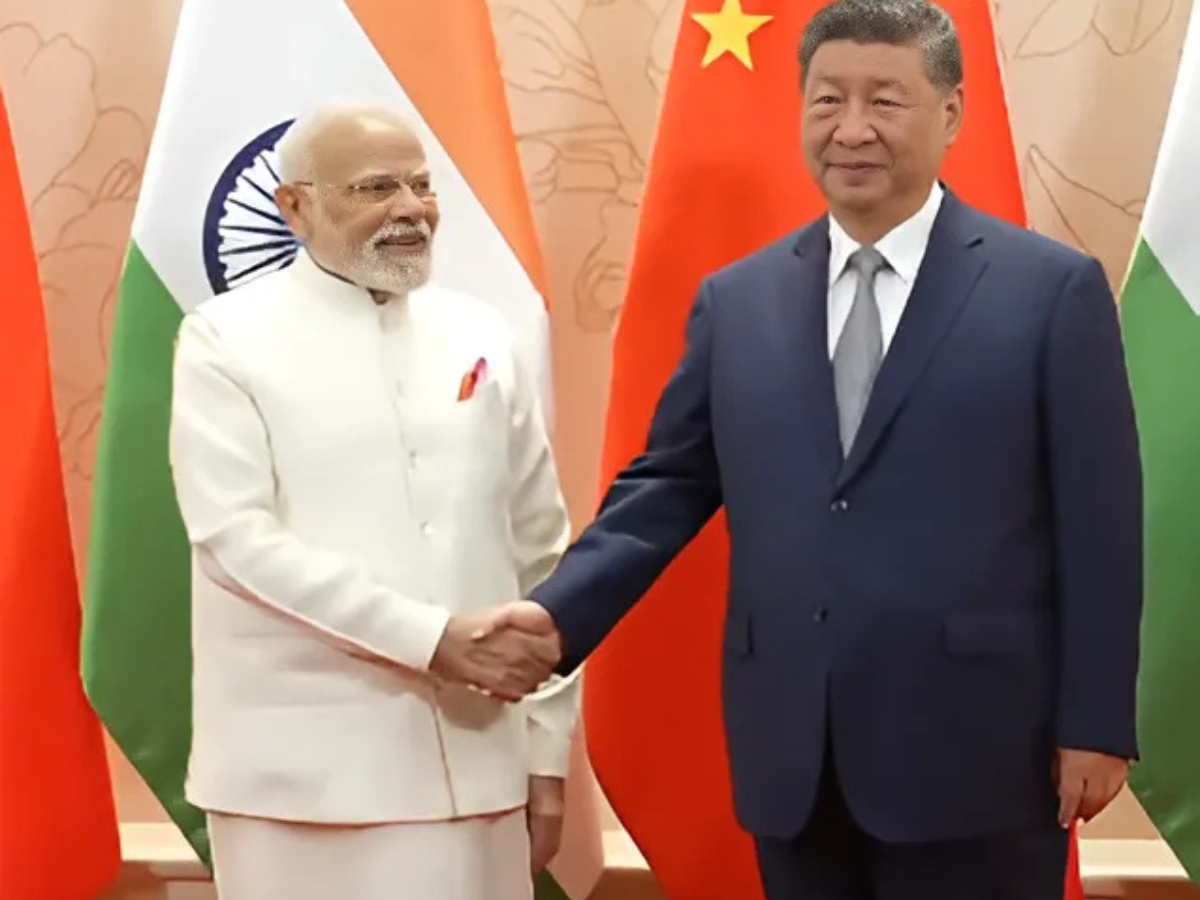
PM Modi and Xi Jinping stress Dragon-Elephant unity at SCO Summit, highlighting India-China friendship and global cooperation. Photo/ANI Screen Grab.
Prime Minister Narendra Modi held bilateral talks with Chinese President Xi Jinping on the sidelines of the SCO Summit in Tianjin city on Sunday. Both leaders stressed the changing global order and the role of the two Asian giants for the future of billions of people in the two countries. The two leaders also spoke about the ned for maintaining a friendly and cooperative relationship.
Xi spoke about the symbolic representation of both countries, saying, “the World is going towards transformation. China and India are two of the most civilizational countries. We are the world’s two most populous countries and part of the Global South… It is vital to be friends, a good neighbour, and the Dragon and the Elephant to come together.”
He further stressed the need for collaboration between the two Asian powers, noting the historical and cultural significance of their symbols in fostering mutual respect.
The dragon has long been associated with China, with several legends explaining its origin. One such story links it to the ancient Emperor Huang Di. Legend holds that Huang Di’s coat of arms was a snake, and whenever he conquered a tribe, he incorporated the conquered region’s emblem into his kingdom.
The dragon is seen as a unit of multiple elements. It has the body of a snake, the tail of a fish, antlers of a deer, the face of a qilin, talons of an eagle, and the eyes of a demon.
These features represent the emblems given by Huang Di, who is regarded as an ancestor of the Chinese people. This is the legacy that has led to its association with China. Owing to this, the people of China are often called the “descendants of the dragon.”
Elephants in India symbolize strength and fertility. They also have religious and cultural importance, particularly in Hinduism.
“In Puranic Hinduism, the elephant is associated with Lord Ganesha, the remover of obstacles and the god of wisdom,” cultural experts say.
It represents the qualities of intelligence, power, and auspiciousness that are deeply rooted within Indian tradition.
The bear in Russia is associated with various Russian states, including the Russian Empire, the Soviet Union, and the modern Russian Federation. It represents the Eurasian brown bear and has appeared in cultural depictions since the 16th century. T
Western portrayals of the bear have often emphasized Russia as “big, brutal, and clumsy,” appearing in caricatures and political commentary.
However, within Russia, the bear is embraced as a symbol of national pride, strength, resilience, and cultural identity.
Zubair Amin is a Senior Journalist at NewsX with over seven years of experience in reporting and editorial work. He has written for leading national and international publications, including Foreign Policy Magazine, Al Jazeera, The Economic Times, The Indian Express, The Wire, Article 14, Mongabay, News9, among others. His primary focus is on international affairs, with a strong interest in US politics and policy. He also writes on West Asia, Indian polity, and constitutional issues. Zubair tweets at zubaiyr.amin
A bomb threat at Dick's Sporting Goods in Canton Marketplace, Georgia, triggered evacuations and heavy…
The Coyote Flats Fire near Rockerville, Rapid City, has grown to 30–50 acres amid hot,…
Dhurandhar 2 sees Ranveer Singh as Hamza navigating Karachi’s criminal underworld in Aditya Dhar’s intense,…
