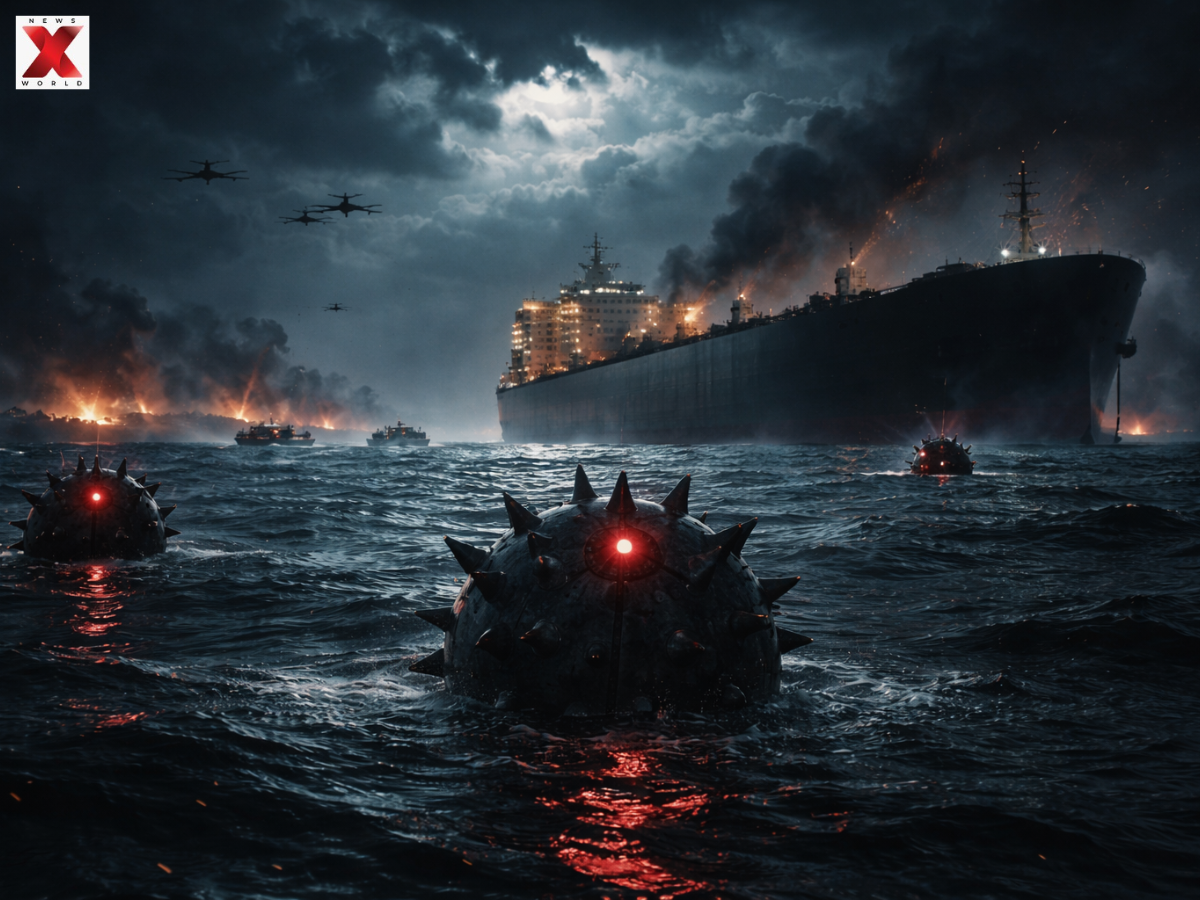
Iran warns against land invasion, threatens to lay naval mines (AI IMAGE)
US IRAN WAR: Iran’s Defence Council made it clear on Monday that if anyone attacks Iran’s coast or islands, the country won’t hesitate to deploy explosive sea mines across the Persian Gulf.
Reuters quoted officials saying those mines could be dropped directly from Iran’s shoreline, and that would throw Gulf shipping routes and communications into chaos.
The Council warned the Gulf could get locked down, just like the narrow Strait of Hormuz, and stay that way for a long time. They even brought up the 1980s, when over 100 minesweepers struggled to clear just a handful of mines. The message? Clearing those waters wouldn’t be easy.
Right now, the US is mulling over its own response. Axios reported that Washington is thinking about taking over or blockading Iran’s Kharg Island, the country’s main oil export point, to force Tehran to reopen the Strait of Hormuz to worldwide shipping. Israel’s not staying quiet either, throwing out the possibility of a ground operation in the ongoing war.
Things are heating up fast. President Trump’s 48-hour deadline for Iran to reopen the waterway ends just before midnight GMT on Tuesday.
As the clock ticks down, tensions are driving up global energy prices. Trump hasn’t minced words, warning on social media that the US would destroy Iranian power plants if Tehran doesn’t back down.
Sea mines are explosive naval weapons hidden underwater, waiting to wreck ships and submarines. They sit quietly until something triggers them, a brush of a hull, a magnetic signature, a sudden noise, or even a small change in water pressure as a vessel passes by.
They’re cheap to make, but their impact can be huge. Militaries use them both for defence (blocking off areas) and offence (denying enemies safe passage).
Bottom mines rest on the seafloor and pick off ships passing overhead, mostly in shallow water. Moored mines hang by cables, floating at a set depth, usually deeper water territory.
Then there are drifting mines, which float with the current. These have been banned in most places for obvious reasons (they go where they want, hitting whoever), but some are still used.
Here’s what goes on during a mine deployment. You can drop them from aircraft, ships, submarines. Advanced mines can sense a ship’s magnetic field, its noise (propeller sounds), or the pressure changes it creates.
When the sensors decide, they set off a huge explosion, sometimes delivering over 2,000 pounds of firepower. But it’s not just the blast: many modern mines explode under a ship, which creates a gigantic gas bubble. That bubble lifts the ship, then collapses. The result? The ship snaps in half, or as they say, “breaks its back.”
Mines get put in place using all sorts of clever tricks: surface ships, stealthy small boats, aeroplanes, and submarines can all do the job.
Some mines are dropped straight down, some get rolled off rails, and others are stuck directly onto hulls, each method depending on what’s needed and how sneaky you want to be. In shallow waters, people use parachutes from planes or fast drop-offs from boats.
Surface vessels, like small boats and trawlers, can quietly place mines and get out quick. Aircraft including helicopters and planes drop mines using parachutes.
Submarines have their own secret approach, laying mines through torpedo tubes with little risk of detection. And for the hands-on approach, divers attach limpet mines right onto a ship’s hull, using magnets or their own gear.
The latest US Marine and sailor deployment to the Middle East indicates that Washington might be planning a more direct attack to defend the Strait of Hormuz and possibly destroy the oil export facilities of Iran, as reported by The Washington Post.
The report has said that 4,500 US sailors and Marines, including an infantry battalion landing team, will be sent to the region with the support of helicopters, F-35 fighter jets and armoured landing vehicles.
The need to make an immediate comparison allows seeing that 2024 had virtually no shipments, and the surge can be interpreted as a direct reaction to the existing supply crisis.
The Pentagon too has moved faster to deploy a similar unit, the 11 th Marine Expeditionary Unit in San Diego, a move that has been viewed as a bolster to amphibious assault captaincy in the Gulf.
Gen Z & Millennials Are Shopping Gold Differently This Akshaya Tritiya
Akshaya Tritiya 2026, is just round the corner. Gone are the days when people were…
Sathankulam case: 9 cops convicted for brutal custodial killing of father-son duo during COVID lockdown;…
IPL 2026: Mumbai Indians face fresh concern over Jasprit Bumrah’s availability after the Team India…
