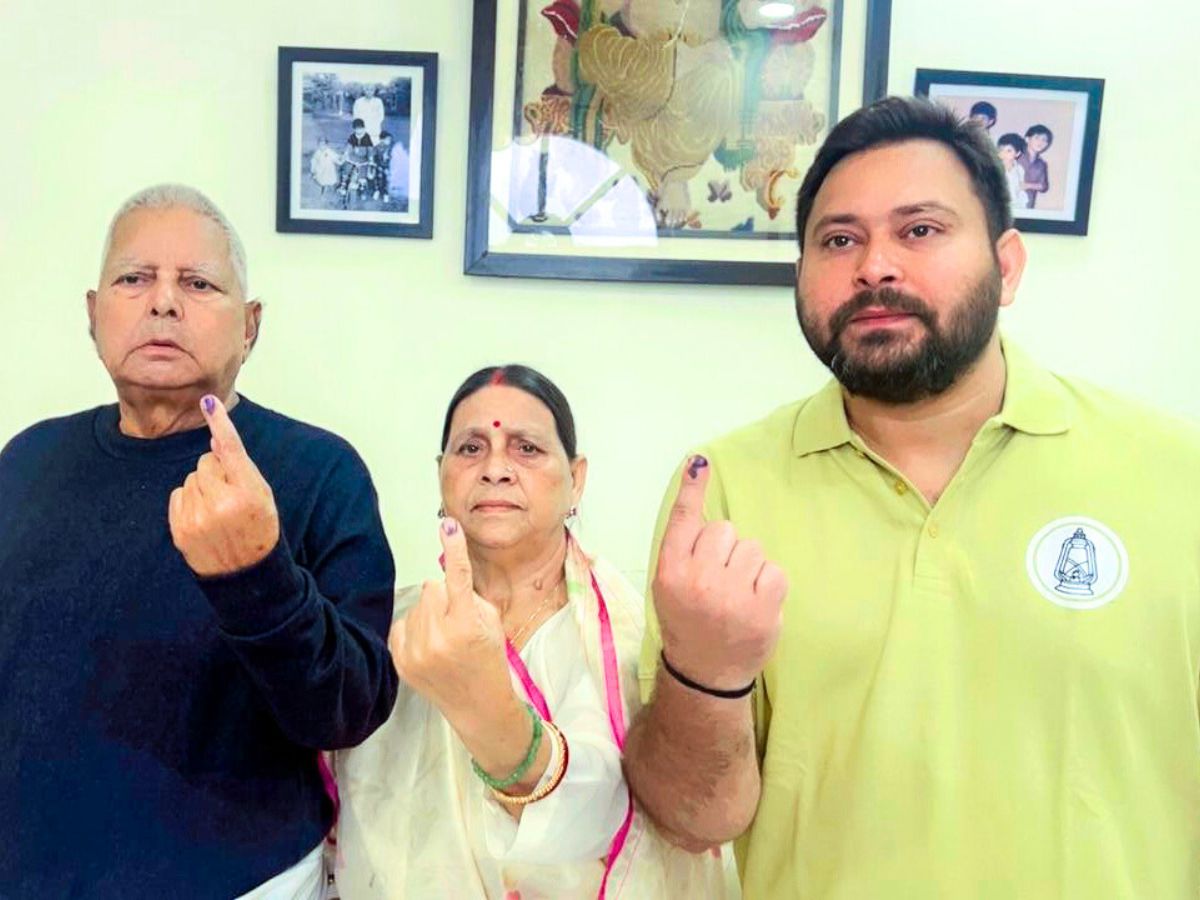
RJD’s Tejashwi Yadav, with former CMs Rabri Devi and Lalu Prasad Yadav (Photo: ANI)
Bihar Election Results 2025 have marked a watershed moment in the state’s electoral history, showcasing an unprecedented transformation from decades of violence, booth capturing, and large-scale repolling to zero violence and zero repolls. For a state long associated with the infamous term “Jungle Raj”, the 2025 elections signal a dramatic shift in governance, policing, and voter confidence.
For decades, Bihar’s elections were synonymous with bloodshed, caste tensions, and muscle-power dominance. Historical records show a grim pattern:
1985 Bihar elections: 63 deaths and repolling in 156 booths
1990 Bihar elections: 87 deaths due to poll-related violence
1995 Bihar elections: TN Seshan postponed polls four times amid unprecedented violence and malpractice
2005 Bihar elections: repolling ordered in 660 booths after widespread booth capturing and intimidation
These figures reflected a political culture deeply shaped by caste hierarchies, agrarian conflicts, and the rise of bahubali politics.
Bihar’s violent political legacy stretches far beyond elections. During the 1930s–40s, the region saw large-scale Kisan Sabha movements, led by Swami Sahajanand Saraswati, challenging oppressive zamindari structures. The era was marked by brutal state and landlord retaliation.
Another flashpoint was the Janeu movement of the 1920s, where backward castes Yadavs, Koeris, and Kurmis asserted equality by wearing the sacred thread, triggering violent backlash from upper castes.
In post-independence Bihar, three forms of violence shaped politics:
Naxal violence
Caste violence
Bahubali/criminal-politician violence
Even after the Bihar Abolition of Zamindari Act (1950) and the Bhoodan Andolan, land conflict, caste oppression, and inequality persisted, often spilling into elections.
The phrase “Jungle Raj” popularized during the Lalu Prasad Yadav–Rabri Devi rule (1990–2005) re-emerged in public debate as Bihar awaited the 2025 election results. Critics historically used the term to describe alleged breakdowns in law and order under RJD governments.
Two infamous cases from the era resurfaced during campaign rhetoric:
A shocking instance revealing the nexus between crime and politics. Champa, wife of an IAS officer, accused RJD-linked Mrityunjay Yadav of repeated rape and threats. Despite her complaints, local police allegedly ignored her pleas until she wrote to the Governor.
Convictions in 2002 were overturned by the Patna High Court in 2010.
The suspicious deaths of Shilpi Jain and Gautam Singh initially dubbed a suicide were linked to an MLA close to the ruling leadership. The CBI later echoed the suicide theory, though the family still alleges murder and seeks a fresh probe.
These cases symbolised a time when political clout often overshadowed justice.
Against this turbulent backdrop, the 2025 Bihar Assembly elections stand out as a stunning departure. For the first time in decades:
This is one of the rare instances in Bihar’s modern history where no booths saw malpractice or violence serious enough to warrant repolls.
Election officials credit:
Strengthened law and order
Enhanced surveillance and deployment
Strict ECI protocols
Weakening of bahubali dominance
Increased voter awareness and transparency
The transformation underscores how Bihar’s political culture has shifted from fear-driven elections to fair, peaceful, and participatory democracy.
The contrast between thousands of repolls and scores of deaths in earlier elections versus the zero-violence, zero-repoll 2025 polls is nothing short of historic. Whether this shift becomes permanent will depend on governance and accountability, but the 2025 mandate shows that Bihar has decisively moved beyond its violent political past.
Sofia Babu Chacko is a journalist with over five years of experience reporting on Indian politics, crime, human rights, gender issues, and stories about marginalized communities. She believes journalism plays a crucial role in amplifying unheard voices and bringing attention to issues that truly matter. Sofia has contributed articles to The New Indian Express, Youth Ki Awaaz, and Maktoob Media. She is also a recipient of the 2025 Laadli Media Awards for gender sensitivity. Beyond the newsroom, she is a music enthusiast who enjoys singing. Connect with Sofia on X: https://x.com/SBCism
PM Narendra Modi addressed the ITV Network NXT Summit, recalling the legacy of the Dandi…
The Indian team recently made history by becoming the first team to successfully retain the…
Prime Minister Narendra Modi addressed the iTV Network’s NXT Summit, marking the historic anniversary of…
