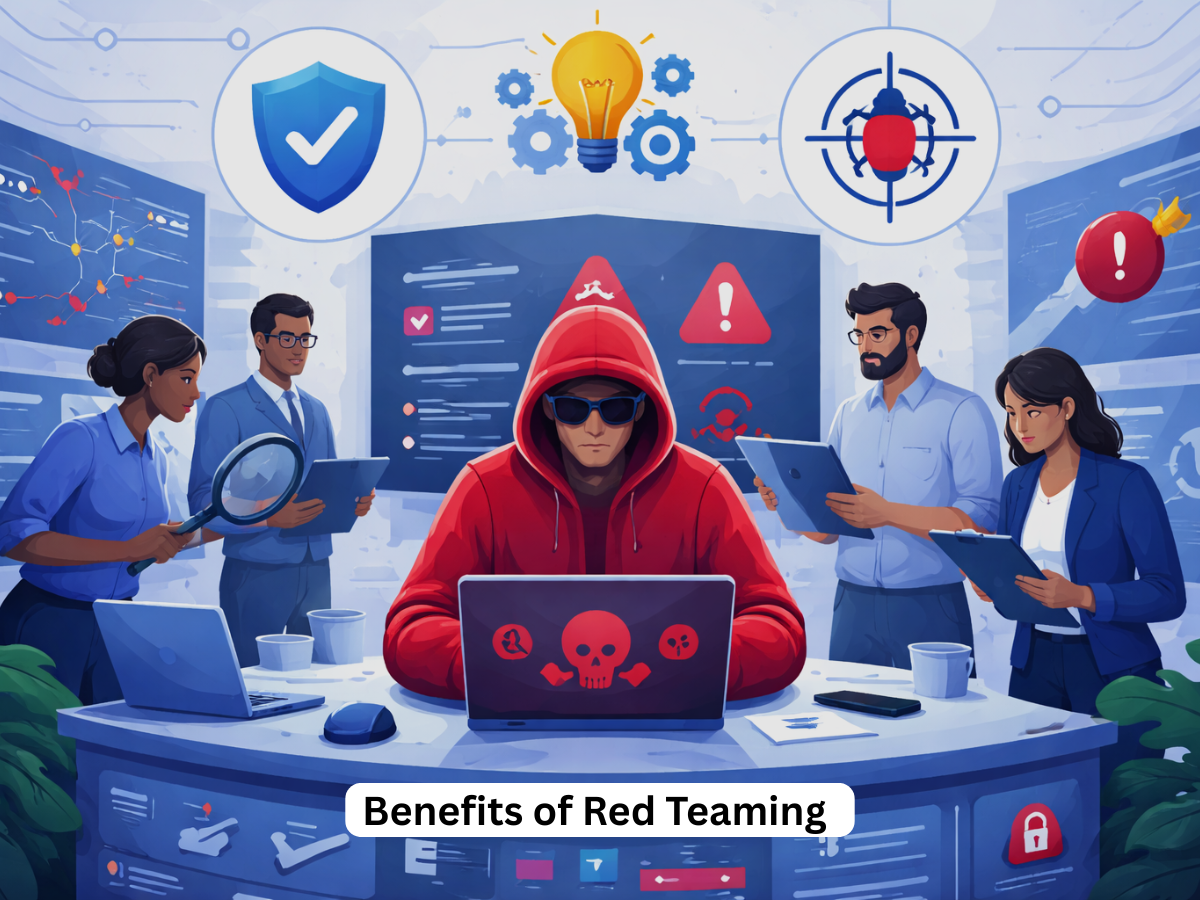
Security teams often struggle with clarity.
On paper, most organisations look prepared. Firewalls sit in place. Endpoint agents report back. Policies exist, often carefully written and occasionally reviewed. Yet when a genuine adversary applies pressure, small assumptions unravel. Controls that appeared solid show gaps. Processes stall. People hesitate.
The benefits of red teaming begin to surface in those moments.
Red teaming is not another compliance activity. It is not a checklist-driven exercise designed to produce a report that sits in a folder. It is a deliberate simulation of adversarial behaviour, conducted with enough realism to expose how an organisation actually performs under stress.
That distinction matters more than many realise.
Most security assurance work focuses on validation. Vulnerability assessments identify known weaknesses. Penetration tests exploit specific flaws within a defined scope. Both are useful. Neither fully reflects how attackers operate in the wild.
Adversaries do not follow scope documents. They do not limit themselves to a single application or subnet. They chain weaknesses across technical controls, human behaviour and business process. They test response times. They look for fatigue.
The benefits of red teaming become visible because the exercise mirrors that behaviour. Instead of proving that one control works, it examines whether the wider system holds together.
An organisation may discover that its monitoring detects suspicious activity within minutes, which looks reassuring. Yet investigation procedures might be unclear. Escalation may require multiple approvals. Senior stakeholders might not know when they should step in.
On paper, everything worked. In practice, the delay allowed lateral movement.
That gap between theory and performance is where red teaming earns its value.
There is often quiet confidence in detection capability. Dashboards display alerts. Threat intelligence feeds update continuously. Managed services provide regular reporting.
Confidence shifts when a red team begins operating discreetly.
One financial services firm believed its Security Operations Centre responded within fifteen minutes to critical alerts. During a controlled engagement, a simulated credential compromise went unnoticed for several hours. The alert existed, but it blended into background noise. Analysts prioritised other activity.
No system failure occurred. No individual made an obvious mistake. The environment simply behaved differently under realistic conditions.
The benefits of red teaming here were not about blame. They were about calibration. The organisation adjusted alert thresholds, redefined escalation triggers and refined shift handovers. None of those changes would have emerged from a static review.
Detection tools reveal what is technically visible. Red teaming reveals what is operationally actionable.
Technology rarely fails in isolation. People and process determine whether early warning signs translate into containment.
During a red team engagement in a manufacturing environment, simulated phishing emails bypassed email filtering controls. Several employees reported the messages promptly. The security team responded, but internal communication stalled. Operations managers were unsure whether to halt certain systems. Leadership hesitated over potential disruption.
The attack scenario remained controlled, yet the exercise exposed uncertainty around authority and decision rights.
The benefits of red teaming extend beyond identifying a compromised endpoint. They highlight cultural friction. They show where communication chains slow down. They surface assumptions that no one has previously challenged.
It is uncomfortable work. It is also necessary.
Organisations often invest heavily in technical controls while leaving crisis coordination underdeveloped. A red team does not criticise that imbalance. It demonstrates it.
Isolated testing tends to produce isolated findings. A vulnerable web application remains a web application issue. Weak password hygiene becomes a user awareness matter.
Adversaries do not categorise weaknesses so neatly.
Red teaming traces potential paths from initial access to business impact. It might begin with open-source intelligence gathering, pivot through credential reuse, then move laterally into sensitive environments. Along the way, small gaps combine into something more serious.
To visualise how this unfolds, consider a simplified attack chain:
Public information reveals exposed services and employee details.
A phishing email or exploited vulnerability provides limited access.
Misconfigured permissions allow expanded control.
Access spreads across systems through reused credentials or weak segmentation.
Sensitive information becomes reachable, or operational systems are impacted.
This sequence is not theoretical. It reflects common patterns observed in incidents involving groups like Conti and LAPSUS$, where relatively modest entry points escalated into significant business disruption.
The benefits of red teaming lie in mapping these pathways before a real adversary does. When stakeholders see how a minor oversight can connect to a strategic risk, conversations change. Security stops being abstract.
Board reporting often focuses on metrics. Patch percentages. Phishing simulation results. Compliance status against frameworks.
Those indicators have value. They rarely convey how resilient the organisation would be against a determined threat actor.
A well-designed red team engagement produces evidence that senior leaders can understand. Not a list of vulnerabilities, but a narrative. It may demonstrate that sensitive data could be accessed within days. It may show that critical systems could be disrupted without triggering immediate containment.
That kind of insight influences investment decisions more effectively than generic risk statements.
The benefits of red teaming therefore extend into governance. It sharpens risk discussions. It grounds cyber strategy in observable behaviour rather than optimistic projections.
Some boards underestimate this until they witness a simulated compromise presented in detail. The atmosphere shifts. Abstract cyber risk becomes tangible operational exposure.
There is a misconception that red teaming undermines internal confidence. In reality, when conducted properly, it strengthens it.
Transparency around objectives matters. Executive sponsorship matters. Clear rules of engagement matter.
When teams understand that the purpose is improvement rather than fault-finding, the exercise becomes collaborative. Findings are absorbed more constructively. Defensive teams often appreciate the opportunity to test their capabilities in a controlled environment.
The benefits of red teaming are diminished if it turns into theatre. It should not aim to embarrass staff or produce dramatic presentations. The objective is measured realism.
In several engagements across healthcare and logistics sectors, defensive teams reported increased cohesion after red team exercises. They gained clearer insight into each other’s roles. Incident response plans became more grounded. Runbooks were refined with practical adjustments rather than theoretical edits.
Trust grows when teams confront weaknesses together.
Security architectures evolve over time. Mergers introduce new systems. Cloud services expand quietly. Legacy platforms persist because replacing them is inconvenient.
Documentation rarely keeps pace.
Red teaming uncovers blind spots created by this gradual complexity. An overlooked administrative account. A development server with relaxed monitoring. A remote access pathway assumed to be decommissioned.
These are not dramatic failures. They are remnants of change.
The benefits of red teaming include exposing those remnants before they align into exploitable routes. Often, remediation is straightforward once visibility improves. The difficulty lies in discovering the issue in the first place.
Routine assessments may miss these areas because they operate within defined scopes. A red team, working from an adversarial mindset, follows opportunity rather than documentation.
One engagement provides insight. Repeated engagements provide direction.
Organisations that treat red teaming as a recurring discipline begin to observe patterns. Detection times improve. Escalation becomes smoother. Attack paths close gradually.
Progress is rarely linear. New technologies introduce fresh risk. Staff turnover alters experience levels. Threat landscapes evolve.
The benefits of red teaming become cumulative when findings inform architectural decisions, training priorities and investment planning. It shifts from a periodic challenge into a feedback loop.
Importantly, maturity does not eliminate risk. It reduces uncertainty. It builds familiarity with adversity. That familiarity can be decisive during a genuine incident.
The benefits of red teaming are not confined to technical discovery. They reach into governance, operations and culture. They reveal how systems and people behave when assumptions are tested. They replace comfort with clarity.
For organisations seeking assurance that extends beyond compliance, controlled adversarial simulation offers something more honest. It exposes friction. It highlights resilience. It forces alignment between policy and practice.
If you’re looking for professional red teaming, you should think of working with well-known cybersecurity companies like CyberNX. Their red teaming services use trusted frameworks and tools to imitate advanced, multi-stage cyberattacks. This helps organisations find their weak spots and make their people, processes and technology stronger.
Security maturity grows when organisations see themselves as an attacker would. Red teaming provides that perspective.
Hijack Attempt: United Airlines Flight Diverted After Unruly Passenger Tries To Storm Cockpit
A United Airlines flight from Chicago to Minneapolis was diverted to Madison, Wisconsin, after a…
Gold and Silver Prices Today In India On 30 May: Check Latest Rates In Major Cities NOW!
Gold prices in India on 30 May 2026 remain elevated across cities, with strong MCX…
Anthony Gordon has completed a blockbuster transfer from Newcastle United to FC Barcelona, signing a…

